Lee Hojun, Song Wook
Department of Rehabilitation Medicine, Seoul National University Bundang Hospital, Seongnam, Korea.
Department of Sports and Health Science, Kyungsung University, Busan, Korea.
J Obes Metab Syndr. 2018 Sep 30;27(3):150-157. doi: 10.7570/jomes.2018.27.3.150.
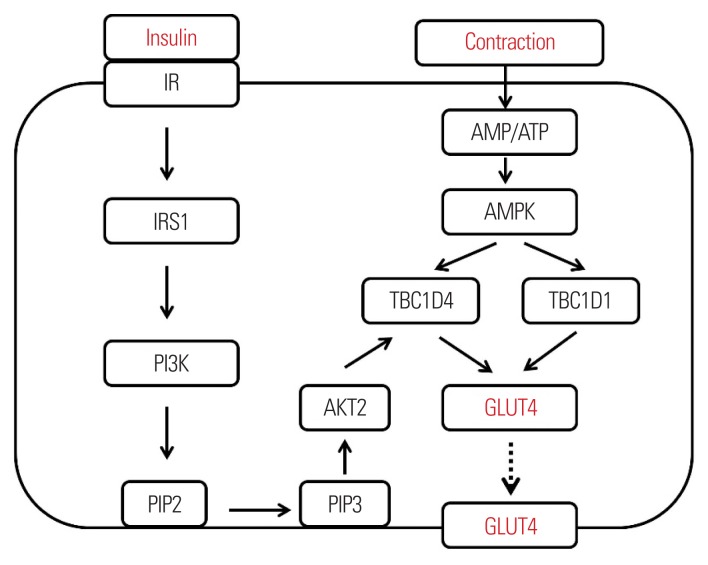
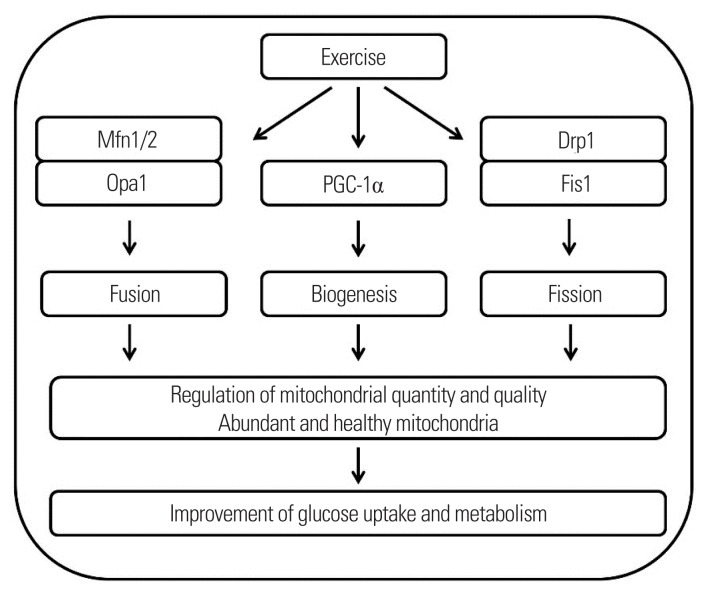
Exercise is regarded as a potent stimulus in modulation of glucose utility and mitochondrial adaptations in skeletal muscle, leading to enhanced metabolic health. As mitochondria play a crucial role in sustaining metabolic homeostasis, and disturbances in mitochondrial function are highly linked with development of metabolic diseases, a comprehensive understanding of exercise-mediated mitochondrial remodeling under the pathophysiological condition of type 2 diabetes is warranted to develop an efficient therapeutic strategy. Although it is evident that the primary etiology of type 2 diabetes is insulin resistance, there is accumulating evidence linking abnormal mitochondrial functional and morphological properties to development of type 2 diabetes. Despite this, the precise molecular and cellular events that underline these phenomena remain uncertain. Mitochondria are highly dynamic subcellular organelles that can change mass and shape as necessary via coordinated processes such as mitochondrial fusion, fission, and biogenesis. Mitochondrial fusion is controlled by proteins, including mitofusin-1, mitofusin-2, and optic atrophy protein 1, while the fission process is mainly modulated by control of fission protein 1 and dynamin-related protein 1. Peroxisome proliferator-activated receptor gamma coactivator-1α acts as a master controller of mitochondrial biogenesis. The present review's primary aims were to briefly discuss the cellular mechanisms of muscle fiber type-dependent glucose uptake and to highlight emerging evidence linking disturbances in mitochondrial dynamics to development of insulin resistance and type 2 diabetes. The potential for exercise to normalize type 2 diabetes-induced aberrant mitochondrial integrity is also addressed.
运动被视为调节骨骼肌葡萄糖利用和线粒体适应性的有效刺激因素,可促进代谢健康。由于线粒体在维持代谢稳态中起着关键作用,且线粒体功能紊乱与代谢性疾病的发展密切相关,因此有必要全面了解2型糖尿病病理生理条件下运动介导的线粒体重塑,以制定有效的治疗策略。虽然2型糖尿病的主要病因是胰岛素抵抗这一点很明显,但越来越多的证据表明线粒体功能和形态特性异常与2型糖尿病的发展有关。尽管如此,这些现象背后的确切分子和细胞事件仍不确定。线粒体是高度动态的亚细胞器,可通过线粒体融合、裂变和生物发生等协调过程根据需要改变质量和形状。线粒体融合由包括线粒体融合蛋白1、线粒体融合蛋白2和视神经萎缩蛋白1在内的蛋白质控制,而裂变过程主要由裂变蛋白1和动力相关蛋白1调控。过氧化物酶体增殖物激活受体γ共激活因子-1α是线粒体生物发生的主要调控因子。本综述的主要目的是简要讨论肌纤维类型依赖性葡萄糖摄取的细胞机制,并强调将线粒体动力学紊乱与胰岛素抵抗和2型糖尿病发展联系起来的新证据。还探讨了运动使2型糖尿病诱导的线粒体完整性异常恢复正常的潜力。