Department of Endocrinology, Diabetology and Internal Medicine, Medical University of Bialystok, Sklodowskiej-Curie 24A, 15-276 Bialystok, Poland.
Clinical Research Centre, Medical University of Bialystok, Sklodowskiej-Curie 24A, 15-276 Bialystok, Poland.
Cells. 2021 Nov 4;10(11):3013. doi: 10.3390/cells10113013.
Mitochondrial dysfunction has been implicated in the pathogenesis of type 2 diabetes, but its contribution to the early stages of dysglycemia remains poorly understood. By collecting a high-resolution stage-based spectrum of dysglycemia, our study fills this gap by evaluating derangement in both the function and quantity of mitochondria. We sampled mitochondria in skeletal muscle and subcutaneous adipose tissues of subjects with progressive advancement of dysglycemia under a three-month exercise intervention.
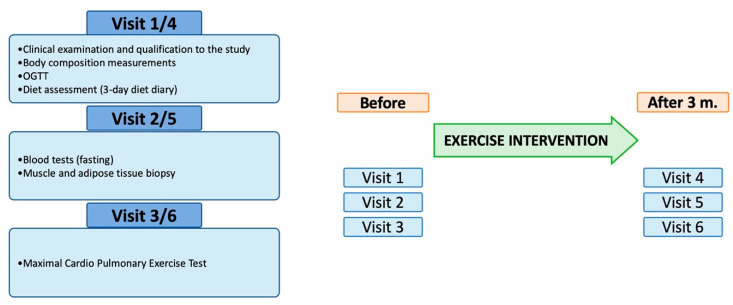
We measured clinical metabolic parameters and gathered skeletal muscle and adipose tissue biopsies before and after the three-month exercise intervention. We then assayed the number of mitochondria via citrate synthase (CS) activity and functional parameters with high-resolution respirometry.
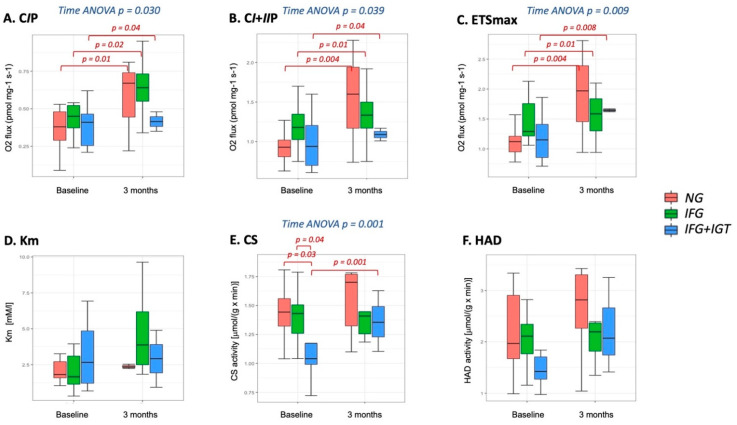
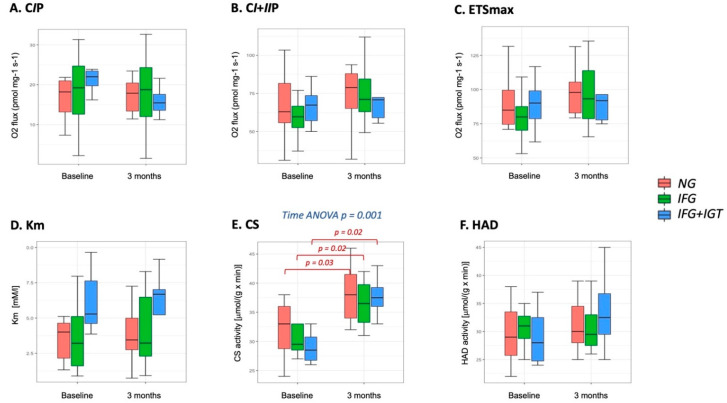
In muscle, there were no differences in mitochondrial quantity or function at baseline between normoglycemics and prediabetics. However, the intervention caused improvement in CS activity, implying an increase in mitochondrial quantity. By contrast in adipose tissue, baseline differences in CS activity were present, with the lowest CS activity coincident with impaired fasting glucose and impaired glucose tolerance (IFG + IGT). Finally, CS activity, but few of the functional metrics, improved under the intervention.
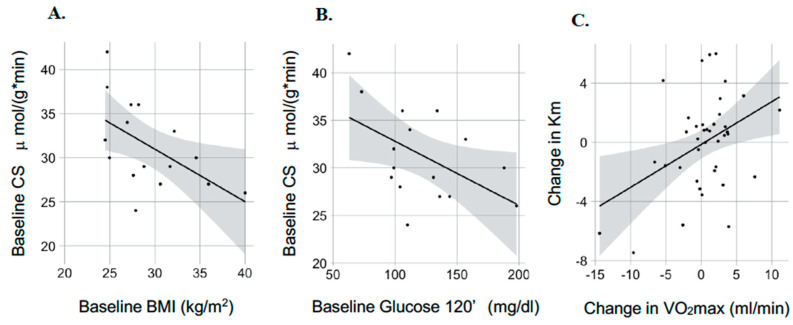
We show that in prediabetes, no differences in the function or amount of mitochondria (measured by CS activity) in skeletal muscle are apparent, but in adipose tissue of subjects with IFG + IGT, a significantly reduced activity of CS was observed. Finally, metabolic improvements under the exercise correlate to improvements in the amount, rather than function, of mitochondria in both tissues.
线粒体功能障碍与 2 型糖尿病的发病机制有关,但它对糖调节受损早期阶段的贡献仍知之甚少。通过收集高分辨率的基于阶段的糖调节受损谱,我们的研究通过评估线粒体功能和数量的紊乱来填补这一空白。我们在三个月的运动干预下,对糖调节受损进展的受试者的骨骼肌和皮下脂肪组织中采集线粒体。
我们测量了临床代谢参数,并在三个月的运动干预前后采集了骨骼肌和脂肪组织活检。然后,我们通过柠檬酸合酶 (CS) 活性和高分辨率呼吸测定法测定了线粒体的数量和功能参数。
在肌肉中,正常血糖者和糖尿病前期者的基线线粒体数量或功能没有差异。然而,干预导致 CS 活性的改善,表明线粒体数量的增加。相比之下,在脂肪组织中,基线时 CS 活性存在差异,最低的 CS 活性与空腹血糖受损和糖耐量受损 (IFG + IGT) 一致。最后,干预后 CS 活性,但很少有功能指标改善。
我们表明,在糖尿病前期,骨骼肌中线粒体的功能或数量(通过 CS 活性测量)没有差异,但在 IFG + IGT 受试者的脂肪组织中,CS 的活性明显降低。最后,运动下的代谢改善与两种组织中线粒体数量的增加而不是功能的改善相关。