Lamain-de Ruiter Marije, Kwee Anneke, Naaktgeboren Christiana A, Franx Arie, Moons Karel G M, Koster Maria P H
1Birth Centre, Division Woman and Baby, University Medical Centre Utrecht, KE.04.123.1, PO BOX 85090, 3508 AB Utrecht, The Netherlands.
2Julius Centre for Health Sciences and Primary Care, University Medical Centre Utrecht, Str. 6.131, PO BOX 85500, 3508 AB Utrecht, The Netherlands.
Diagn Progn Res. 2017 Feb 8;1:3. doi: 10.1186/s41512-016-0005-7. eCollection 2017.
Numerous prediction models for gestational diabetes mellitus (GDM) have been developed, but their methodological quality is unknown. The objective is to systematically review all studies describing first-trimester prediction models for GDM and to assess their methodological quality.
MEDLINE and EMBASE were searched until December 2014. Key words for GDM, first trimester of pregnancy, and prediction modeling studies were combined. Prediction models for GDM performed up to 14 weeks of gestation that only include routinely measured predictors were eligible.Data was extracted by the CHecklist for critical Appraisal and data extraction for systematic Reviews of prediction Modelling Studies (CHARMS). Data on risk predictors and performance measures were also extracted. Each study was scored for risk of bias.
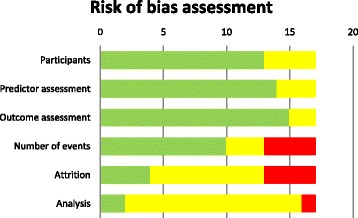
Our search yielded 7761 articles, of which 17 were eligible for review (14 development studies and 3 external validation studies). The definition and prevalence of GDM varied widely across studies. Maternal age and body mass index were the most common predictors. Discrimination was acceptable for all studies. Calibration was reported for four studies. Risk of bias for participant selection, predictor assessment, and outcome assessment was low in general. Moderate to high risk of bias was seen for the number of events, attrition, and analysis.
Most studies showed moderate to low methodological quality, and few prediction models for GDM have been externally validated. External validation is recommended to enhance generalizability and assess their true value in clinical practice.
已经开发出许多用于妊娠期糖尿病(GDM)的预测模型,但其方法学质量尚不清楚。目的是系统回顾所有描述早孕期GDM预测模型的研究,并评估其方法学质量。
检索MEDLINE和EMBASE直至2014年12月。将GDM、妊娠早期和预测模型研究的关键词进行组合。仅纳入常规测量预测指标且在妊娠14周前进行的GDM预测模型符合纳入标准。通过预测模型研究系统评价的关键评估和数据提取清单(CHARMS)提取数据。还提取了风险预测指标和性能测量的数据。对每项研究的偏倚风险进行评分。
我们的检索共获得7761篇文章,其中17篇符合综述标准(14项开发研究和3项外部验证研究)。不同研究中GDM的定义和患病率差异很大。母亲年龄和体重指数是最常见的预测指标。所有研究的区分度均可接受。四项研究报告了校准情况。总体而言,参与者选择、预测指标评估和结局评估的偏倚风险较低。在事件数量、失访和分析方面观察到中度至高偏倚风险。
大多数研究显示方法学质量为中度至低度,且很少有GDM预测模型经过外部验证。建议进行外部验证以提高可推广性并评估其在临床实践中的真正价值。