• 文献检索
  • 文档翻译
  • 深度研究
  • 学术资讯
  • Suppr Zotero 插件Zotero 插件
  • 邀请有礼
  • 套餐&价格
  • 历史记录
应用&插件
Suppr Zotero 插件Zotero 插件浏览器插件Mac 客户端Windows 客户端微信小程序
定价
高级版会员购买积分包购买API积分包
服务
文献检索文档翻译深度研究API 文档MCP 服务
关于我们
关于 Suppr公司介绍联系我们用户协议隐私条款
关注我们

Suppr 超能文献

核心技术专利:CN118964589B侵权必究
粤ICP备2023148730 号-1Suppr @ 2026

文献检索

告别复杂PubMed语法,用中文像聊天一样搜索,搜遍4000万医学文献。AI智能推荐,让科研检索更轻松。

立即免费搜索

文件翻译

保留排版,准确专业,支持PDF/Word/PPT等文件格式,支持 12+语言互译。

免费翻译文档

深度研究

AI帮你快速写综述,25分钟生成高质量综述,智能提取关键信息,辅助科研写作。

立即免费体验

预后研究的系统评价:对五本核心临床期刊的批判性评估

Systematic reviews of prognosis studies: a critical appraisal of five core clinical journals.

作者信息

Matino Davide, Chai-Adisaksopha Chatree, Iorio Alfonso

机构信息

1Department of Health Research Methods, Evidence, and Impact, McMaster University, Hamilton, Canada.

2Department of Experimental Medicine, University of Perugia, Perugia, Italy.

出版信息

Diagn Progn Res. 2017 Mar 16;1:9. doi: 10.1186/s41512-017-0008-z. eCollection 2017.

DOI:10.1186/s41512-017-0008-z
PMID:31093540
原文链接:https://pmc.ncbi.nlm.nih.gov/articles/PMC6460771/
Abstract

BACKGROUND

Prognosis research refers to the investigation of association between a baseline health state, patient characteristic and future outcomes. The findings of several prognostic studies can be summarized in systematic reviews (SRs), but some characteristics of prognostic studies may result in difficulties when performing the analyses. This study aimed to investigate trends in the volume and quality of SRs of prognostic studies in the literature.

METHODS

We conducted a systematic review in five high-impact clinical journals (Annals of Internal Medicine, BMJ, Circulation, JAMA, and Stroke) to identify SRs of prognosis studies focused on fundamental prognosis research and prognostic factor research published between 2000 and 2012. We excluded studies of clinical prediction guides or implementation studies. The quality of the SRs was rated based on the Meta-analysis of Observational Studies in Epidemiology (MOOSE) and the PRISMA checklists.

RESULTS

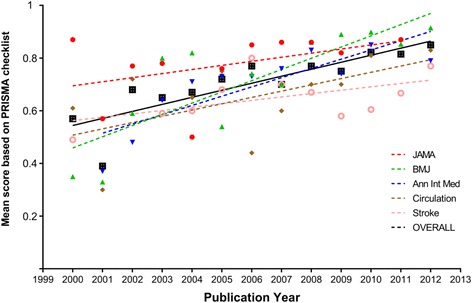
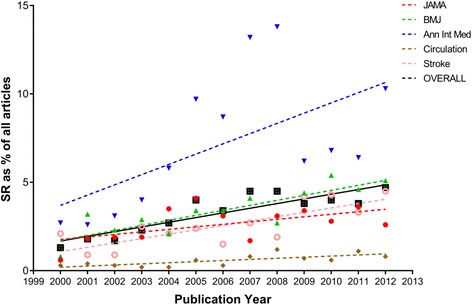
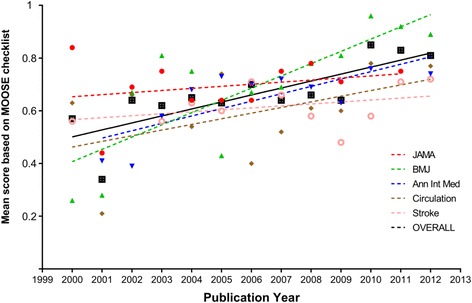
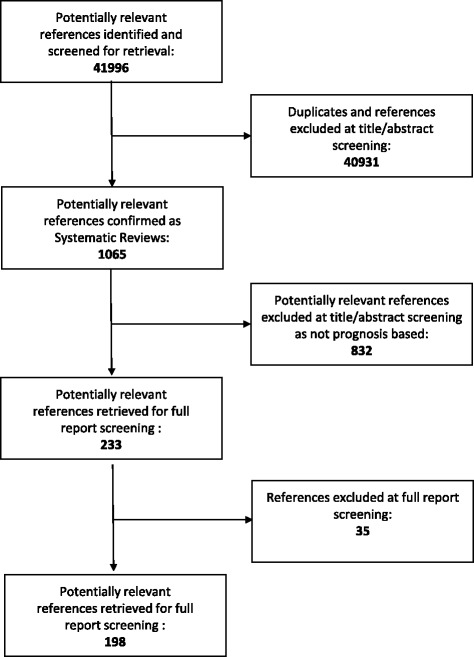
Over the 13-year period, 1065 SRs were published. Of these, 198 were SRs of prognosis studies. The proportion of all SRs to published articles increased from 0.86% in 2000 to 4.2% in 2012. Likewise, the proportion of prognosis SRs to all SRs increased from 10.3% in 2000 to 17.7% in 2012. MOOSE and PRISMA mean summary scores consistently increased over time for all journals, indicating that the quality of reporting in these SRs has steadily improved. However, several items were not consistently well reported by investigators.

CONCLUSIONS

This study shows that there is a growing number of SRs of prognosis studies. However, the quality is suboptimal when assessed with the generic reporting guidelines for observational studies. New reporting guidelines and risk of bias tools for prognosis studies are needed to improve the quality of future research in this field.

摘要

背景

预后研究是指对基线健康状况、患者特征与未来结局之间的关联进行调查。多项预后研究的结果可在系统评价(SRs)中进行总结,但预后研究的某些特征可能会在进行分析时带来困难。本研究旨在调查文献中预后研究系统评价的数量和质量趋势。

方法

我们在五种高影响力临床期刊(《内科学年鉴》《英国医学杂志》《循环》《美国医学会杂志》和《中风》)上进行了一项系统评价,以识别2000年至2012年间发表的聚焦于基础预后研究和预后因素研究的预后研究系统评价。我们排除了临床预测指南或实施研究。基于流行病学观察性研究的Meta分析(MOOSE)和PRISMA清单对系统评价的质量进行评分。

结果

在这13年期间,共发表了1065篇系统评价。其中,198篇是预后研究的系统评价。所有系统评价占发表文章的比例从2000年的0.86%增至2012年的4.2%。同样,预后研究系统评价占所有系统评价的比例从2000年的10.3%增至2012年的17.7%。所有期刊的MOOSE和PRISMA平均总分随时间持续增加,表明这些系统评价的报告质量稳步提高。然而,一些项目调查人员并未始终如一地进行良好报告。

结论

本研究表明,预后研究的系统评价数量在不断增加。然而,根据观察性研究的通用报告指南进行评估时,质量并不理想。需要新的预后研究报告指南和偏倚风险工具来提高该领域未来研究的质量。
https://cdn.ncbi.nlm.nih.gov/pmc/blobs/52a7/6460771/74124c15cfe8/41512_2017_8_Fig5_HTML.jpg
https://cdn.ncbi.nlm.nih.gov/pmc/blobs/52a7/6460771/252aa55d7912/41512_2017_8_Fig1_HTML.jpg
https://cdn.ncbi.nlm.nih.gov/pmc/blobs/52a7/6460771/93b3400d0d86/41512_2017_8_Fig2_HTML.jpg
https://cdn.ncbi.nlm.nih.gov/pmc/blobs/52a7/6460771/c1788fa366bf/41512_2017_8_Fig3_HTML.jpg
https://cdn.ncbi.nlm.nih.gov/pmc/blobs/52a7/6460771/71f8eb206e33/41512_2017_8_Fig4_HTML.jpg
https://cdn.ncbi.nlm.nih.gov/pmc/blobs/52a7/6460771/74124c15cfe8/41512_2017_8_Fig5_HTML.jpg
https://cdn.ncbi.nlm.nih.gov/pmc/blobs/52a7/6460771/252aa55d7912/41512_2017_8_Fig1_HTML.jpg
https://cdn.ncbi.nlm.nih.gov/pmc/blobs/52a7/6460771/93b3400d0d86/41512_2017_8_Fig2_HTML.jpg
https://cdn.ncbi.nlm.nih.gov/pmc/blobs/52a7/6460771/c1788fa366bf/41512_2017_8_Fig3_HTML.jpg
https://cdn.ncbi.nlm.nih.gov/pmc/blobs/52a7/6460771/71f8eb206e33/41512_2017_8_Fig4_HTML.jpg
https://cdn.ncbi.nlm.nih.gov/pmc/blobs/52a7/6460771/74124c15cfe8/41512_2017_8_Fig5_HTML.jpg

相似文献

1
Systematic reviews of prognosis studies: a critical appraisal of five core clinical journals.预后研究的系统评价:对五本核心临床期刊的批判性评估
Diagn Progn Res. 2017 Mar 16;1:9. doi: 10.1186/s41512-017-0008-z. eCollection 2017.
2
Methodological and Reporting Quality of Systematic Reviews Published in the Highest Ranking Journals in the Field of Pain.疼痛领域排名最高期刊发表的系统评价的方法学和报告质量。
Anesth Analg. 2017 Oct;125(4):1348-1354. doi: 10.1213/ANE.0000000000002227.
3
Quality of reporting in systematic reviews published in dermatology journals.发表于皮肤病学杂志的系统评价中的报告质量。
Br J Dermatol. 2020 Jun;182(6):1469-1476. doi: 10.1111/bjd.18528. Epub 2019 Dec 5.
4
Endorsement of PRISMA statement and quality of systematic reviews and meta-analyses published in nursing journals: a cross-sectional study.护理期刊发表的系统评价和荟萃分析对PRISMA声明的认可情况及质量:一项横断面研究
BMJ Open. 2017 Feb 7;7(2):e013905. doi: 10.1136/bmjopen-2016-013905.
5
Reporting Quality of Systematic Reviews and Meta-Analyses of Otorhinolaryngologic Articles Based on the PRISMA Statement.基于PRISMA声明的耳鼻咽喉科文章系统评价和Meta分析的报告质量
PLoS One. 2015 Aug 28;10(8):e0136540. doi: 10.1371/journal.pone.0136540. eCollection 2015.
6
The future of Cochrane Neonatal.考克兰新生儿协作网的未来。
Early Hum Dev. 2020 Nov;150:105191. doi: 10.1016/j.earlhumdev.2020.105191. Epub 2020 Sep 12.
7
Evaluations of the uptake and impact of the Preferred Reporting Items for Systematic reviews and Meta-Analyses (PRISMA) Statement and extensions: a scoping review.评价系统评价和荟萃分析首选报告项目(PRISMA)声明及其扩展的采用和影响:范围综述。
Syst Rev. 2017 Dec 19;6(1):263. doi: 10.1186/s13643-017-0663-8.
8
Nearly 80 systematic reviews were published each day: Observational study on trends in epidemiology and reporting over the years 2000-2019.每天发表近 80 篇系统评价:2000 年至 2019 年流行病学趋势和报告的观察性研究。
J Clin Epidemiol. 2021 Oct;138:1-11. doi: 10.1016/j.jclinepi.2021.05.022. Epub 2021 Jun 4.
9
Assessing the reporting quality of systematic reviews of observational studies in preeclampsia.评估子痫前期观察性研究系统评价报告质量。
Arch Gynecol Obstet. 2019 Mar;299(3):689-694. doi: 10.1007/s00404-018-5023-y. Epub 2019 Jan 4.
10
Epidemiology, quality, and reporting characteristics of systematic reviews and meta-analyses of nursing interventions published in Chinese journals.发表于中文期刊的护理干预系统评价和Meta分析的流行病学、质量及报告特征
Nurs Outlook. 2015 Jul-Aug;63(4):446-455.e4. doi: 10.1016/j.outlook.2014.11.020. Epub 2014 Dec 4.

引用本文的文献

1
Design aspects for prognostic factor studies.预后因素研究的设计方面。
BMJ Open. 2025 Aug 31;15(8):e095065. doi: 10.1136/bmjopen-2024-095065.
2
Comparison of Frailty Scores in Newly Diagnosed Patients with Multiple Myeloma: A Review.新诊断多发性骨髓瘤患者衰弱评分的比较:一项综述
J Frailty Aging. 2019;8(4):215-221. doi: 10.14283/jfa.2019.25.
3
Inadequate diversity of information resources searched in US-affiliated systematic reviews and meta-analyses: 2005-2016.美国关联的系统评价和荟萃分析中信息资源搜索的多样性不足:2005-2016 年。

本文引用的文献

1
Use of GRADE for assessment of evidence about prognosis: rating confidence in estimates of event rates in broad categories of patients.使用GRADE评估预后证据:对广泛患者类别中事件发生率估计值的置信度评级
BMJ. 2015 Mar 16;350:h870. doi: 10.1136/bmj.h870.
2
Preferred reporting items for systematic review and meta-analysis protocols (PRISMA-P) 2015: elaboration and explanation.系统评价和荟萃分析议定书的首选报告项目(PRISMA-P)2015:详细说明和解释。
BMJ. 2015 Jan 2;350:g7647. doi: 10.1136/bmj.g7647.
3
Assessing bias in studies of prognostic factors.
J Clin Epidemiol. 2018 Oct;102:50-62. doi: 10.1016/j.jclinepi.2018.05.024. Epub 2018 Jun 4.
4
Inclusion and definition of acute renal dysfunction in critically ill patients in randomized controlled trials: a systematic review.纳入和定义危重病患者随机对照试验中的急性肾功能障碍:系统评价。
Crit Care. 2018 Apr 24;22(1):106. doi: 10.1186/s13054-018-2009-x.
评估预后因素研究中的偏倚。
Ann Intern Med. 2013 Feb 19;158(4):280-6. doi: 10.7326/0003-4819-158-4-201302190-00009.
4
Prognosis Research Strategy (PROGRESS) 3: prognostic model research.预后研究策略(PROGRESS)3:预后模型研究。
PLoS Med. 2013;10(2):e1001381. doi: 10.1371/journal.pmed.1001381. Epub 2013 Feb 5.
5
Prognosis Research Strategy (PROGRESS) 2: prognostic factor research.预后研究策略(PROGRESS)2:预后因素研究。
PLoS Med. 2013;10(2):e1001380. doi: 10.1371/journal.pmed.1001380. Epub 2013 Feb 5.
6
Prognosis research strategy (PROGRESS) 4: stratified medicine research.预后研究策略(PROGRESS)4:分层医学研究。
BMJ. 2013 Feb 5;346:e5793. doi: 10.1136/bmj.e5793.
7
Prognosis research strategy (PROGRESS) 1: a framework for researching clinical outcomes.预后研究策略(PROGRESS)1:研究临床结局的框架。
BMJ. 2013 Feb 5;346:e5595. doi: 10.1136/bmj.e5595.
8
Uncertainties in baseline risk estimates and confidence in treatment effects.基线风险估计的不确定性和对治疗效果的信心。
BMJ. 2012 Nov 14;345:e7401. doi: 10.1136/bmj.e7401.
9
Evaluating the quality of research into a single prognostic biomarker: a systematic review and meta-analysis of 83 studies of C-reactive protein in stable coronary artery disease.评估单个预后生物标志物的研究质量:83 项稳定型冠状动脉疾病 C 反应蛋白研究的系统评价和荟萃分析。
PLoS Med. 2010 Jun 1;7(6):e1000286. doi: 10.1371/journal.pmed.1000286.
10
Ten steps towards improving prognosis research.改善预后研究的十个步骤。
BMJ. 2009 Dec 30;339:b4184. doi: 10.1136/bmj.b4184.