Department of Microbial Ecology, Netherlands Institute of Ecology (NIOO-KNAW), Wageningen, The Netherlands.
Soil Biology Group, Wageningen University, Wageningen, The Netherlands.
PLoS One. 2019 May 16;14(5):e0216730. doi: 10.1371/journal.pone.0216730. eCollection 2019.
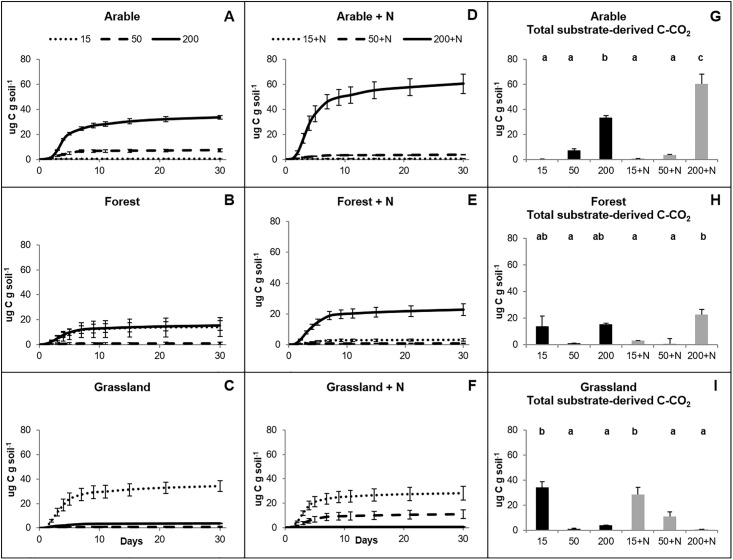
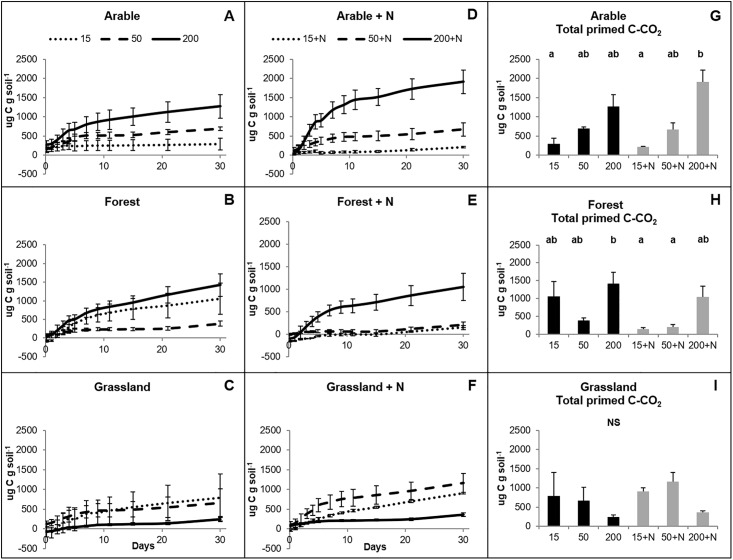
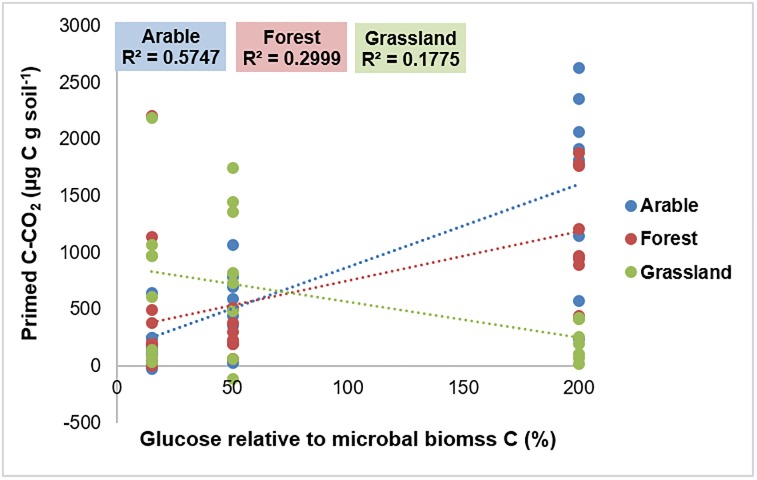
Priming effects (PEs) are defined as short-term changes in the turnover of soil organic matter (SOM) caused by the addition of easily degradable organic compounds to the soil. PEs are ubiquitous but the direction (acceleration or retardation of SOM decomposition) and magnitude are not easy to predict. It has been suggested that the ratio between the amount of added PE-triggering substrate to the size of initial soil microbial biomass is an important factor influencing PEs. However, this is mainly based on comparison of different studies and not on direct experimentation. The aim of the current study is to examine the impact of glucose-to-microbial biomass ratios on PEs for three different ecosystems. We did this by adding three different amounts of 13C-glucose with or without addition of mineral N (NH4NO3) to soils collected from arable lands, grasslands and forests. The addition of 13C-glucose was equivalent to 15%, 50% and 200% of microbial biomass C. After one month of incubation, glucose had induced positive PEs for almost all the treatments, with differences in magnitude related to the soil origin and the amount of glucose added. For arable and forest soils, the primed C increased with increasing amount of glucose added, whereas for grassland soils this relationship was negative. We found positive correlations between glucose-derived C and primed C and the strength of these correlations was different among the three ecosystems considered. Generally, additions of mineral N next to glucose (C:N = 15:1) had little effect on the flux of substrate-derived C and primed C. Overall, our study does not support the hypothesis that the trigger-substrate to microbial biomass ratio can be an important predictor of PEs. Rather our results indicate that the amount of energy obtained from decomposing trigger substrates is an important factor for the magnitude of PEs.
激发效应 (PEs) 被定义为向土壤中添加易降解有机化合物后土壤有机物质 (SOM) 周转率的短期变化。PEs 普遍存在,但方向(加速或减缓 SOM 分解)和幅度不容易预测。有人认为,添加的激发底物与初始土壤微生物生物量的大小之间的比例是影响 PEs 的一个重要因素。然而,这主要是基于对不同研究的比较,而不是基于直接实验。本研究的目的是检验葡萄糖与微生物生物量比值对三种不同生态系统中 PEs 的影响。我们通过向从耕地、草地和森林采集的土壤中添加三种不同量的 13C-葡萄糖并添加或不添加矿物氮 (NH4NO3) 来实现这一目标。添加的 13C-葡萄糖相当于微生物生物量 C 的 15%、50%和 200%。经过一个月的培养,葡萄糖几乎对所有处理都诱导出了正的 PEs,其幅度差异与土壤来源和添加的葡萄糖量有关。对于耕地和森林土壤,随着葡萄糖添加量的增加,激发的 C 增加,而对于草地土壤,这种关系为负。我们发现葡萄糖衍生的 C 与激发的 C 之间存在正相关关系,并且这种相关性在考虑的三个生态系统之间存在差异。一般来说,在葡萄糖旁边添加矿物氮(C:N = 15:1)对底物衍生的 C 和激发的 C 的通量几乎没有影响。总体而言,我们的研究不支持触发底物与微生物生物量的比例可以成为 PEs 重要预测因子的假设。相反,我们的结果表明,从分解触发底物中获得的能量量是 PEs 幅度的一个重要因素。