Centre for Global Vaccine Research, Institute of Infection and Global Health, University of Liverpool, members of Liverpool Health Partners, Liverpool, UK.
Field Service-North West, National Infection Service, Public Health England, Liverpool, UK.
BMJ Open. 2019 May 15;9(5):e027739. doi: 10.1136/bmjopen-2018-027739.
Hospitals in the UK are under increasing clinical and financial pressures. Following introduction of childhood rotavirus vaccination in the UK in 2013, rotavirus gastroenteritis (RVGE) hospitalisations reduced significantly. We evaluated changes in 'hospital pressures' (demand on healthcare resources and staff) following rotavirus vaccine introduction in a paediatric setting in the UK.
Retrospective hospital database analysis between July 2007 and June 2015.
A large paediatric hospital providing primary, secondary and tertiary care in Merseyside, UK.
Hospital admissions aged <15 years. Outcomes were calculated for four different patient groups identified through diagnosis coding (International Classification of Disease, 10th edition) and/or laboratory confirmation: all admissions; any infection, acute gastroenteritis and RVGE.
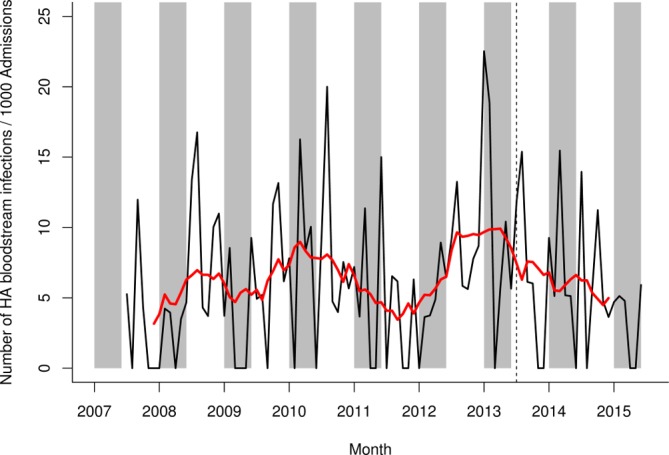
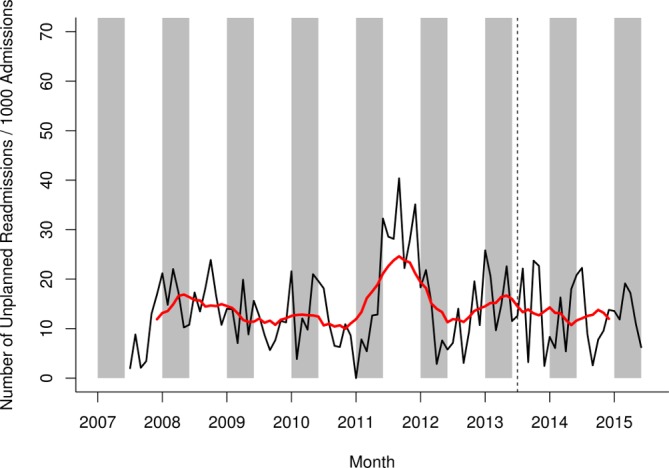
Hospital pressures were compared before and after rotavirus vaccine introduction: these included bed occupancy, hospital-acquired infection rate, unplanned readmission rate and outlier rate (medical patients admitted to surgical wards due to lack of medical beds). Interrupted time-series analysis was used to evaluate changes in bed occupancy.
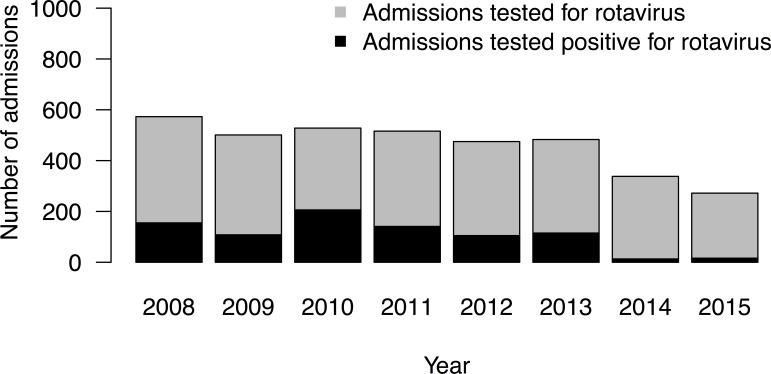
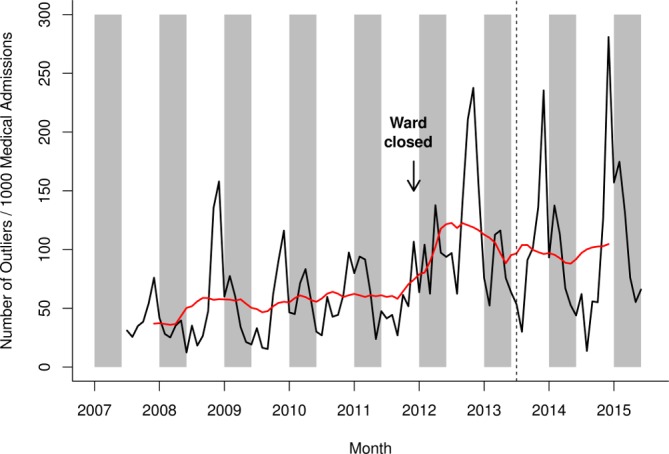
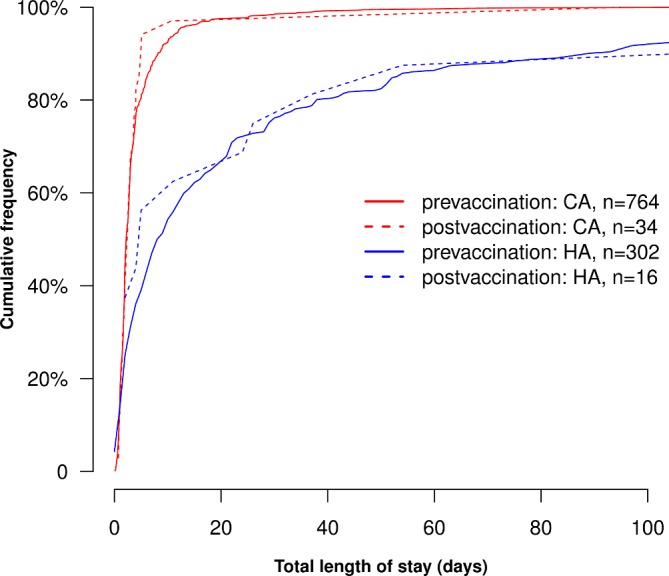
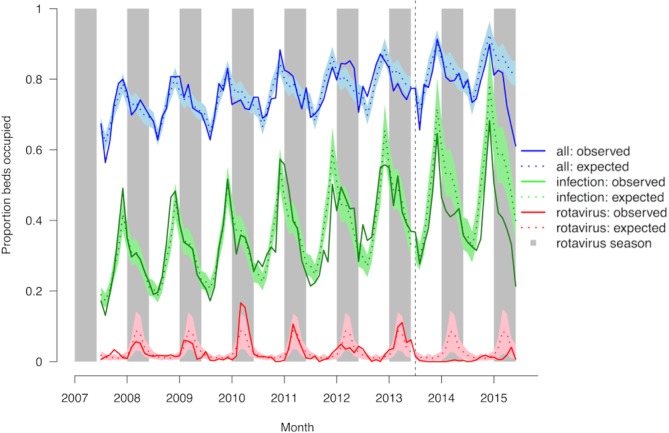
There were 116 871 admissions during the study period. Lower bed occupancy in the rotavirus season in the postvaccination period was observed for RVGE (-89%, 95% CI 73% to 95%), acute gastroenteritis (-63%, 95% CI 39% to 78%) and any infection (-23%, 95% CI 15% to 31%). No significant overall reduction in bed occupancy was observed (-4%, 95% CI -1% to 9%). No changes were observed for the other outcomes.
Rotavirus vaccine introduction was not associated with reduced hospital pressures. A reduction in RVGE hospitalisation without change in overall bed occupancy suggests that beds available were used for a different patient population, possibly reflecting a previously unmet need.
NCT03271593.
英国的医院正面临越来越大的临床和财务压力。2013 年英国引入儿童轮状病毒疫苗后,轮状病毒肠胃炎(RVGE)的住院治疗显著减少。我们评估了在英国儿科环境中引入轮状病毒疫苗后,“医院压力”(医疗资源和人员需求)的变化。
2007 年 7 月至 2015 年 6 月的回顾性医院数据库分析。
英国默西塞德的一家大型儿科医院,提供初级、二级和三级保健。
年龄<15 岁的住院患者。通过诊断编码(国际疾病分类,第 10 版)和/或实验室确认,对四个不同的患者群体计算了结果:所有住院患者;任何感染、急性肠胃炎和 RVGE。
比较轮状病毒疫苗引入前后的医院压力:这些压力包括床位占用率、医院获得性感染率、非计划再入院率和异常值率(由于缺乏医疗床位,将外科病房收治的内科患者)。中断时间序列分析用于评估床位占用率的变化。
在研究期间,共有 116871 例住院患者。在疫苗接种后季节,RVGE(减少 89%,95%置信区间 73%至 95%)、急性肠胃炎(减少 63%,95%置信区间 39%至 78%)和任何感染(减少 23%,95%置信区间 15%至 31%)的轮状病毒季节床位占用率较低。整体床位占用率未见显著下降(减少 4%,95%置信区间 -1%至 9%)。其他结果未见变化。
轮状病毒疫苗的引入与医院压力的降低无关。RVGE 住院人数减少而整体床位占用率不变表明,可用床位用于不同的患者群体,这可能反映了以前未满足的需求。
NCT03271593。