Unit for Environmental Sciences and Management, North West University, Potchefstroom Campus, Private Bag X6001, Potchefstroom 2520, South Africa.
Department of Veterinary Parasitology and Entomology, University of Maiduguri, P. M. B. 1069, Maiduguri 600230, Nigeria.
Int J Environ Res Public Health. 2019 May 16;16(10):1736. doi: 10.3390/ijerph16101736.
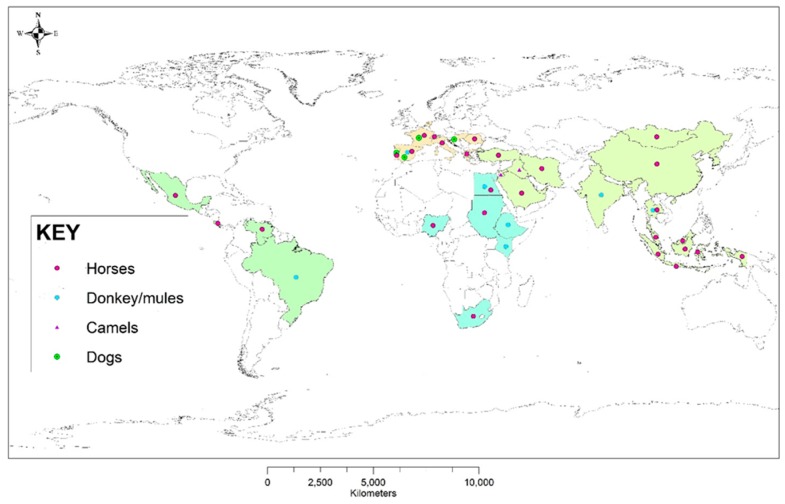
Equine Piroplasmosis (EP) is a tick-borne disease caused by apicomplexan protozoan parasites, and . The disease is responsible for serious economic losses to the equine industry. It principally affects donkeys, horses, mules, and zebra but DNA of the parasites has also been detected in dogs and camels raising doubt about their host specificity. The disease is endemic in tropical and temperate regions of the world where the competent tick vectors are prevalent. Infected equids remain carrier for life with infection, whilst, infection with is cleared within a few years. This review focuses on all aspects of the disease from the historical overview, biology of the parasite, epidemiology of the disease (specifically highlighting other non-equine hosts, such as dogs and camels), vector, clinical manifestations, risk factors, immunology, genetic diversity, diagnosis, treatment, and prevention.
马梨形虫病(EP)是一种由顶复门原生动物寄生虫引起的蜱传疾病, 和 。该疾病给马业造成了严重的经济损失。它主要影响驴、马、骡和斑马,但寄生虫的 DNA 也已在狗和骆驼中检测到,这使人怀疑它们的宿主特异性。该疾病在世界上的热带和温带地区流行,这些地区有能力传播的蜱虫。受感染的马科动物终身携带 感染,而 感染在几年内就会清除。这篇综述重点介绍了该疾病的各个方面,包括历史概述、寄生虫生物学、疾病的流行病学(特别强调了其他非马科动物宿主,如狗和骆驼)、媒介、临床表现、危险因素、免疫学、遗传多样性、诊断、治疗和预防。