Division of Research, Kaiser Permanente Northern California, Oakland.
Department of Psychology, Stanford University, Stanford, CA.
Med Care. 2019 Jul;57(7):528-535. doi: 10.1097/MLR.0000000000001133.
The objective of this study was to test whether 2 interventions promote interest in diabetes prevention among women with a history of gestational diabetes mellitus, who face high lifetime risk for diabetes.
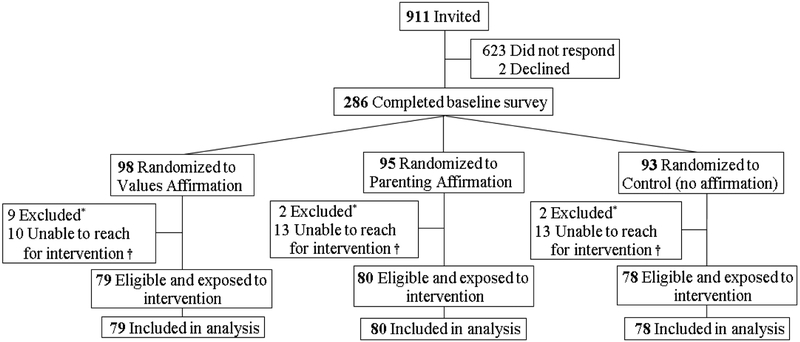
We designed an email outreach message promoting an existing preventive lifestyle program. The message incorporated values affirmation, a theory-based intervention that can improve openness to health information but typically relies on a writing exercise less practical in health care settings. In a 3-arm randomized study, 237 women with elevated body mass index and a history of gestational diabetes mellitus were randomized to read an outreach message containing either no affirmation (control) or 1 of 2 affirmations, streamlined to remove the typical writing exercise: either a values affirmation prompting reflection on any personal value, or a parenting affirmation prompting reflection on caregiving-related values. Outcomes included demonstrating interest in the lifestyle program (seeking information about it or intending to join) and seeking publicly-available health information about diabetes prevention.
Compared with control, participants randomized to the values affirmation more frequently demonstrated interest in the lifestyle program (59.0% vs. 74.4%; adjusted relative risk: 1.31; 95% confidence interval: 1.04-1.66) and sought information about diabetes prevention (59.0% vs. 73.4%; adjusted relative risk: 1.22; 95% confidence interval: 0.97-1.54). The parenting affirmation yielded no significant differences in either outcome.
A streamlined values affirmation, designed for feasibility in a health care setting, can promote interest in diabetes prevention among women at high risk. Research is needed to evaluate its effects on diabetes prevention program enrollment and clinical outcomes.
本研究旨在测试两项干预措施是否能激发有妊娠糖尿病史的女性对糖尿病预防的兴趣,因为这些女性一生中患糖尿病的风险很高。
我们设计了一封电子邮件外展信息,以推广现有的预防生活方式计划。该信息采用了价值观肯定,这是一种基于理论的干预措施,可以提高对健康信息的开放性,但通常依赖于在医疗保健环境中不太实用的写作练习。在一项 3 臂随机研究中,237 名身体质量指数升高且有妊娠糖尿病史的女性被随机分配阅读外展信息,信息中包含没有肯定(对照组)或 2 种肯定中的 1 种,简化了去除典型的写作练习:要么是价值观肯定,促使反思任何个人价值观,要么是育儿肯定,促使反思与照顾相关的价值观。结果包括表现出对生活方式计划的兴趣(寻求有关该计划的信息或打算加入)和寻求公开的糖尿病预防健康信息。
与对照组相比,随机分配到价值观肯定组的参与者更频繁地表现出对生活方式计划的兴趣(59.0%比 74.4%;调整后的相对风险:1.31;95%置信区间:1.04-1.66),并寻求有关糖尿病预防的信息(59.0%比 73.4%;调整后的相对风险:1.22;95%置信区间:0.97-1.54)。育儿肯定在这两个结果上均无显著差异。
一种简化的价值观肯定,为在医疗保健环境中的可行性而设计,可以激发高风险女性对糖尿病预防的兴趣。需要研究其对糖尿病预防计划参与和临床结果的影响。