Hojabri Zoya, Mirmohammadkhani Majid, Darabi Narges, Arab Maedeh, Pajand Omid
Microbiology Department, Faculty of Medicine, Semnan University of Medical Sciences, Semnan, Iran,
Social Determinants of Health Research Center, Semnan University of Medical Sciences, Semnan, Iran,
Infect Drug Resist. 2019 Apr 17;12:893-903. doi: 10.2147/IDR.S199759. eCollection 2019.
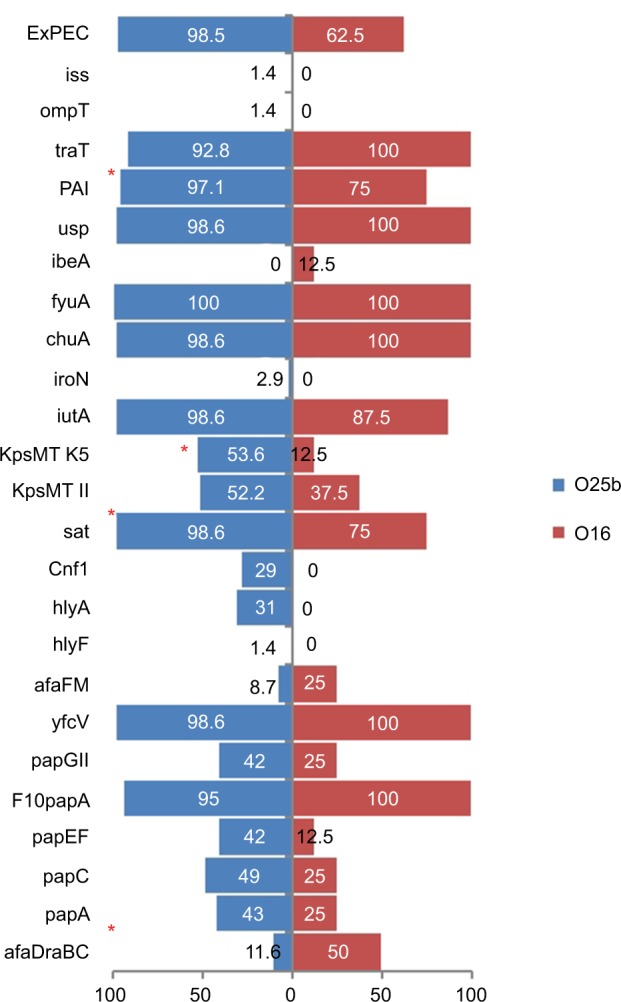
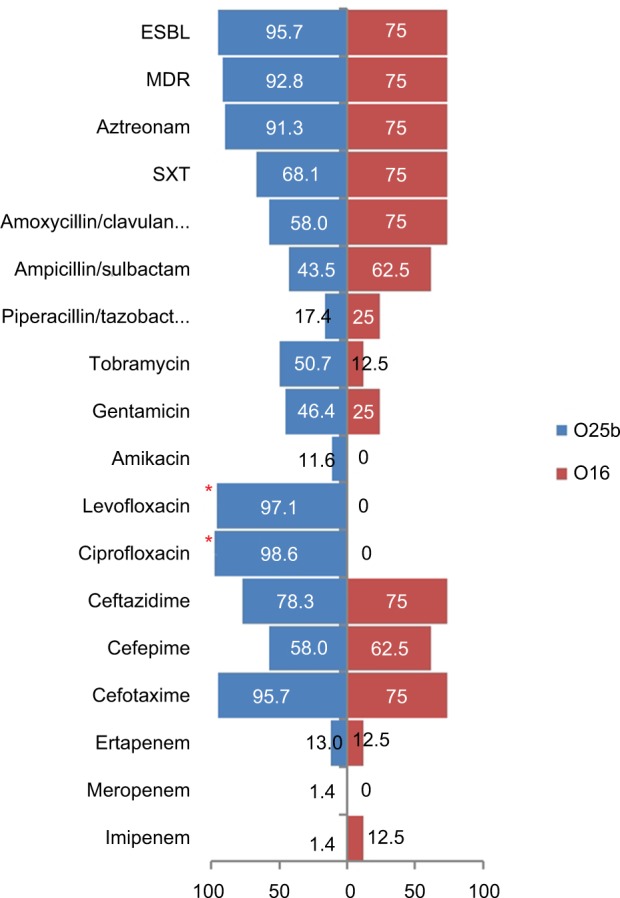
sequence types (STs) 69, 73, 95, 127, and 131 are major STs frequently causing extraintestinal infections. The prevalence of specific clones and their virulence and resistance profiles has not been described from Iran. The aim of this study was to characterize antimicrobial-susceptibility profiles and virulence traits of five major clones of recovered from human extraintestinal infections in Semnan, Iran. We compared these traits between major ST clones and also between O25b and O16 subgroups of the ST131 clone.
We characterized the five major ST clones among 335 collected isolates obtained from extraintestinal infections, and phylogenetic groups, antimicrobial susceptibility, and virulence/resistance-gene profiles of these major STs were studied.
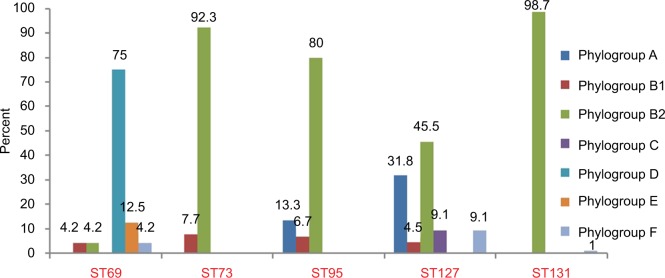
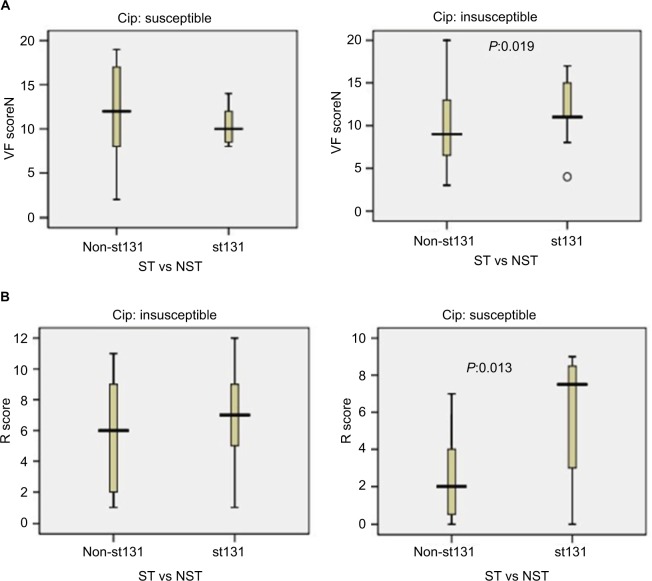
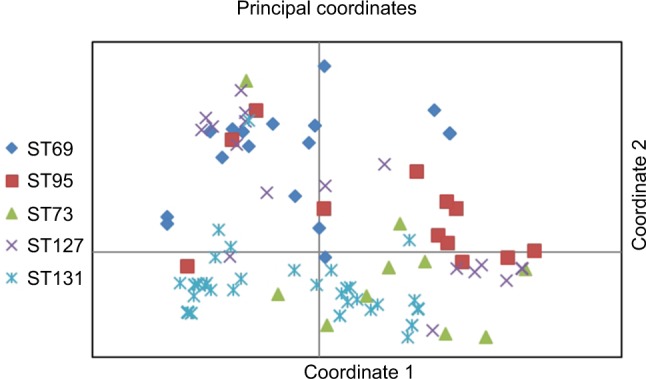
The highest rates of the multidrug-resistance phenotype were detected among ST131 (85.7%) and ST69 (41.7%), and trimethoprim/sulfamethoxazole resistance was detected significantly among the latter clone. Of the 151 isolates belonging to major ST clones, was detected among all except the ST127 clone, while genes were harbored by 14 (9.2%) isolates, which all belonged to the ST131 clone. Aggregate virulence scores (median) of ST131 isolates (11) were slightly higher than ST69 (8.50) strains, but were lower than ST73 (16), ST95 (16), and ST127 (12.50) isolates. Principal-coordinate analysis revealed distinct virulence profiles with the ST131 clone. ST73, ST95 and ST131 were enriched with "urovirulence" traits, including phylogroup B2 and group B2-associated accessory traits (, , , , , and ) and the derived variables extraintestinal pathogenic and uropathogenic . In contrast, ST69 was depleted of these traits, but enriched with phylogroups D and E.
Our data emphasize that isolates of the ST131 clone have the ability to make a balance between resistance and virulence traits to establish a wider clone in extraintestinal pathogenic .
序列类型(STs)69、73、95、127和131是经常引起肠外感染的主要STs。伊朗尚未描述特定克隆的流行情况及其毒力和耐药性特征。本研究的目的是对从伊朗塞姆南的人类肠外感染中分离出的五个主要克隆的抗菌药物敏感性谱和毒力特征进行表征。我们比较了主要ST克隆之间以及ST131克隆的O25b和O16亚组之间的这些特征。
我们对从肠外感染中收集的335株分离株中的五个主要ST克隆进行了表征,并研究了这些主要STs的系统发育组、抗菌药物敏感性以及毒力/耐药基因谱。
在ST131(85.7%)和ST69(41.7%)中检测到最高的多重耐药表型率,并且在后一个克隆中显著检测到对甲氧苄啶/磺胺甲恶唑的耐药性。在属于主要ST克隆的151株分离株中,除ST127克隆外,在所有分离株中均检测到了[未明确的某种物质或特征],而14株(9.2%)分离株携带了[未明确的某种基因],这些分离株均属于ST131克隆。ST131分离株的总体毒力评分(中位数)(11)略高于ST69(8.50)菌株,但低于ST73(16)、ST95(16)和ST127(12.50)分离株。主坐标分析揭示了ST131克隆具有独特的毒力谱。ST73、ST95和ST131富含“尿路毒力”特征,包括B2系统发育组和与B2组相关的辅助特征([未明确的多种特征])以及衍生变量肠外致病性[未明确的某种物质或特征]和尿路致病性[未明确的某种物质或特征]。相比之下,ST69缺乏这些特征,但富含D和E系统发育组。
我们的数据强调,ST131克隆的分离株有能力在耐药性和毒力特征之间取得平衡,以在肠外致病性[未明确的某种物质或特征]中建立更广泛的克隆。