Amsterdam UMC, University of Amsterdam, Department of Medical Informatics, Amsterdam Public Health Research Institute, Amsterdam, The Netherlands.
National Intensive Care Evaluation (NICE) foundation, Amsterdam, The Netherlands.
PLoS One. 2019 May 23;14(5):e0217225. doi: 10.1371/journal.pone.0217225. eCollection 2019.
General Practitioners (GPs) play a key role in the healthcare trajectory of patients. If the patient experiences problems that are typically non-life-threatening, such as the symptoms of post-intensive-care syndrome, the GP will be the first healthcare professional they consult. The primary aim of this study is to gain insight in the frequency of GP consultations during the year before hospital admission and the year after discharge for ICU survivors and a matched control group from the general population. The secondary aim of this study is to gain insight into differences between subgroups of the ICU population with respect to the frequency of GP consultations.
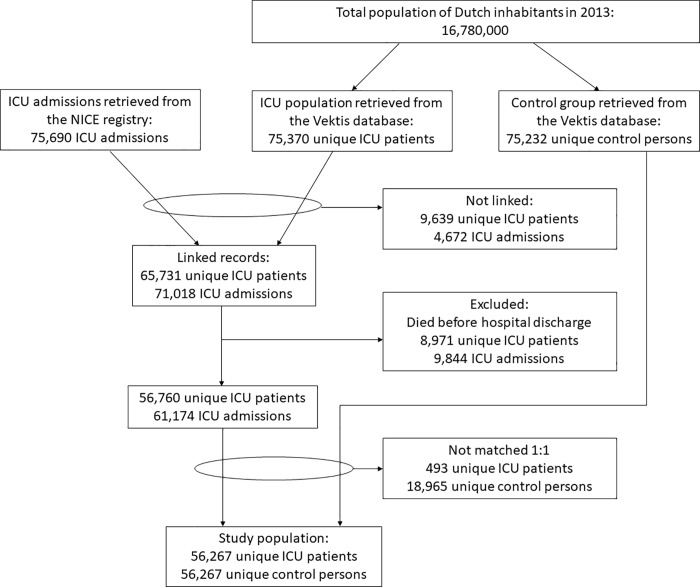
We conducted a retrospective cohort study, combining a national health insurance claims database and a national quality registry for ICUs. Clinical data of patients admitted to an ICU in 2013 were enriched with claims data from the years 2012, 2013 and 2014. Poisson regression was used to assess the differences in frequency of GP consultations between the ICU population and the control group.
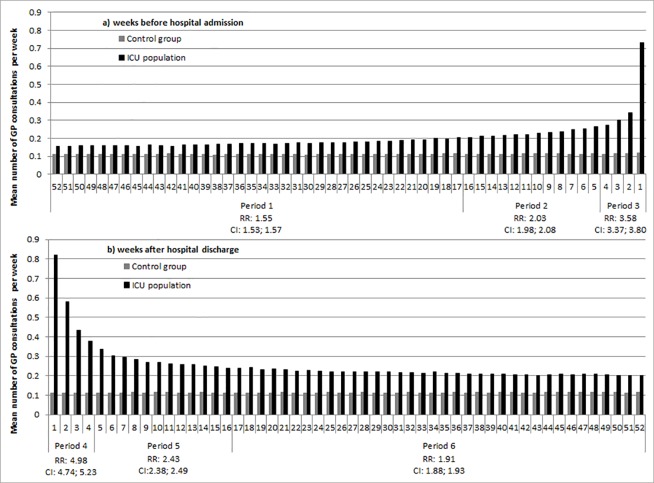
ICU patients have more consultations with GPs during the year before and after admission than individuals in the control group. In the last four weeks before admission, ICU patients have 3.58 (CI 3.37; 3.80) times more GP consultations than the control group, and during the first four weeks after discharge they have 4.98 (CI 4.74; 5.23) times more GP consultations. In the year after hospital discharge ICU survivors have an increased GP consultation rate compared to the year before their hospital admission.
Close to hospital admission and shortly after hospital discharge, the frequency of GP consultations substantially increases in the population of ICU survivors. Even a year after hospital discharge, ICU survivors have increased GP consultation rates. Therefore, GPs should be well informed about the problems ICU patients suffer after discharge, in order to provide suitable follow-up care.
全科医生(GP)在患者的医疗轨迹中起着关键作用。如果患者出现通常非危及生命的问题,例如重症监护后综合征的症状,他们将首先咨询的医疗保健专业人员就是全科医生。本研究的主要目的是了解 ICU 幸存者及其在一般人群中的匹配对照组在入院前一年和出院后一年中 GP 咨询的频率。本研究的次要目的是了解 ICU 人群亚组在 GP 咨询频率方面的差异。
我们进行了一项回顾性队列研究,将国家健康保险索赔数据库和 ICU 国家质量登记处相结合。2013 年 ICU 收治患者的临床数据通过 2012 年、2013 年和 2014 年的索赔数据进行了丰富。使用泊松回归来评估 ICU 人群与对照组之间 GP 咨询频率的差异。
与对照组相比,ICU 患者在入院前和入院后一年中与 GP 的咨询次数更多。在入院前的最后四周,ICU 患者的 GP 咨询次数比对照组多 3.58 倍(95%CI 3.37;3.80),出院后前四周,他们的 GP 咨询次数比对照组多 4.98 倍(95%CI 4.74;5.23)。在出院后的一年中,与入院前一年相比,ICU 幸存者的 GP 咨询率增加。
在接近入院和出院后不久,ICU 幸存者的 GP 咨询频率大幅增加。即使在出院一年后,ICU 幸存者的 GP 咨询率也会增加。因此,全科医生应该充分了解 ICU 患者出院后所面临的问题,以便提供适当的随访护理。