Institute for Intelligent Systems Research and Innovation, Deakin University, Waurn Ponds, VIC 3216, Australia.
PLoS One. 2019 May 23;14(5):e0217288. doi: 10.1371/journal.pone.0217288. eCollection 2019.
Optical measurement techniques and recent advances in wearable technology have made heart rate (HR) sensing simpler and more affordable.
The Polar OH1 is an arm worn optical heart rate monitor. The objectives of this study are two-fold; 1) to validate the OH1 optical HR sensor with the gold standard of HR measurement, electrocardiography (ECG), over a range of moderate to high intensity physical activities, 2) to validate wearing the OH1 at the temple as an alternative location to its recommended wearing location around the forearm and upper arm.
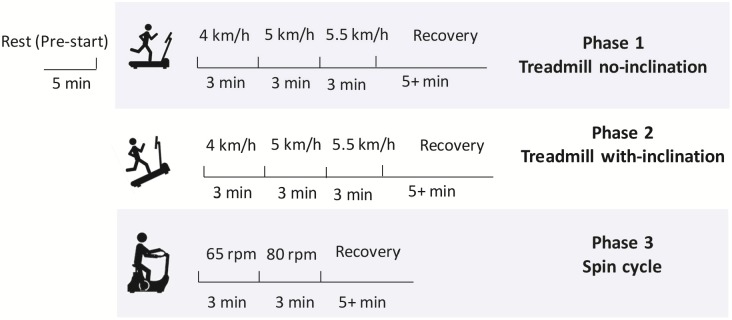
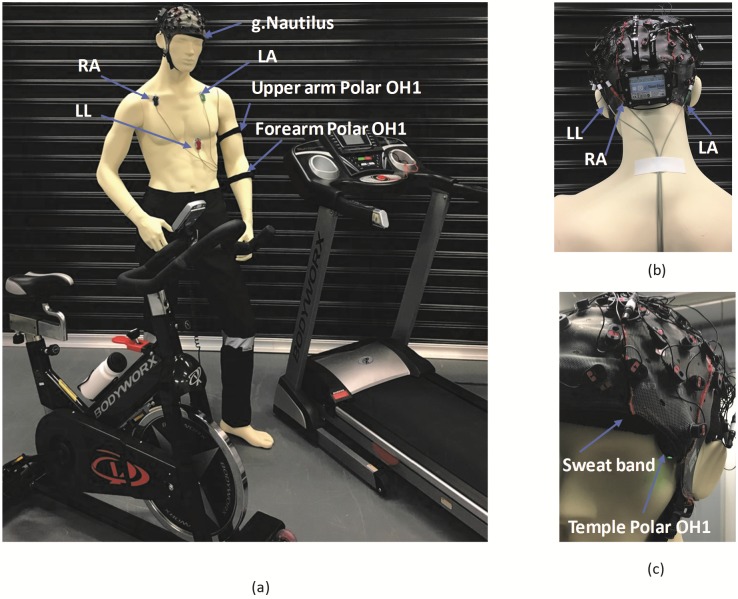
Twenty-four individuals participated in a physical exercise protocol, by walking on a treadmill and riding a stationary spin bike at different speeds while the criterion measure, ECG and Polar OH1 HR were recorded simultaneously at three different body locations; forearm, upper arm and the temple. Time synchronised HR data points were compared using Bland-Altman analyses and intraclass correlation.
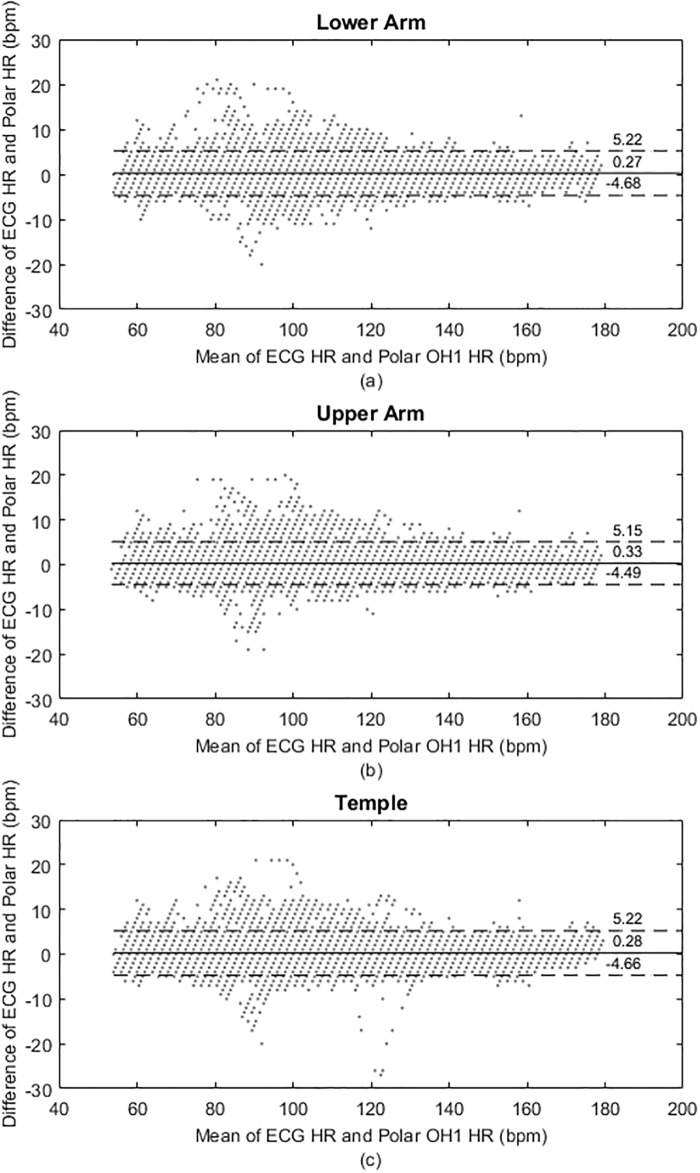
The intraclass correlation between the ECG and Polar OH1, for the aggregated data, was 0.99 and the estimated mean bias ranged 0.27-0.33 bpm for the sensor locations. The three sensors exhibited a 95% limit of agreement (LoA: forearm 5.22, -4.68 bpm; upper arm 5.15, -4.49; temple 5.22, -4.66). The mean of the ECG HR for the aggregated data was 112.15 ± 24.52 bpm. The intraclass correlation of HR values below and above this mean were 0.98 and 0.99 respectively. The reported mean bias ranged 0.38-0.47 bpm (95% LoA: forearm 6.14, -5.38 bpm; upper arm 6.07, -5.13 bpm; temple 6.09, -5.31 bpm), and 0.15-0.16 bpm (95% LoA: forearm 3.99, -3.69 bpm; upper arm 3.90, -3.58 bpm; temple 4.06, -3.76 bpm) respectively. During different exercise intensities, the intraclass correlation ranged 0.95-0.99 for the three sensor locations. During the entire protocol, the estimated mean bias was in the range -0.15-0.55 bpm, 0.01-0.53 bpm and -0.37-0.48 bpm, for the forearm, upper arm and temple locations respectively. The corresponding upper limits of 95% LoA were 3.22-7.03 bpm, 3.25-6.82 bpm and 3.18-7.04 bpm while the lower limits of 95% LoA were -6.36-(-2.35) bpm, -6.46-(-2.30) bpm and -7.42-(-2.41) bpm.
Polar OH1 demonstrates high level of agreement with the criterion measure ECG HR, thus can be used as a valid measure of HR in lab and field settings during moderate and high intensity physical activities.
光学测量技术和可穿戴技术的最新进展使得心率(HR)感测变得更加简单和经济实惠。
Polar OH1 是一款手臂佩戴的光学心率监测器。本研究的目的有两个;1)验证 OH1 光学 HR 传感器与 HR 测量的金标准——心电图(ECG)在中高强度体力活动范围内的相关性,2)验证将 OH1 佩戴在太阳穴位置作为其推荐的在前臂和上臂佩戴位置的替代位置的有效性。
24 名参与者参加了一项体能锻炼方案,在跑步机上行走和在固定自行车上骑行不同速度,同时同步记录标准测量值——ECG 和 Polar OH1 HR,在三个不同的身体位置:前臂、上臂和太阳穴。使用 Bland-Altman 分析和组内相关系数比较时间同步的 HR 数据点。
ECG 和 Polar OH1 的组内相关系数为 0.99,对于传感器位置,估计的平均偏差范围为 0.27-0.33 bpm。三个传感器的 95%一致性界限(LoA:前臂 5.22,-4.68 bpm;上臂 5.15,-4.49;太阳穴 5.22,-4.66)。汇总数据的平均 ECG HR 为 112.15±24.52 bpm。低于和高于该平均值的 HR 值的组内相关系数分别为 0.98 和 0.99。报告的平均偏差范围为 0.38-0.47 bpm(95% LoA:前臂 6.14,-5.38 bpm;上臂 6.07,-5.13 bpm;太阳穴 6.09,-5.31 bpm)和 0.15-0.16 bpm(95% LoA:前臂 3.99,-3.69 bpm;上臂 3.90,-3.58 bpm;太阳穴 4.06,-3.76 bpm)。在不同的运动强度下,三个传感器位置的组内相关系数范围为 0.95-0.99。在整个方案期间,估计的平均偏差范围为-0.15-0.55 bpm、0.01-0.53 bpm 和-0.37-0.48 bpm,分别对应于前臂、上臂和太阳穴位置。95%LoA 的上限分别为 3.22-7.03 bpm、3.25-6.82 bpm 和 3.18-7.04 bpm,95%LoA 的下限分别为-6.36-(-2.35) bpm、-6.46-(-2.30) bpm 和-7.42-(-2.41) bpm。
Polar OH1 与 ECG HR 的金标准高度一致,因此可以在中高强度体力活动期间在实验室和现场环境中用作 HR 的有效测量工具。