Department of Nutrition and food hygiene, college of Public health of Zhengzhou University, Zhengzhou, China.
PLoS One. 2019 May 23;14(5):e0217311. doi: 10.1371/journal.pone.0217311. eCollection 2019.
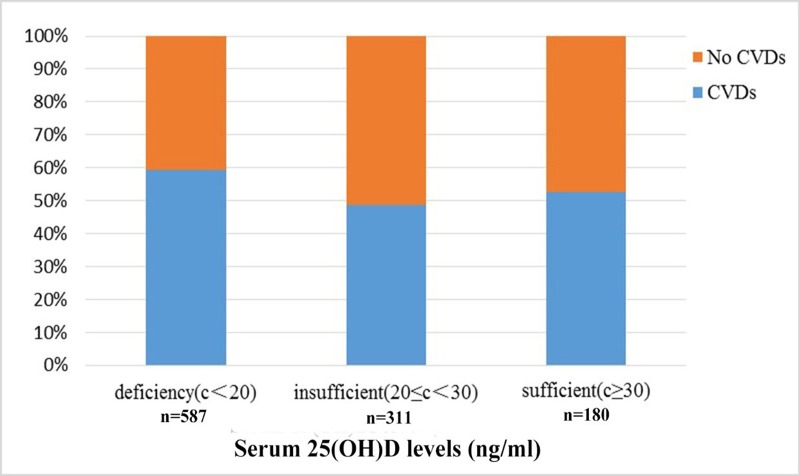
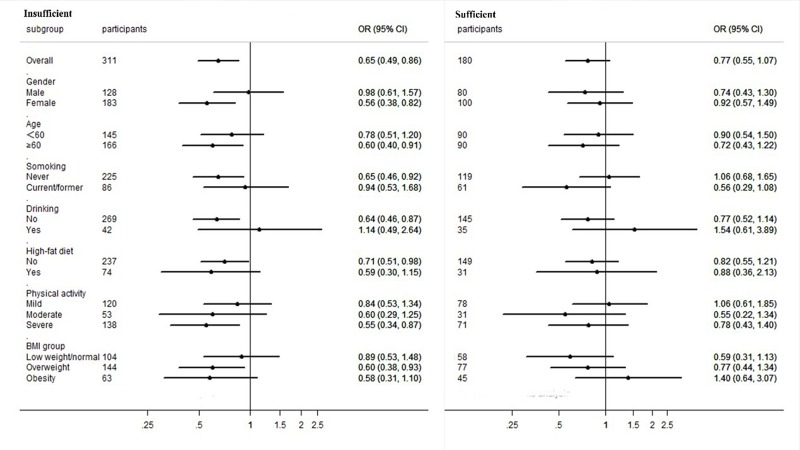
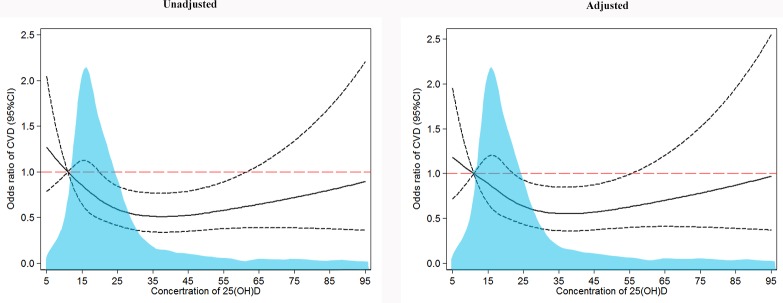
Previous studies have suggested that vitamin D is associated with cardiovascular disease (CVD), however, the relationship between vitamin D levels and CVD risk is still unclear. The purpose of this study was to assess the relationship of serum concentration of 25-hydroxyvitamin D (25(OH)D) with CVD in rural residents of Henan province of China. Basic information and medical history were gathered through face-to-face surveys from July 2013 to August 2015, and biochemical indicators were gathered in a laboratory setting. Logistic and restricted cubic splines regression analyses were used to estimate odd ratios (ORs) and 95% confidence intervals (95%CI) of CVD. A total of 1078 participants were included, the mean serum 25(OH)D concentration was determined to be 25 ± 18 ng/ml, with 54.45% of the participants presenting vitamin D deficiency [25(OH)D < 20 ng/mL]. Moreover, the prevalence of CVD was 59.28% in the vitamin D deficient group, which was higher than in the insufficient (48.55%) and sufficient groups (52.78%). After adjusting for potential confounders, compared with the deficient group, the ORs (95%CI) of CVDs were 0.68 (0.50, 0.91) in the insufficient group and 0.81 (0.56, 1.16) in the sufficient group. A nonlinear (U-shaped) association was observed between the risk of CVD and 25(OH)D concentration. Further research suggested that the risk of CVD was higher in males than in females. In conclusion, a U-shape association between serum levels of 25(OH)D and the risk of CVD was identified in our study, suggesting a nonlinear relationship between vitamin D with the prevalence of CVD.
先前的研究表明,维生素 D 与心血管疾病(CVD)有关,然而,维生素 D 水平与 CVD 风险之间的关系仍不清楚。本研究旨在评估中国河南省农村居民血清 25-羟维生素 D(25(OH)D)浓度与 CVD 的关系。基本信息和病史通过 2013 年 7 月至 2015 年 8 月的面对面调查收集,生化指标在实验室环境中收集。使用逻辑回归和限制立方样条回归分析来估计 CVD 的比值比(OR)和 95%置信区间(95%CI)。共纳入 1078 名参与者,平均血清 25(OH)D 浓度为 25±18ng/ml,54.45%的参与者存在维生素 D 缺乏症[25(OH)D<20ng/ml]。此外,维生素 D 缺乏组 CVD 的患病率为 59.28%,高于维生素 D 不足组(48.55%)和充足组(52.78%)。在调整了潜在的混杂因素后,与缺乏组相比,不足组和充足组 CVD 的 OR(95%CI)分别为 0.68(0.50,0.91)和 0.81(0.56,1.16)。观察到 CVD 风险与 25(OH)D 浓度之间呈非线性(U 型)关联。进一步的研究表明,CVD 的风险在男性中高于女性。总之,本研究发现血清 25(OH)D 水平与 CVD 风险之间存在 U 型关联,提示维生素 D 与 CVD 患病率之间存在非线性关系。