Department of Family Medicine and Emergency Medicine, Université de Sherbrooke, Sherbrooke, Quebec, Canada.
Department of Health Sciences, Université du Québec à Chicoutimi, Chicoutimi, Quebec, Canada.
BMJ Open. 2019 May 24;9(5):e027750. doi: 10.1136/bmjopen-2018-027750.
Frequent users represent a small proportion of emergency department users, but they account for a disproportionately large number of visits. Their use of emergency departments is often considered suboptimal. It would be more efficient to identify and treat those patients earlier in their health problem trajectory. It is therefore essential to describe their characteristics and to predict their emergency department use. In order to do so, adequate statistical tools are needed. The objective of this study was to determine the statistical tools used in identifying variables associated with frequent use or predicting the risk of becoming a frequent user.
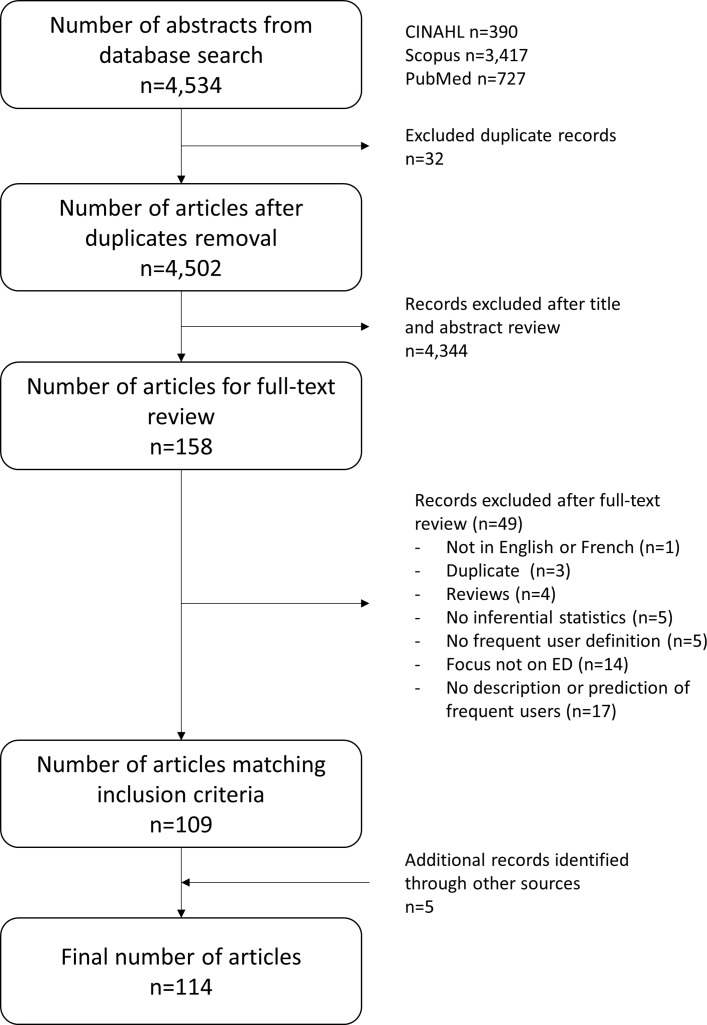
We performed a scoping review following an established 5-stage methodological framework. We searched PubMed, Scopus and CINAHL databases in February 2019 using search strategies defined with the help of an information specialist. Out of 4534 potential abstracts, we selected 114 articles based on defined criteria and presented in a content analysis.
We identified four classes of statistical tools. Regression models were found to be the most common practice, followed by hypothesis testing. The logistic regression was found to be the most used statistical tool, followed by χ2 test and t-test of associations between variables. Other tools were marginally used.
This scoping review lists common statistical tools used for analysing frequent users in emergency departments. It highlights the fact that some are well established while others are much less so. More research is needed to apply appropriate techniques to health data or to diversify statistical point of views.
急诊部门的高频使用者占比较小,但他们的就诊次数却不成比例地多。他们对急诊部门的使用往往被认为是不理想的。如果能更早地在患者健康问题的轨迹上识别和治疗这些患者,效率会更高。因此,描述他们的特征并预测他们急诊部门的使用情况是至关重要的。为此,需要足够的统计工具。本研究的目的是确定用于识别与高频使用相关的变量或预测成为高频使用者风险的统计工具。
我们按照既定的 5 阶段方法框架进行了范围综述。我们使用信息专家协助制定的搜索策略,于 2019 年 2 月在 PubMed、Scopus 和 CINAHL 数据库中进行了搜索。在 4534 篇潜在的摘要中,我们根据既定标准选择了 114 篇文章,并进行了内容分析。
我们确定了四类统计工具。回归模型被发现是最常见的做法,其次是假设检验。逻辑回归被发现是最常用的统计工具,其次是 χ2 检验和变量之间的 t 检验。其他工具的使用则较为边缘化。
本范围综述列出了常用于分析急诊部门高频使用者的常见统计工具。它强调了一些工具已经得到了很好的确立,而其他工具则不太成熟。需要更多的研究来将适当的技术应用于健康数据,或使统计观点多样化。