Aldo Galluzzo Laboratory of Regenerative Medicine, Department of Health Promotion Sciences, Maternal and infant Care, Internal Medicine and Medical Specialties, PROMISE, University of Palermo, 90127 Palermo, Italy.
ATeN (Advanced Technologies Network Center), University of Palermo, 90127 Palermo, Italy.
Int J Mol Sci. 2019 May 26;20(10):2580. doi: 10.3390/ijms20102580.
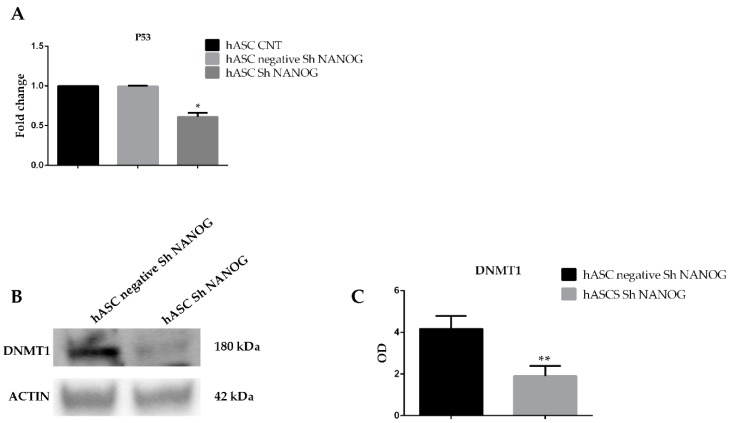
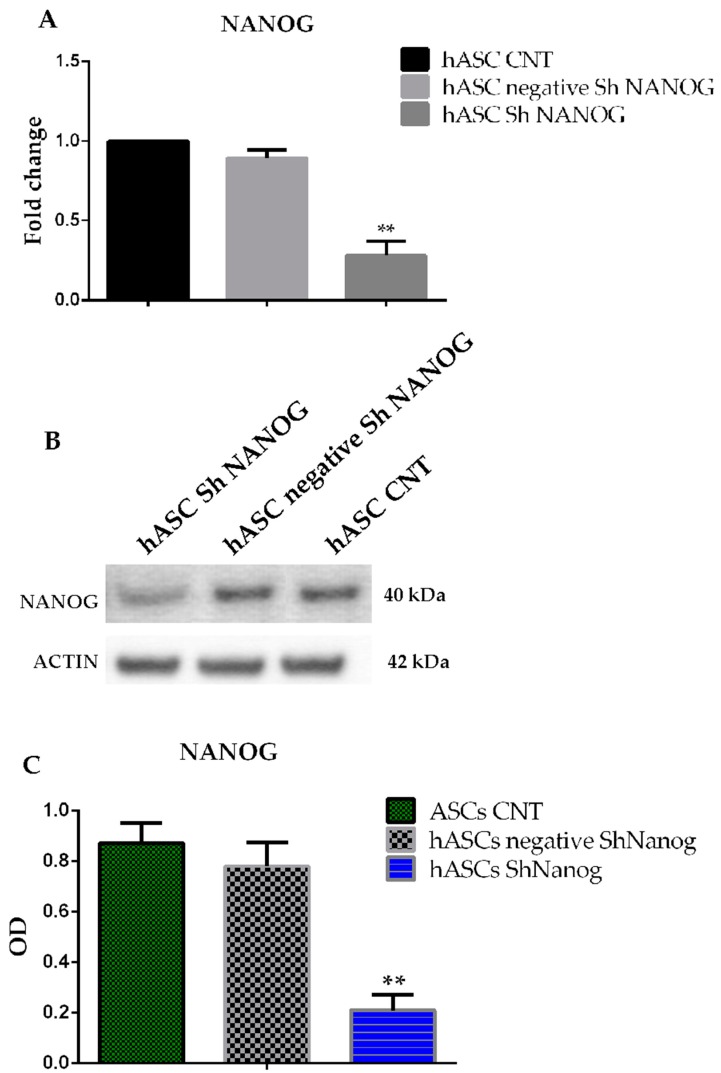
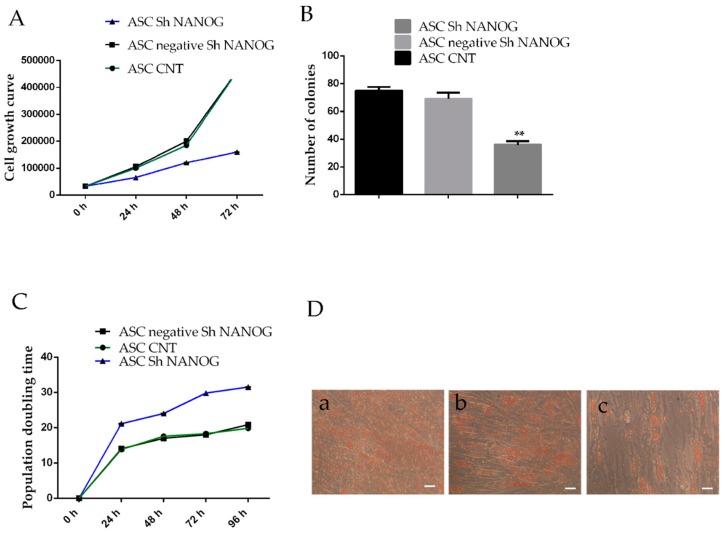
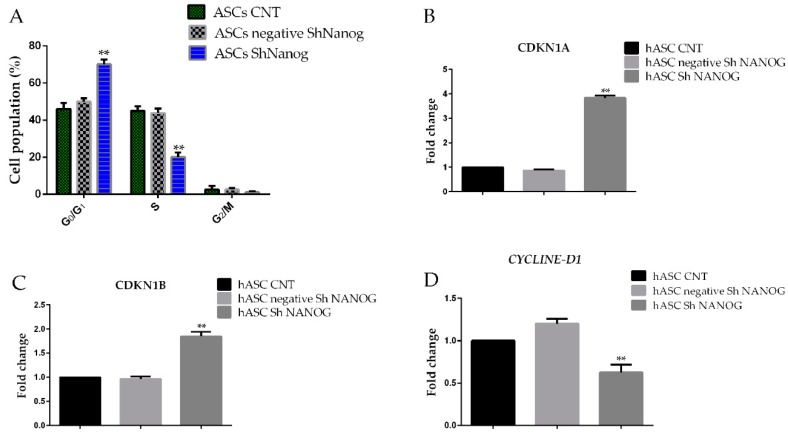
The core components of regenerative medicine are stem cells with high self-renewal and tissue regeneration potentials. Adult stem cells can be obtained from many organs and tissues. , and represent the core regulatory network that suppresses differentiation-associated genes, maintaining the pluripotency of mesenchymal stem cells. The roles of in maintaining self-renewal and undifferentiated status of adult stem cells are still not perfectly established. In this study we define the effects of downregulation of in maintaining self-renewal and undifferentiated state in mesenchymal stem cells (MSCs) derived from subcutaneous adipose tissue (hASCs). hASCs were expanded and transfected in vitro with short hairpin Lentivirus targeting . Gene suppressions were achieved at both transcript and proteome levels. The effect of knockdown on proliferation after 10 passages and on the cell cycle was evaluated by proliferation assay, colony forming unit (CFU), qRT-PCR and cell cycle analysis by flow-cytometry. Moreover, involvement in differentiation ability was evaluated. We report that downregulation of revealed a decrease in the proliferation and differentiation rate, inducing cell cycle arrest by increasing / (Cyclin-dependent kinase inhibitor 1B) and / (Cyclin-dependent kinase inhibitor 1A) through and regulate /. Furthermore, induced downregulation of , a major DNA methyltransferase responsible for maintaining methylation status during DNA replication probably involved in cell cycle regulation. Our study confirms that regulates the complex transcription network of plasticity of the cells, inducing cell cycle arrest and reducing differentiation potential.
再生医学的核心成分是具有高自我更新和组织再生潜力的干细胞。成体干细胞可从许多器官和组织中获得。、和代表抑制分化相关基因、维持间充质干细胞多能性的核心调控网络。在维持成体干细胞的自我更新和未分化状态方面,的作用尚未完全确定。在本研究中,我们定义了下调在维持源自皮下脂肪组织的间充质干细胞(hASCs)的自我更新和未分化状态中的作用。hASCs 在体外进行扩增,并通过靶向的短发夹 Lentivirus 进行转染。在转录和蛋白质组水平上均实现了基因抑制。通过增殖测定、集落形成单位(CFU)、qRT-PCR 和流式细胞术分析细胞周期来评估 10 代后的增殖和细胞周期中 敲低的效果。此外,还评估了在分化能力中的作用。我们报告下调导致增殖和分化率降低,通过增加/(细胞周期蛋白依赖性激酶抑制剂 1B)和/(细胞周期蛋白依赖性激酶抑制剂 1A)通过和调节/,诱导细胞周期停滞。此外,诱导主要的 DNA 甲基转移酶的下调,该酶负责在 DNA 复制过程中维持甲基化状态,可能参与细胞周期调控。我们的研究证实了调节细胞可塑性的复杂转录网络,诱导细胞周期停滞并降低分化潜能。