Neurodegenerative Diseases Group, Biocruces Bizkaia Health Research Institute, Barakaldo, Spain.
Ophthalmology Department, Cruces University Hospital, Barakaldo, Spain.
Mov Disord. 2019 Sep;34(9):1315-1324. doi: 10.1002/mds.27728. Epub 2019 May 28.
Retinal optical coherence tomography findings in Lewy body diseases and their implications for visual outcomes remain controversial. We investigated whether region-specific thickness analysis of retinal layers could improve the detection of macular atrophy and unravel its association with visual disability in Parkinson's disease.
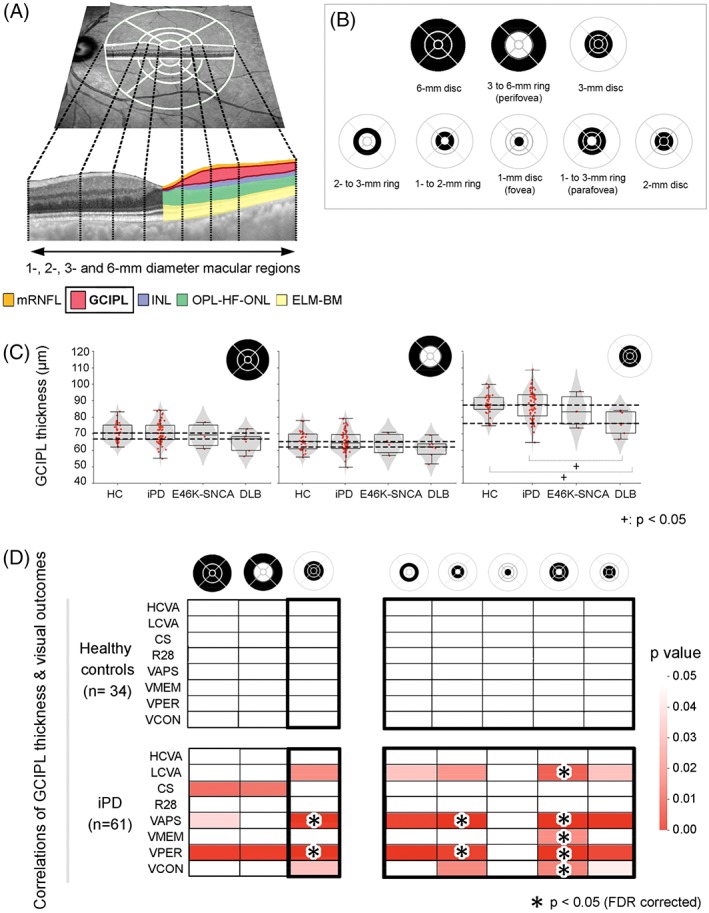
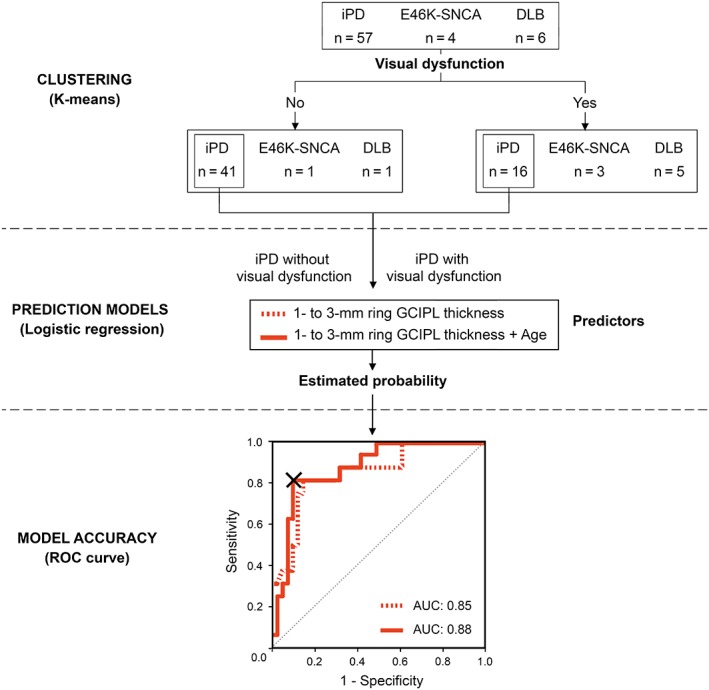
Patients with idiopathic Parkinson's disease (n = 63), dementia with Lewy bodies (n = 8), and E46K mutation carriers in the α-synuclein gene (E46K-SNCA) (n = 4) and 34 controls underwent Spectralis optical coherence tomography macular scans and a comprehensive battery of visual function and cognition tests. We computed mean retinal layer thicknesses of both eyes within 1-, 2-, 3-, and 6-mm diameter macular discs and in concentric parafoveal (1- to 2-mm, 2- to 3-mm, 1- to 3-mm) and perifoveal (3- to 6-mm) rings. Group differences in imaging parameters and their relationship with visual outcomes were analyzed. A multivariate logistic model was developed to predict visual impairment from optical coherence tomography measurements in Parkinson's disease, and cutoff values were determined with receiver operating characteristic analysis.
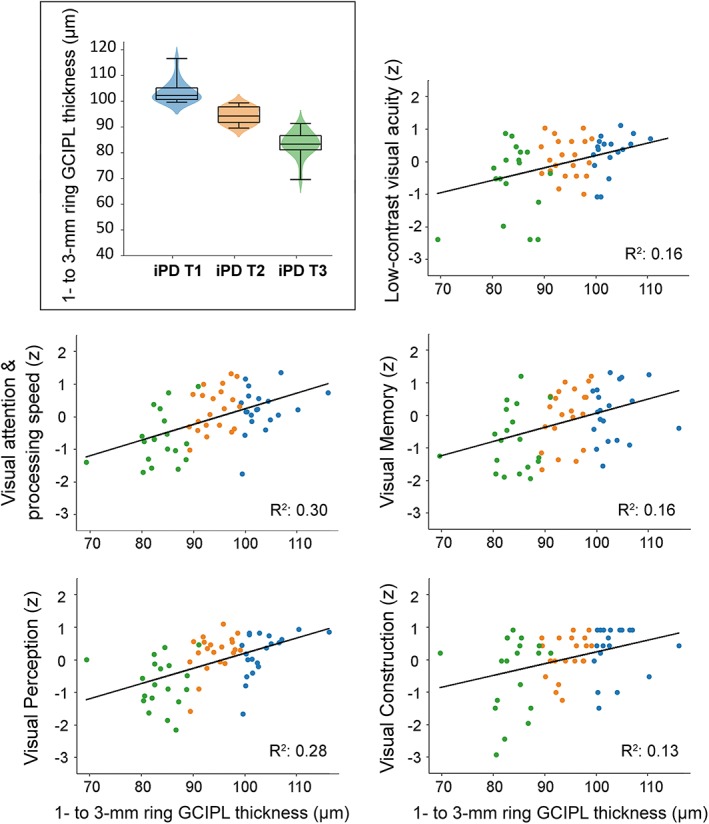
When compared with controls, patients with dementia with Lewy bodies had significant thinning of the ganglion cell-inner plexiform layer complex within the central 3-mm disc mainly because of differences in 1- to 3-mm parafoveal thickness. This parameter was strongly correlated in patients, but not in controls, with low contrast visual acuity and visual cognition outcomes (P < .05, False Discovery Rate), achieving 88% of accuracy in predicting visual impairment in Parkinson's disease.
Our findings support that parafoveal thinning of ganglion cell-inner plexiform complex is a sensitive and clinically relevant imaging biomarker for Lewy body diseases, specifically for Parkinson's disease. © 2019 The Authors. Movement Disorders published by Wiley Periodicals, Inc. on behalf of International Parkinson and Movement Disorder Society.
Lewy 体疾病的视网膜光学相干断层扫描(OCT)结果及其对视功能预后的影响仍存在争议。我们旨在研究是否可以通过特定区域视网膜厚度分析来提高黄斑萎缩的检出率,并阐明其与帕金森病(PD)患者视力障碍的相关性。
纳入特发性 PD 患者(63 例)、路易体痴呆(DLB)患者(8 例)、α-突触核蛋白基因 E46K 突变携带者(E46K-SNCA,4 例)和 34 名健康对照者,进行 Spectralis OCT 黄斑扫描和一系列视觉功能及认知测试。我们计算了双眼 1、2、3 和 6mm 黄斑盘直径内以及 1-2mm、2-3mm、1-3mm 近旁中心凹和 3-6mm 中心凹旁环的平均视网膜层厚度。分析了不同组别间的成像参数差异及其与视觉功能的相关性。建立了一个多变量逻辑回归模型,用于预测 PD 患者的 OCT 测量值与视力障碍的关系,并通过接受者操作特征曲线分析确定截断值。
与对照组相比,DLB 患者的中央 3mm 盘内神经节细胞-内丛状层复合体厚度变薄,主要表现为 1-3mm 近旁中心凹厚度变薄。该参数在患者中与低对比视力和视觉认知结果密切相关(P<0.05,错误发现率),对 PD 患者的视力损害预测准确率达 88%。
本研究结果支持神经节细胞-内丛状层复合体旁中心凹变薄是 Lewy 体疾病,尤其是 PD 的一种敏感且具有临床相关性的影像学生物标志物。