Akkuş Gamze, Güney Isa Burak, Ok Fesih, Evran Mehtap, Izol Volkan, Erdoğan Şeyda, Bayazıt Yıldırım, Sert Murat, Tetiker Tamer
Division of Endocrinology, Internal Medicine and Endocrinology, Cukurova University Medical Faculty, Department of Internal Medicine, Adana, Turkey.
Nuclear Medicine Department, Cukurova University Medical Faculty, Adana, Turkey.
Endocr Connect. 2019 Jul;8(7):838-845. doi: 10.1530/EC-19-0204.
The management of adrenal incidentaloma is still a challenge with respect to determining its functionality (hormone secretion) and malignancy. In this light, we performed 18F-FDG PET/CT scan to assess the SUVmax values in different adrenal masses including Cushing syndrome, pheochromocytoma, primary hyperaldosteronism and non-functional adrenal adenomas.
Total 109 (73 F, 36 M) patients with adrenal mass (incidentaloma), mean age of 53.3 ± 10.2 years (range, 24-70) were screened by 18F-FDG PET/CT. Data of 18F-FDG PET/CT imaging of the patients were assessed by the same specialist. Adrenal masses were identified according to the calculated standardized uptake values (SUVs). Clinical examination, 24-h urine cortisol, catecholamine metabolites, 1-mg dexamethasone suppression test, aldosterone/renin ratio and serum electrolytes were analyzed.
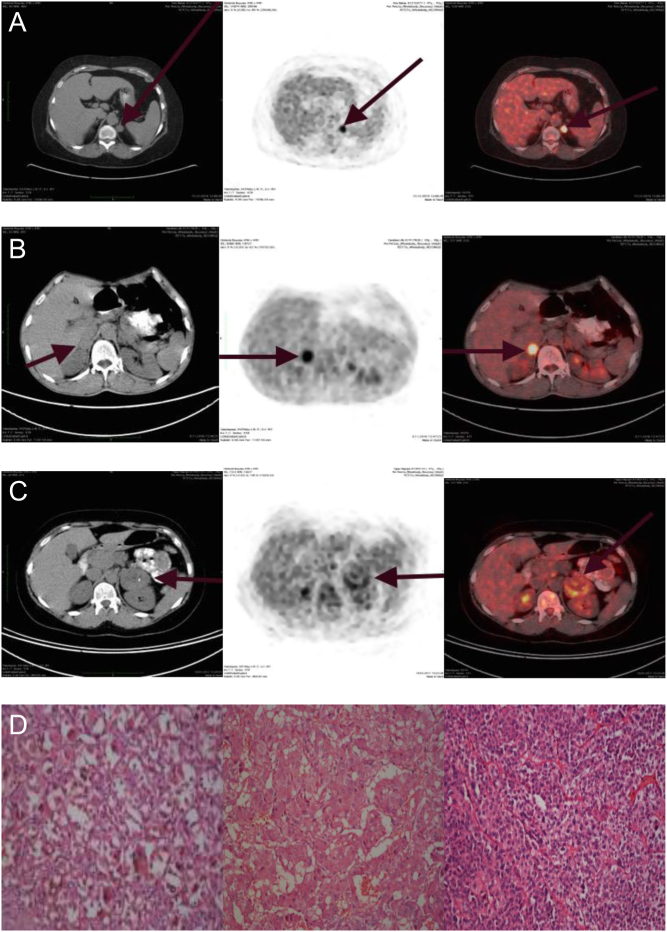
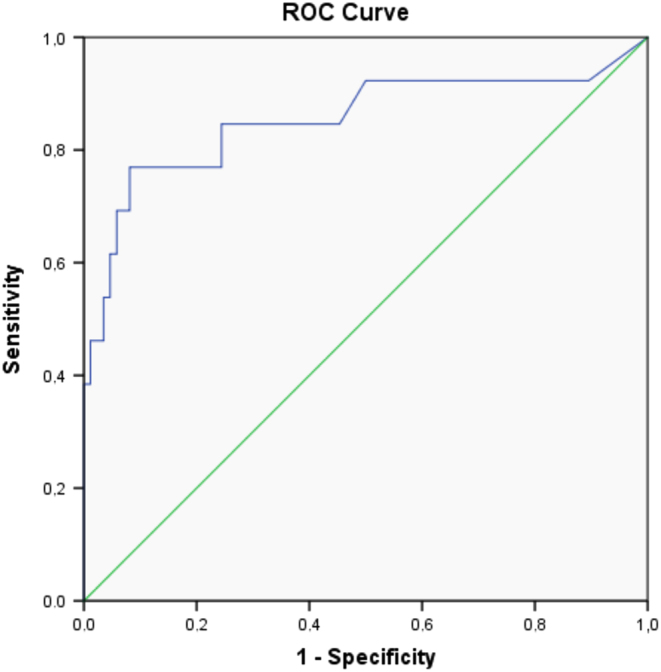
Based on the clinical and hormonal evaluations, there were 100 patients with non-functional adrenal mass, four with cortisol-secreting, four with pheochromocytomas and one with aldosterone-secreting adenoma. Mean adrenal mass diameter of 109 patients was 2.1 ± 4.3 (range, 1-6.5 cm). The 18F-FDG PET/CT imaging of the patients revealed that lower SUVmax values were found in non-functional adrenal masses (SUVmax 3.2) when compared to the functional adrenal masses including four with cortisol-secreting adenoma (SUVmax 10.1); four with pheochromcytoma (SUVmax 8.7) and one with aldosterone-secreting adenomas (SUVmax 3.30). Cortisol-secreting (Cushing syndrome) adrenal masses showed the highest SUVmax value (10.1), and a cut-off SUVmax of 4.135 was found with an 84.6% sensitivity and 75.6% specificity cortisol-secreting adrenal adenoma.
Consistent with the similar studies, non-functional adrenal adenomas typically do not show increased FDG uptake and a certain form of functional adenoma could present various FDG uptake in FDG PET/CT. Especially functional adrenal adenomas (cortisol secreting was the highest) showed increased FDG uptake in comparison to the non-functional adrenal masses. Therefore, setting a specific SUVmax value in the differentiation of malignant adrenal lesion from the benign one is risky and further studies, including a high number of functional adrenal mass are needed.
在确定肾上腺偶发瘤的功能(激素分泌)和恶性程度方面,其管理仍然是一项挑战。有鉴于此,我们进行了18F-FDG PET/CT扫描,以评估不同肾上腺肿块(包括库欣综合征、嗜铬细胞瘤、原发性醛固酮增多症和无功能肾上腺腺瘤)的最大标准化摄取值(SUVmax)。
通过18F-FDG PET/CT对总共109例(73例女性,36例男性)肾上腺肿块(偶发瘤)患者进行筛查,这些患者的平均年龄为53.3±10.2岁(范围为24 - 70岁)。患者的18F-FDG PET/CT成像数据由同一位专家评估。根据计算出的标准化摄取值(SUVs)识别肾上腺肿块。分析临床检查、24小时尿皮质醇、儿茶酚胺代谢产物、1毫克地塞米松抑制试验、醛固酮/肾素比值和血清电解质。
基于临床和激素评估,有100例无功能肾上腺肿块患者,4例皮质醇分泌性患者,4例嗜铬细胞瘤患者和1例醛固酮分泌性腺瘤患者。这109例患者肾上腺肿块的平均直径为2.1±4.3(范围为1 - 6.5厘米)。患者的18F-FDG PET/CT成像显示,与功能性肾上腺肿块相比,无功能肾上腺肿块的SUVmax值较低(SUVmax为3.2),其中包括4例皮质醇分泌性腺瘤(SUVmax为10.1);4例嗜铬细胞瘤(SUVmax为8.7)和1例醛固酮分泌性腺瘤(SUVmax为3.30)。皮质醇分泌性(库欣综合征)肾上腺肿块的SUVmax值最高(10.1),发现SUVmax的截断值为4.135时,诊断皮质醇分泌性腺瘤的敏感性为84.6%,特异性为75.6%。
与类似研究一致,无功能肾上腺腺瘤通常不会显示FDG摄取增加,而某种形式的功能性腺瘤在FDG PET/CT中可能呈现不同的FDG摄取情况。特别是功能性肾上腺腺瘤(皮质醇分泌性最高)与无功能肾上腺肿块相比,显示出FDG摄取增加。因此,设定一个特定的SUVmax值来区分肾上腺恶性病变和良性病变存在风险,需要进一步开展研究,包括纳入大量功能性肾上腺肿块的研究。