Marchi Filippo, Filauro Marta, Missale Francesco, Parrinello Giampiero, Incandela Fabiola, Bacigalupo Almalina, Vecchio Stefania, Piazza Cesare, Peretti Giorgio
IRCCS Ospedale Policlinico San Martino, 16132 Genoa, Italy.
Department of Otorhinolaryngology-Head and Neck Surgery, University of Genoa, 16132 Genoa, Italy.
Cancers (Basel). 2019 May 24;11(5):717. doi: 10.3390/cancers11050717.
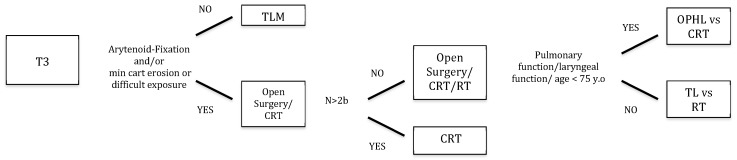
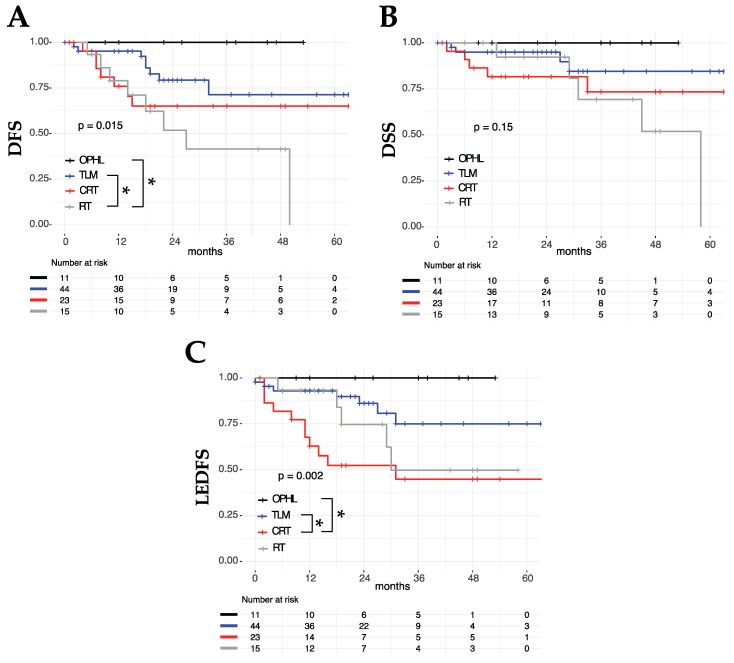
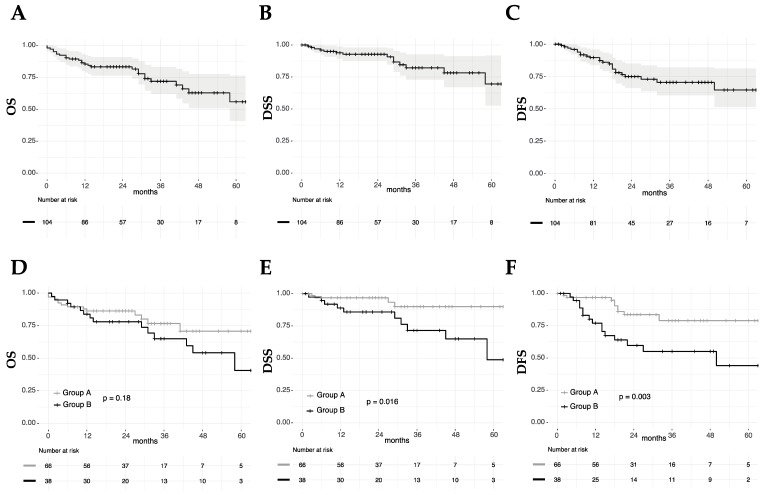
The optimal treatment for T3 laryngeal carcinoma (LC) is still a matter of debate. Different therapeutic options are available: Transoral laser microsurgery (TLM), open partial horizontal laryngectomies (OPHLs), total laryngectomy (TL), and organ preservation protocols (radiation therapy (RT) or chemo-radiation (CRT)). This study aimed to retrospectively evaluate oncologic outcomes of 104 T3 LCs treated by surgery or non-surgical approaches from January 2011 to December 2016 at a single academic tertiary referral center. Each case was evaluated by a multidisciplinary team (MDT) devoted to the management of head and neck cancers. We divided the cohort into two subgroups: Group A, surgical treatment (TLM, OPHLs, TL) and Group B, non-surgical treatment (RT, CRT). For the entire cohort, two- and five-year overall survival (OS) rates were 83% and 56%, respectively. The two- and five-year disease-free survival (DFS) rates were 75% and 65%, and disease-specific survival rates were 93% and 70%, respectively. The N category was a significant independent prognosticator for OS ( = 0.02), whereas Group B was significantly and independently associated with DFS (HR 4.10, = 0.006). Analyzing laryngo-esophageal dysfunction-free survival as an outcome, it was found that this was significantly lower in higher N categories ( = 0.04) and in cases that underwent non-surgical treatments ( = 0.002). Optimization of oncologic outcomes in T3 LCs may be obtained only by a comprehensive MDT approach, considering that different treatment options have heterogenous toxicity profiles and indications.
T3期喉癌(LC)的最佳治疗方案仍存在争议。目前有多种治疗选择:经口激光显微手术(TLM)、开放性部分水平喉切除术(OPHLs)、全喉切除术(TL)以及器官保留方案(放射治疗(RT)或放化疗(CRT))。本研究旨在回顾性评估2011年1月至2016年12月期间在一家单一的学术三级转诊中心接受手术或非手术治疗的104例T3期喉癌患者的肿瘤学结局。每例患者均由一个致力于头颈癌管理的多学科团队(MDT)进行评估。我们将该队列分为两个亚组:A组为手术治疗(TLM、OPHLs、TL),B组为非手术治疗(RT、CRT)。对于整个队列,两年和五年总生存率(OS)分别为83%和56%。两年和五年无病生存率(DFS)分别为75%和65%,疾病特异性生存率分别为93%和70%。N分期是OS的一个显著独立预后因素(P = 0.02),而B组与DFS显著且独立相关(风险比4.10,P = 0.006)。将喉食管功能无障碍生存率作为一项结局指标进行分析发现,在N分期较高的患者中(P = 0.04)以及接受非手术治疗的患者中(P = 0.002),该生存率显著较低。考虑到不同的治疗选择具有不同的毒性特征和适应证,只有通过全面的MDT方法才能实现T3期喉癌肿瘤学结局的优化。