Research Service, Veterans Affairs Nebraska-Western Iowa Health Care System, Omaha, Nebraska.
Department of Internal Medicine, University of Nebraska Medical Center, Omaha, Nebraska.
Am J Physiol Gastrointest Liver Physiol. 2019 Aug 1;317(2):G127-G140. doi: 10.1152/ajpgi.00064.2019. Epub 2019 May 29.
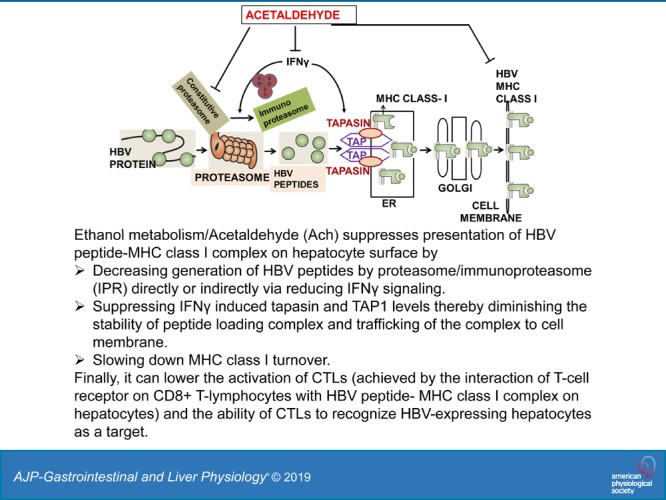
Hepatitis B virus (HBV) infection and alcoholism are major public health problems worldwide, contributing to the development of end-stage liver disease. Alcohol intake affects HBV infection pathogenesis and treatment outcomes. HBV-specific cytotoxic T lymphocytes (CTLs) play an important role in HBV clearance. Many previous studies have focused on alcohol-induced impairments of the immune response. However, it is not clear whether alcohol alters the presentation of HBV peptide-major histocompatibility complex (MHC) class I complexes on infected hepatocytes resulting in escape of its recognition by CTLs. Hence, the focus of this study was to investigate the mechanisms by which ethanol metabolism affects the presentation of CTL epitope on HBV-infected hepatocytes. As demonstrated here, although continuous cell exposure to acetaldehyde-generating system (AGS) increased HBV load in HepG2.2.15 cells, it decreased the expression of HBV core peptide 18-27-human leukocyte antigen-A2complex (CTL epitope) on the cell surface. Moreover, we observed AGS-induced suppression of chymotrypsin- and trypsin-like proteasome activities necessary for peptide processing by proteasome as well as a decline in IFNγ-stimulated immunoproteasome (IPR) function and expression of PA28 activator and immunoproteasome subunits LMP7 and LMP2. Furthermore, IFNγ-induced activation of peptide-loading complex (PLC) components, such as transporter associated with antigen processing (TAP1) and tapasin, were suppressed by AGS. The attenuation of IPR and PLC activation was attributed to AGS-triggered impairment of IFNγ signaling in HepG2.2.15 cells. Collectively, all these downstream events reduced the display of HBV peptide-MHC class I complexes on the hepatocyte surface, which may suppress CTL activation and the recognition of CTL epitopes on HBV-expressing hepatocytes by immune cells, thereby leading to persistence of liver inflammation. Our study shows that in HBV-expressing HepG2.2.15 cells, acetaldehyde alters HBV peptide processing by suppressing chymotrypsin- and trypsin-like proteasome activities and decreases IFNγ-stimulated immunoproteasome function and expression of PA28 activator and immunoproteasome subunits. It also suppresses IFNγ-induced activation of peptide-loading complex (PLC) components due to impairment of IFNγ signaling via the JAK-STAT1 pathway. These acetaldehyde-induced dysfunctions reduced the display of HBV peptide-MHC class I complexes on the hepatocyte surface, thereby leading to persistence of HBV infection.
乙型肝炎病毒(HBV)感染和酗酒是全球主要的公共卫生问题,导致终末期肝病的发生。酒精摄入会影响 HBV 感染的发病机制和治疗效果。HBV 特异性细胞毒性 T 淋巴细胞(CTL)在 HBV 清除中发挥重要作用。许多先前的研究都集中在酒精引起的免疫反应受损上。然而,目前尚不清楚酒精是否会改变感染肝细胞上 HBV 肽-主要组织相容性复合物(MHC)I 类复合物的呈递方式,从而逃避 CTL 的识别。因此,本研究的重点是研究乙醇代谢如何影响感染肝细胞上 CTL 表位的呈现。正如这里所证明的,尽管持续的细胞暴露于乙醛生成系统(AGS)会增加 HepG2.2.15 细胞中的 HBV 载量,但它会降低细胞表面 HBV 核心肽 18-27-人类白细胞抗原-A2 复合物(CTL 表位)的表达。此外,我们观察到 AGS 诱导的细胞蛋白酶体和胰凝乳蛋白酶样蛋白酶体活性下降,这些蛋白酶体对于肽加工是必需的,同时 IFNγ 刺激的免疫蛋白酶体(IPR)功能和 PA28 激活因子以及免疫蛋白酶体亚基 LMP7 和 LMP2 的表达下降。此外,AGS 抑制 IFNγ 诱导的肽加载复合物(PLC)成分,如抗原加工相关转运蛋白(TAP1)和 tapasin 的激活。IPR 和 PLC 激活的衰减归因于 AGS 触发的 HepG2.2.15 细胞中 IFNγ 信号转导的损害。总的来说,所有这些下游事件都减少了肝细胞表面 HBV 肽-MHC I 类复合物的呈现,这可能会抑制 CTL 的激活以及免疫细胞对 HBV 表达肝细胞上 CTL 表位的识别,从而导致肝脏炎症的持续存在。我们的研究表明,在 HBV 表达的 HepG2.2.15 细胞中,乙醛通过抑制胰凝乳蛋白酶样和胰蛋白酶样蛋白酶体活性来改变 HBV 肽的加工,并降低 IFNγ 刺激的免疫蛋白酶体功能和 PA28 激活因子以及免疫蛋白酶体亚基 LMP7 和 LMP2 的表达。它还通过 JAK-STAT1 途径抑制 IFNγ 信号转导,从而抑制 IFNγ 诱导的肽加载复合物(PLC)成分的激活。这些乙醛诱导的功能障碍降低了肝细胞表面 HBV 肽-MHC I 类复合物的呈现,从而导致 HBV 感染的持续存在。