Ministry of Health, Prevention and Control of STI, HIV/AIDS and Viral Hepatitis, Department of Surveillance, Brasília, DF, Brazil; Tropical Medicina Foundation Heitor Vieira Dourado, Manaus, Amazon, AM, Brazil.
Ministry of Health, Prevention and Control of STI, HIV/AIDS and Viral Hepatitis, Department of Surveillance, Brasília, DF, Brazil.
Braz J Infect Dis. 2019 May-Jun;23(3):182-190. doi: 10.1016/j.bjid.2019.04.010. Epub 2019 May 27.
Hepatitis C is a key challenge to public health in Brazil. The objective of this paper was to describe the Brazilian strategy for hepatitis C to meet the 2030 elimination goal proposed by World Health Organization (WHO).
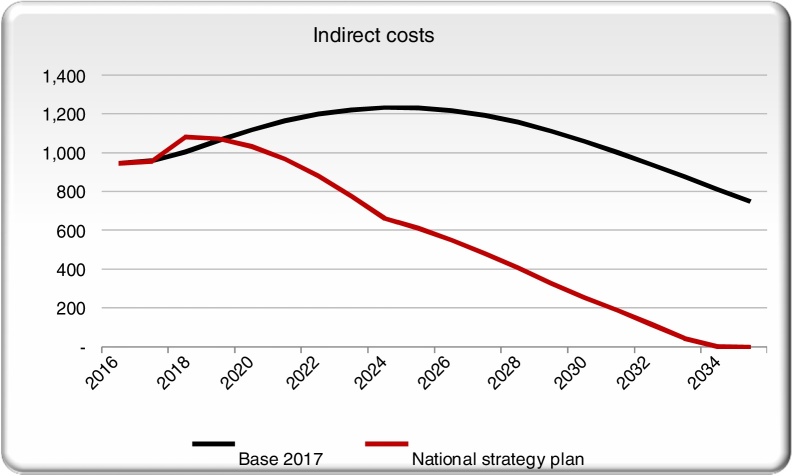
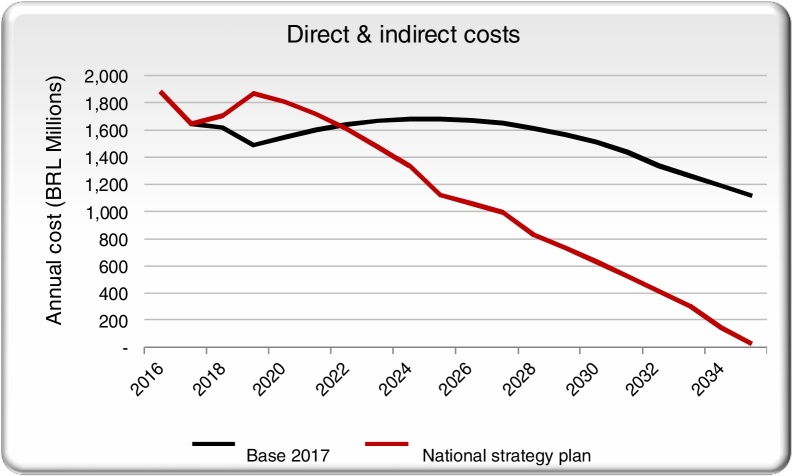
A mathematical modeling approach was used to estimate the current HCV-infected Brazilian population, and to evaluate the relative costs of two different scenarios to address HCV disease burden in Brazil: (1) if no further changes are made to the HCV treatment program in Brazil; (2) where the WHO targets for 2030 elimination are met through diagnosis and treatment efforts peaking before 2024.
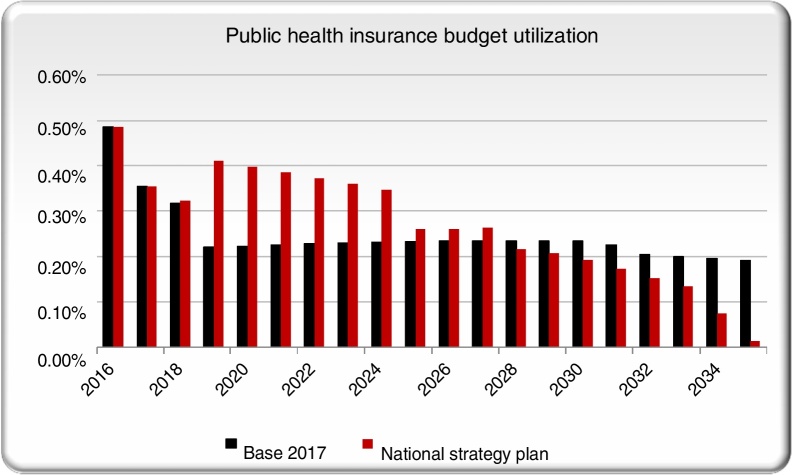
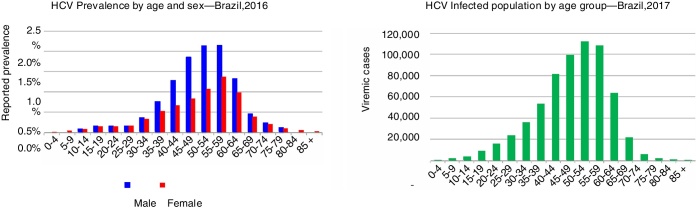
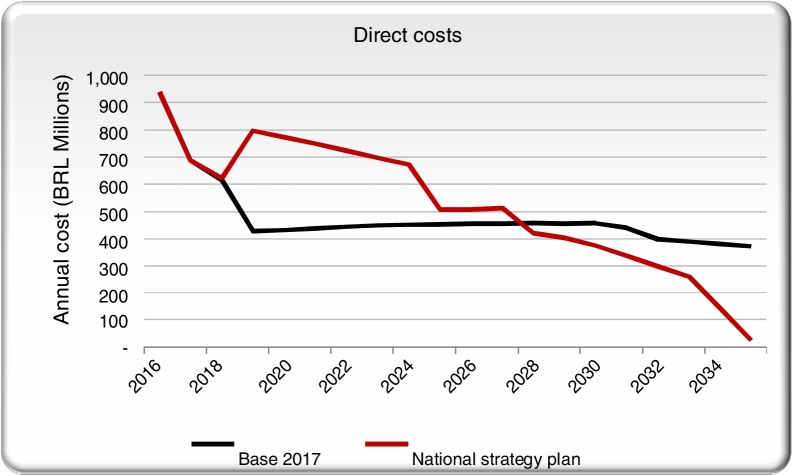
An anti-HCV prevalence of 0.53% was calculated for the total population. It was estimated that the number of HCV-RNA+ individuals in Brazil in 2017 was 632,000 (0.31% of the population). Scale-up of treatment and diagnosis over time will be necessary in order to achieve WHO targets beginning in 2018. Direct costs (diagnostic, treatment and healthcare costs) are projected to increase significantly during the scale-up of treatment and diagnosis in the initial years of the intervention scenario, but then fall below the base case on an annual basis by 2025-2036, once HCV is eliminated, due to health sectors savings from the prevention of HCV liver-related morbidity and mortality.
Achieving the WHO targets is technically feasible in Brazil with a scale-up of treatment and diagnosis over time, beginning in 2018. However, elimination of hepatitis C requires policy changes to substantially scale-up prevention, screening and treatment of HCV, together with public health advocacy to raise awareness among affected populations and healthcare providers.
丙型肝炎是巴西公共卫生的一个主要挑战。本文的目的是描述巴西的丙型肝炎战略,以实现世界卫生组织(WHO)提出的 2030 年消除目标。
采用数学建模方法估计当前巴西丙型肝炎感染人群,并评估两种不同方案在巴西解决丙型肝炎疾病负担的相对成本:(1)如果巴西丙型肝炎治疗方案没有进一步改变;(2)通过在 2024 年之前达到诊断和治疗目标,实现 2030 年消除目标。
计算得出全人群抗 HCV 流行率为 0.53%。估计 2017 年巴西 HCV-RNA+个体数为 632,000 人(占人口的 0.31%)。为了实现 2018 年开始的 WHO 目标,需要随着时间的推移扩大治疗和诊断范围。直接成本(诊断、治疗和医疗保健成本)在治疗和诊断扩大的最初几年预计会显著增加,但到 2025-2036 年,一旦 HCV 被消除,由于预防 HCV 肝相关发病率和死亡率而节省了卫生部门的资金,每年的成本将低于基线。
巴西通过 2018 年开始的治疗和诊断扩大,在技术上可以实现 WHO 目标。然而,消除丙型肝炎需要政策改变,以大幅扩大 HCV 的预防、筛查和治疗,并进行公共卫生宣传,提高受影响人群和医疗保健提供者的认识。