Department of Pharmacology and Toxicology, School of Pharmacy, College of Health and Medical Sciences, Haramaya University, P.O.Box, 235, Harar, Ethiopia.
Department of Nursing, School of Nursing and Midwifery, College of Health and Medical Sciences, Haramaya University, P.O. Box, 235, Harar, Ethiopia.
BMC Pharmacol Toxicol. 2019 May 30;20(1):35. doi: 10.1186/s40360-019-0315-9.
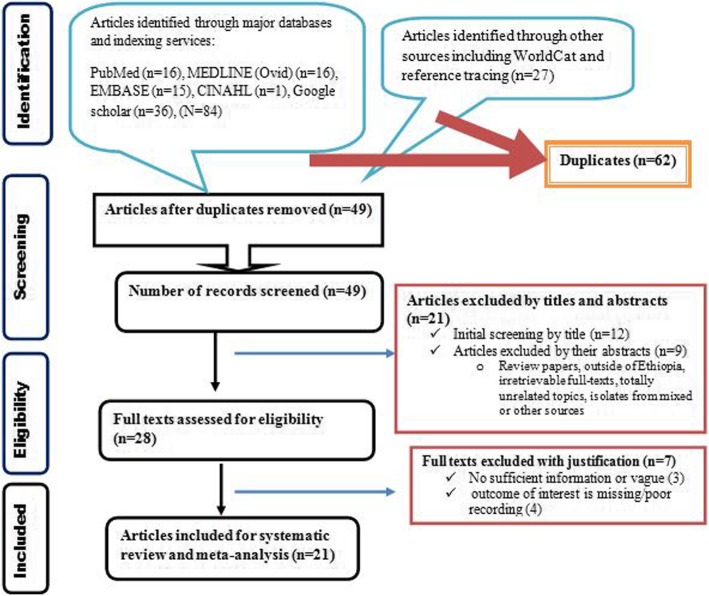
Wound infections are responsible for significant human morbidity and mortality worldwide. Specifically, surgical site infections are the third most commonly reported nosocomial infections accounting approximately a quarter of such infections. This systematic review and meta-analysis is, therefore, aimed to determine microbial profiles cultured from wound samples and their antimicrobial resistance patterns in Ethiopia.
Literature search was carried out through visiting electronic databases and indexing services including PubMed, MEDLINE, EMBASE, CINAHL, and Google Scholar. Original records, available online from 2000 to 2018, addressing the research question and written in English were identified and screened. The relevant data were extracted from included studies using a format prepared in Microsoft Excel and exported to STATA 15.0 software for analyses of outcome measures and subgrouping. Der-Simonian-Laird's random effects model was applied for pooled estimation of outcome measures at 95% confidence level. Comprehensive meta-analysis version-3 software was used for assessing publication bias across studies. The study protocol is registered on PROSPERO with reference number ID: CRD42019117638.
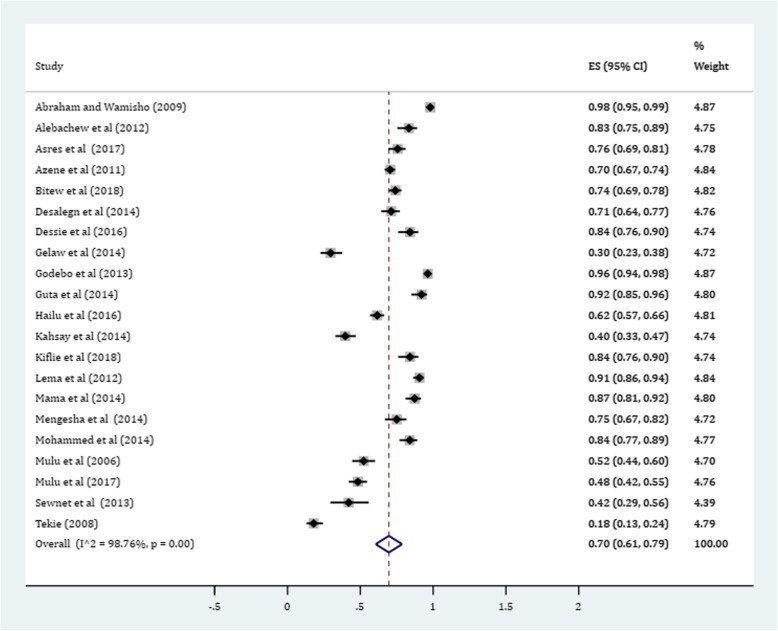
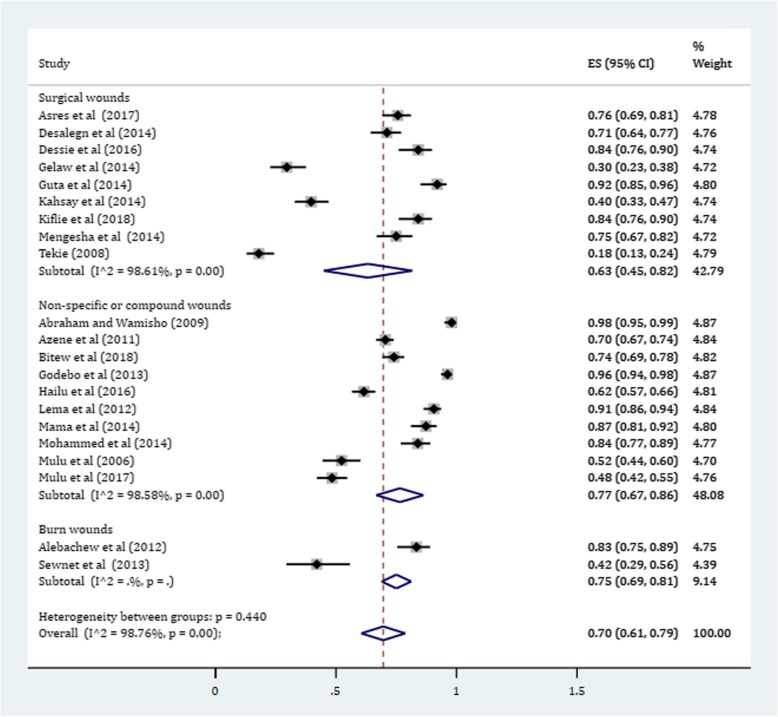
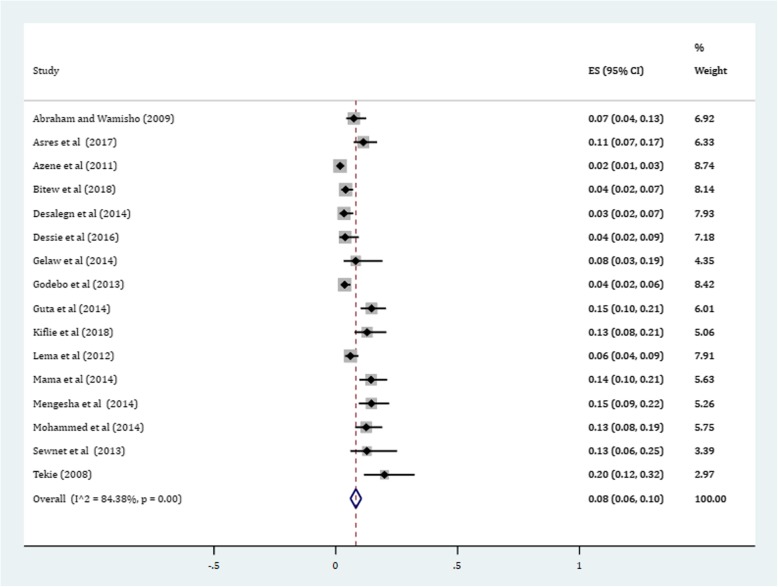
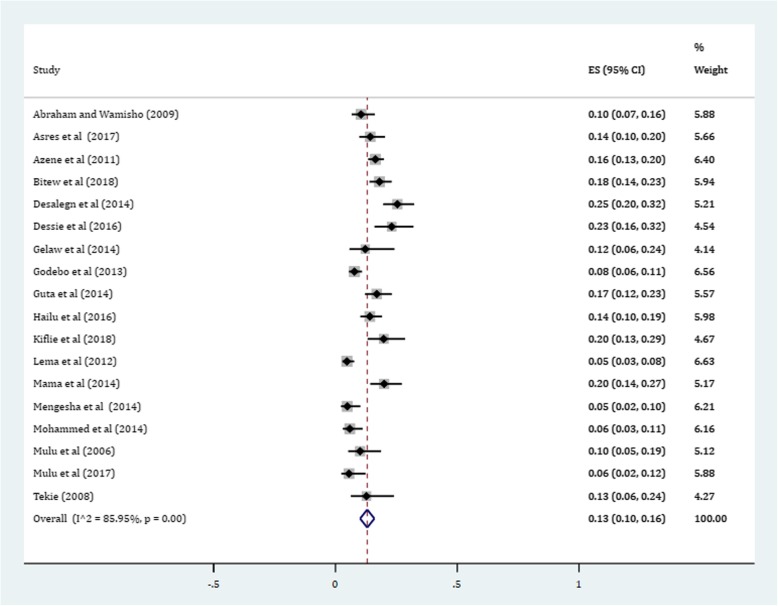
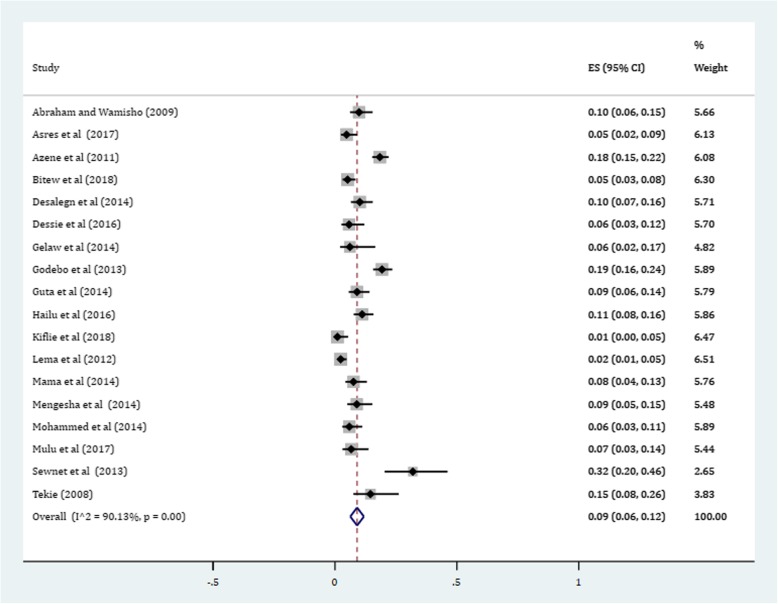
A total of 21 studies with 4284 wound samples, 3012 positive wound cultures and 3598 bacterial isolates were included for systematic review and meta-analysis. The pooled culture positivity was found to be 70.0% (95% CI: 61, 79%). Regarding the bacterial isolates recovered, the pooled prevalence of S. aureus was 36% (95% CI: 29, 42%), from which 49% were methicillin resistant strains. The pooled estimate of E. coli isolates was about 13% (95% CI: 10, 16%) followed by P. aeruginosa, 9% (95% CI: 6, 12%), K. pneumoniae, 9% (95% CI: 6, 11%) and P. mirabilis, 8% (95% CI: 5, 11%). Compared to other antimicrobials, S. aureus has showed lower estimates of resistance against ciprofloxacin, 12% (95% CI: 8, 16%) and gentamicin, 13% (95% CI: 8, 18%). E. coli isolates exhibited the highest point estimate of resistance towards ampicillin (P = 84%; 95% CI: 76, 91%). Gentamicin and ciprofloxacin showed relatively lower estimates of resistance with pooled prevalence being 24% (95% CI: 16, 33%) and 27% (95% CI: 16, 37%), respectively. Likewise, P. aeruginosa showed the lowest pooled estimates of resistance against ciprofloxacin (P = 16%; 95% CI: 9, 24%).
Generally, the wound culture positivity was found very high indicating the likelihood of poly-microbial contamination. S. aureus is by far the most common bacterial isolate recovered from wound infection. The high estimate of resistance was observed among β-lactam antibiotics in all bacterial isolates. Ciprofloxacin and gentamicin were relatively effective in treating wound infections with poly-microbial etiology.
伤口感染是导致全球人类发病率和死亡率的主要原因。具体来说,手术部位感染是第三大常见的医院获得性感染,约占此类感染的四分之一。因此,本系统评价和荟萃分析旨在确定从伤口样本中培养的微生物谱及其在埃塞俄比亚的抗微生物耐药模式。
通过访问电子数据库和索引服务,包括 PubMed、MEDLINE、EMBASE、CINAHL 和 Google Scholar,进行了文献检索。确定了在线发表的 2000 年至 2018 年期间的原始记录,这些记录与研究问题相关且以英文书写,并对其进行了筛选。使用 Microsoft Excel 准备的格式从纳入的研究中提取相关数据,并将其导出到 STATA 15.0 软件中,以分析结局指标和分组。应用 Der-Simonian-Laird 的随机效应模型对结局指标进行 95%置信水平的汇总估计。使用 Comprehensive Meta-Analysis version-3 软件评估研究间的发表偏倚。研究方案已在 PROSPERO 上注册,参考编号为 ID:CRD42019117638。
共纳入 21 项研究,共 4284 份伤口样本、3012 份阳性伤口培养物和 3598 株细菌分离株进行了系统评价和荟萃分析。总的培养阳性率为 70.0%(95%CI:61,79%)。关于回收的细菌分离株,金黄色葡萄球菌的总流行率为 36%(95%CI:29,42%),其中 49%为耐甲氧西林菌株。大肠杆菌分离株的总估计值约为 13%(95%CI:10,16%),其次是铜绿假单胞菌,9%(95%CI:6,12%),肺炎克雷伯菌,9%(95%CI:6,11%)和奇异变形杆菌,8%(95%CI:5,11%)。与其他抗菌药物相比,金黄色葡萄球菌对环丙沙星的耐药率较低,为 12%(95%CI:8,16%)和庆大霉素,13%(95%CI:8,18%)。大肠杆菌分离株对氨苄西林的耐药率最高,估计值为 84%(95%CI:76,91%)。庆大霉素和环丙沙星的耐药率相对较低,总流行率分别为 24%(95%CI:16,33%)和 27%(95%CI:16,37%)。同样,铜绿假单胞菌对环丙沙星的耐药率最低,估计值为 16%(95%CI:9,24%)。
总的来说,伤口培养阳性率非常高,表明存在多种微生物混合污染的可能性。金黄色葡萄球菌是迄今为止从伤口感染中分离出的最常见的细菌。所有细菌分离株中,β-内酰胺类抗生素的耐药率较高。环丙沙星和庆大霉素在治疗多微生物病因引起的伤口感染方面相对有效。