Department of Medical Microbiology, College of Medicine and Health Sciences, University of Gondar, Gondar, Ethiopia.
Global One Health Initiative, East African Regional Office, Addis Ababa, Ethiopia.
PLoS One. 2022 Mar 16;17(3):e0265271. doi: 10.1371/journal.pone.0265271. eCollection 2022.
Diarrhoea is the leading cause of morbidity and mortality in the world particularly in developing countries and among vulnerable groups of the population. Gram-negative enteric bacterial pathogens (GNEBPs) are a group of organisms that reside mainly in the intestine and induce diarrhoea. Antimicrobial agents are usually the part of their treatment regimen. The therapeutic effect of antimicrobials is hindered by the emergence and spread of drug-resistant strains. The information regarding the prevalence and antimicrobial resistance patterns of GNEBPs in Ethiopia is limited and found in a scattered form.
This study was designed to determine the pooled prevalence and drug resistance patterns of GNEBPs by meta-analysis of data from diarrhoeic patients in Ethiopia.
A comprehensive literature search was conducted through internet searches using Google Scholar, PubMed, Science Direct, HINARI databases, and reference lists of previous studies. Published articles were included in the study based on priorly set inclusion and exclusion criteria. Results were presented in the forest plot, tables, and figures with a 95% confidence interval (CI). The inconsistency index (I2) test statistics was used to assess heterogeneity across studies. The pooled prevalence estimate of GNEBPs and their drug resistance patterns were computed by a random-effects model. Software for Statistics and Data Science (STATA) version 14 statistical software was used for the analysis.
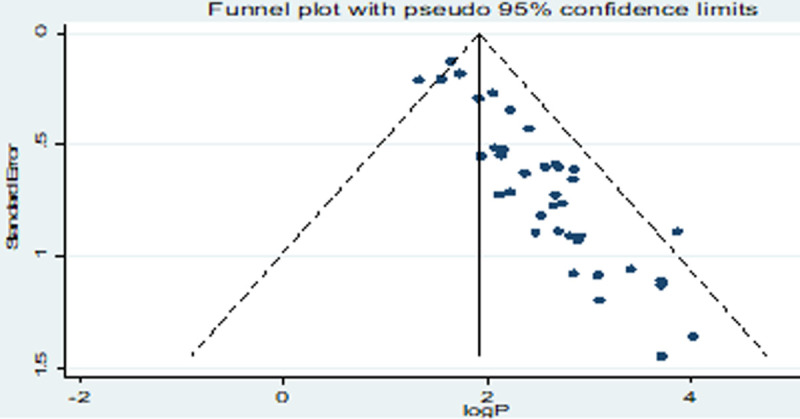
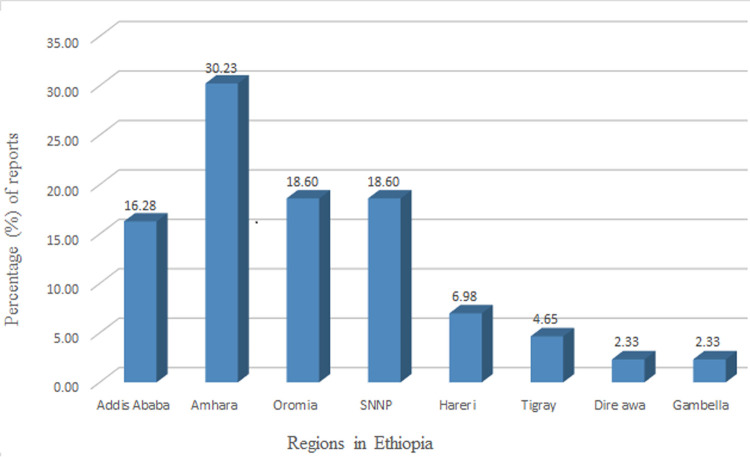
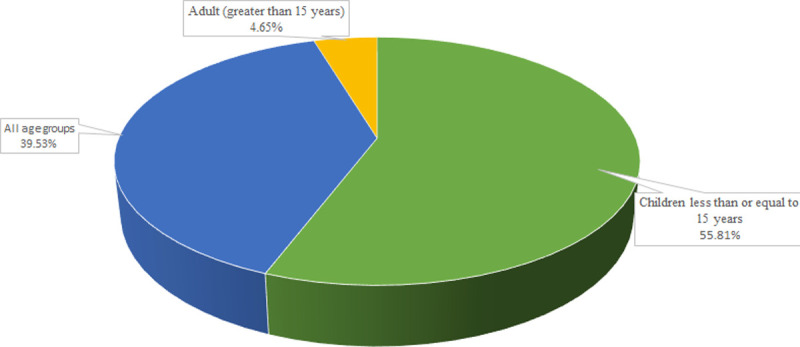
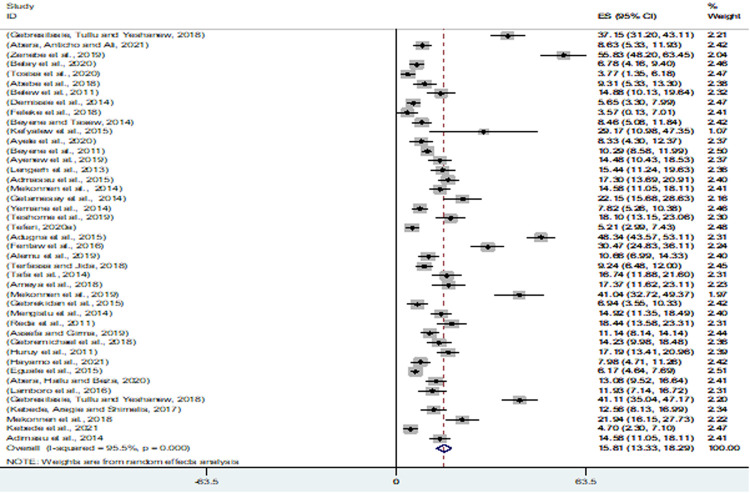
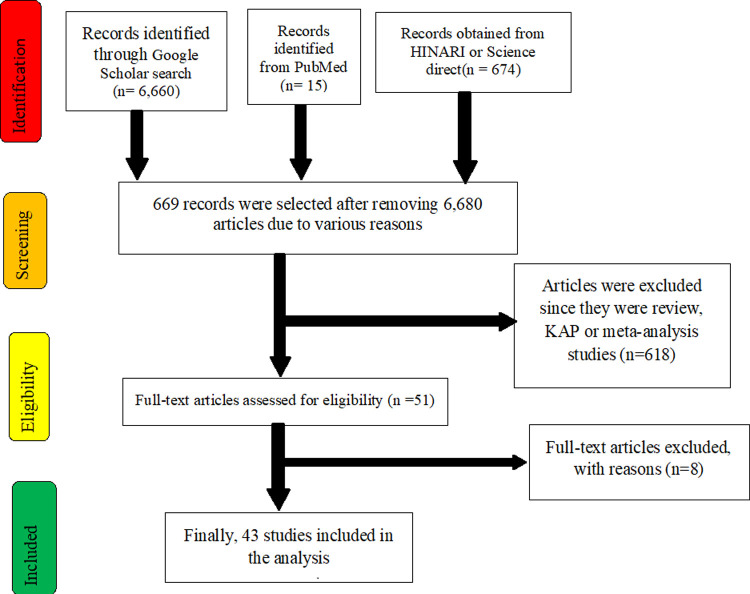
After removing those articles which did not fulfil the inclusion criteria, 43 studies were included in the analysis. Studies were conducted in 8 regions of the country and most of the published articles were from the Amhara region (30.23%) followed by Oromia (18.60%) and Southern Nations, Nationalities, and Peoples' region (SNNP) (18.60%). The pooled prevalence of GNEBPs was 15.81% (CI = 13.33-18.29). The funnel plot indicated the presence of publication bias. The pooled prevalence of GNEBPs in Addis Ababa, Amhara, SNNP, and Oromia regions were 20.08, 16.67, 12.12, and 11.61%, respectively. The pooled prevalence was 14.91, 18.03, and 13.46% among studies conducted from 2006-2010, 2011-2015, and 2016-2021, respectively and it was the highest (20.35%) in children having age less than or equal to 15 years. The pooled prevalence of Escherichia coli, Campylobacter spp., Shigella spp., and Salmonella enterica were 19.79, 10.76, 6.24, and 5.06%, respectively. Large proportions (60-90%) of the isolates were resistant to ampicillin, amoxicillin, tetracycline, and trimethoprim-sulphamethoxazole. The pooled prevalence of multidrug resistance (MDR) was 70.56% (CI = 64.56-76.77%) and MDR in Campylobacter spp., Shigella spp., E. coli, and S. enterica. were 80.78, 79.08, 78.20, and 59.46%, respectively.
The pooled estimate showed a high burden of GNEBPs infections and a high proportion of drug resistance characters to commonly used antimicrobial agents in Ethiopia. Therefore, performing drug susceptibility tests, establishing an antimicrobial surveillance system and confirmation by molecular techniques are needed.
腹泻是世界上发病率和死亡率的主要原因,特别是在发展中国家和人口中的弱势群体中。革兰氏阴性肠道细菌病原体(GNEBPs)是一组主要存在于肠道并引起腹泻的生物体。抗生素通常是其治疗方案的一部分。抗生素的治疗效果受到耐药菌株的出现和传播的阻碍。关于埃塞俄比亚 GNEBPs 的流行率和抗生素耐药模式的信息有限,且分布零散。
本研究旨在通过对埃塞俄比亚腹泻患者的数据进行荟萃分析,确定 GNEBPs 的汇总流行率和药物耐药模式。
通过互联网搜索 Google Scholar、PubMed、Science Direct、HINARI 数据库和先前研究的参考文献,进行全面的文献检索。根据先前设定的纳入和排除标准,将发表的文章纳入研究。结果以森林图、表格和图形呈现,并带有 95%置信区间(CI)。使用不一致指数(I2)检验统计量评估研究之间的异质性。使用随机效应模型计算 GNEBPs 的汇总流行率及其药物耐药模式。使用软件进行统计和数据科学(STATA)版本 14 统计软件进行分析。
在剔除那些不符合纳入标准的文章后,共有 43 项研究纳入分析。研究在该国的 8 个地区进行,大多数已发表的文章来自阿姆哈拉地区(30.23%),其次是奥罗米亚地区(18.60%)和南部民族、国家和人民地区(SNNP)(18.60%)。GNEBPs 的汇总流行率为 15.81%(CI=13.33-18.29)。漏斗图表明存在发表偏倚。在亚的斯亚贝巴、阿姆哈拉、SNNP 和奥罗米亚地区,GNEBPs 的汇总流行率分别为 20.08%、16.67%、12.12%和 11.61%。在 2006-2010 年、2011-2015 年和 2016-2021 年期间进行的研究中,GNEBPs 的汇总流行率分别为 14.91%、18.03%和 13.46%,在年龄小于或等于 15 岁的儿童中最高(20.35%)。大肠杆菌、弯曲杆菌属、志贺氏菌属和沙门氏菌属的流行率分别为 19.79%、10.76%、6.24%和 5.06%。分离株对氨苄西林、阿莫西林、四环素和复方磺胺甲噁唑的耐药率(60-90%)较高。多重耐药(MDR)的汇总流行率为 70.56%(CI=64.56-76.77%),弯曲杆菌属、志贺氏菌属、大肠杆菌和沙门氏菌属的 MDR 分别为 80.78%、79.08%、78.20%和 59.46%。
汇总估计表明,埃塞俄比亚 GNEBPs 感染负担沉重,对常用抗生素的耐药性比例较高。因此,需要进行药敏试验、建立抗生素监测系统,并通过分子技术进行确认。