Department of Molecular and Cellular Pharmacology, University of Miami Leonard M. Miller School of Medicine, Miami, Florida; Interdisciplinary Stem Cell Institute, University of Miami Leonard M. Miller School of Medicine, Miami, Florida.
Interdisciplinary Stem Cell Institute, University of Miami Leonard M. Miller School of Medicine, Miami, Florida; Department of Medicine, Division of Cardiology, University of Miami Leonard M. Miller School of Medicine, Miami, Florida.
J Am Coll Cardiol. 2019 Jun 4;73(21):2705-2718. doi: 10.1016/j.jacc.2019.02.074.
Patients with chronic kidney disease (CKD) and coincident heart failure with preserved ejection fraction (HFpEF) may constitute a distinct HFpEF phenotype. Osteopontin (OPN) is a biomarker of HFpEF and predictive of disease outcome. We recently reported that OPN blockade reversed hypertension, mitochondrial dysfunction, and kidney failure in Col4a3 mice, a model of human Alport syndrome.
The purpose of this study was to identify potential OPN targets in biopsies of HF patients, healthy control subjects, and human induced pluripotent stem cell-derived cardiomyocytes (hiPS-CMs), and to characterize the cardiac phenotype of Col4a3 mice, relate this to HFpEF, and investigate possible causative roles for OPN in driving the cardiomyopathy.
OGDHL mRNA and protein were quantified in myocardial samples from patients with HFpEF, heart failure with reduced ejection fraction, and donor control subjects. OGDHL expression was quantified in hiPS-CMs treated with or without anti-OPN antibody. Cardiac parameters were evaluated in Col4a3 mice with and without global OPN knockout or AAV9-mediated delivery of 2-oxoglutarate dehydrogenase-like (Ogdhl) to the heart.
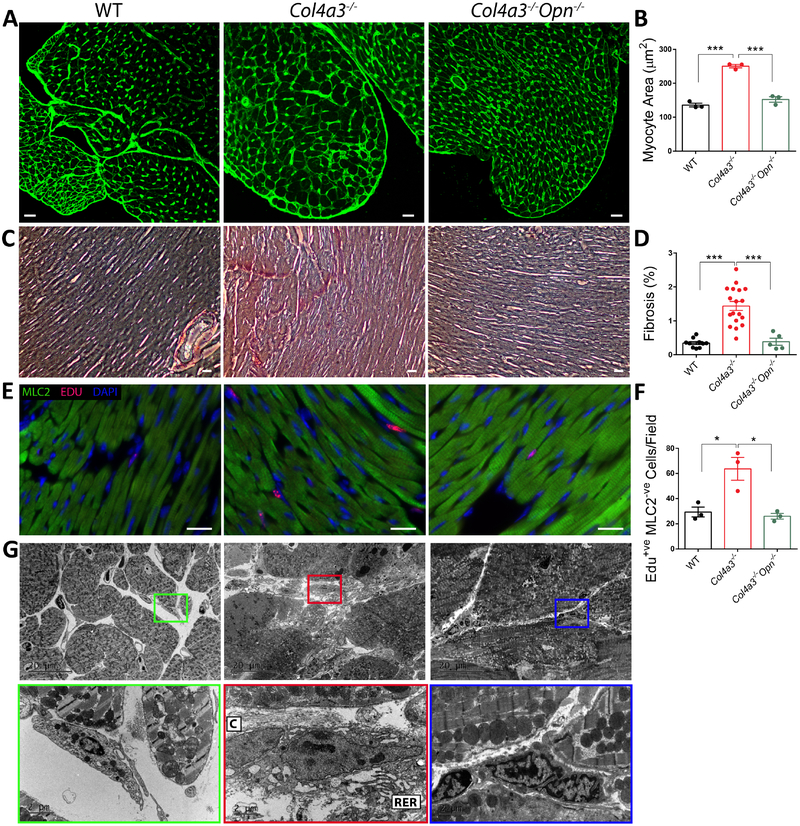
OGDHL mRNA and protein displayed abnormal abundances in cardiac biopsies of HFpEF (n = 17) compared with donor control subjects (n = 12; p < 0.01) or heart failure with reduced ejection fraction patients (n = 12; p < 0.05). Blockade of OPN in hiPS-CMs conferred increased OGDHL expression. Col4a3 mice demonstrated cardiomyopathy with similarities to HFpEF, including diastolic dysfunction, cardiac hypertrophy and fibrosis, pulmonary edema, and impaired mitochondrial function. The cardiomyopathy was ameliorated by Opn coincident with improved renal function and increased expression of Ogdhl. Heart-specific overexpression of Ogdhl in Col4a3 mice also improved cardiac function and cardiomyocyte energy state.
Col4a3 mice present a model of HFpEF secondary to CKD wherein OPN and OGDHL are intermediates, and possibly therapeutic targets.
患有慢性肾病(CKD)和并存射血分数保留型心力衰竭(HFpEF)的患者可能构成一个独特的 HFpEF 表型。骨桥蛋白(OPN)是 HFpEF 的生物标志物,并可预测疾病结局。我们最近报道,OPN 阻断可逆转 Col4a3 小鼠(人类 Alport 综合征的模型)的高血压、线粒体功能障碍和肾衰竭。
本研究的目的是确定 HF 患者、健康对照和人诱导多能干细胞衍生的心肌细胞(hiPS-CMs)活检中的潜在 OPN 靶点,并描述 Col4a3 小鼠的心脏表型,将其与 HFpEF 相关联,并研究 OPN 在驱动心肌病中的可能因果作用。
定量分析 HFpEF、射血分数降低的心力衰竭和供体对照患者心肌样本中的 OGDHL mRNA 和蛋白。定量分析用或不用抗 OPN 抗体处理的 hiPS-CMs 中的 OGDHL 表达。在 Col4a3 小鼠中评估有无全局 OPN 敲除或 AAV9 介导的 2-氧戊二酸脱氢酶样(Ogdhl)到心脏的表达。
与供体对照(n=12;p<0.01)或射血分数降低的心力衰竭患者(n=12;p<0.05)相比,HFpEF(n=17)患者的心脏活检中 OGDHL mRNA 和蛋白表达异常。在 hiPS-CMs 中阻断 OPN 可增加 OGDHL 的表达。Col4a3 小鼠表现出类似于 HFpEF 的心肌病,包括舒张功能障碍、心脏肥大和纤维化、肺水肿和线粒体功能障碍。同时改善肾功能和增加 Ogdhl 表达可改善 Opn 所致的心肌病。Col4a3 小鼠心脏特异性过表达 Ogdhl 也可改善心脏功能和心肌细胞能量状态。
Col4a3 小鼠表现为 CKD 继发的 HFpEF 模型,其中 OPN 和 OGDHL 是中间产物,可能也是治疗靶点。