Lagos L Vanessa, Lee Su A, Fondevila Guillermo, Walk Carrie L, Murphy Michael R, Loor Juan J, Stein Hans H
1Division of Nutritional Sciences, University of Illinois, Urbana, IL 61801 USA.
2Department of Animal Sciences, University of Illinois, Urbana, IL 61801 USA.
J Anim Sci Biotechnol. 2019 May 28;10:47. doi: 10.1186/s40104-019-0349-2. eCollection 2019.
A 21-day experiment was conducted to test the hypothesis that Ca requirements to maximize growth performance expressed as the standardized total tract digestible (STTD) Ca to STTD P ratio is less than 1.40:1. The second hypothesis was that increasing dietary Ca increases plasma Ca concentration and downregulates abundance of genes related to Ca absorption (, , and ) in the duodenum, and tight junction proteins (, , and ) in the duodenum and ileum.
Twenty corn-soybean meal diets were formulated using a 4 × 5 factorial design with diets containing 0.16%, 0.33%, 0.42%, or 0.50% STTD P, and 0.14%, 0.29%, 0.44%, 0.59%, or 0.74% STTD Ca. Six hundred and forty pigs (initial weight: 11.1 ± 1.4 kg) were allotted to 20 diets and 5 blocks in a randomized complete block design. On day 21, weights of pigs and feed left in feeders were recorded and blood, duodenal tissue, ileal mucosa, and the right femur were collected from 1 pig per pen. Abundance of mRNA was determined in duodenal and ileal tissue via quantitative RT-PCR. Data were analyzed using a response surface model.
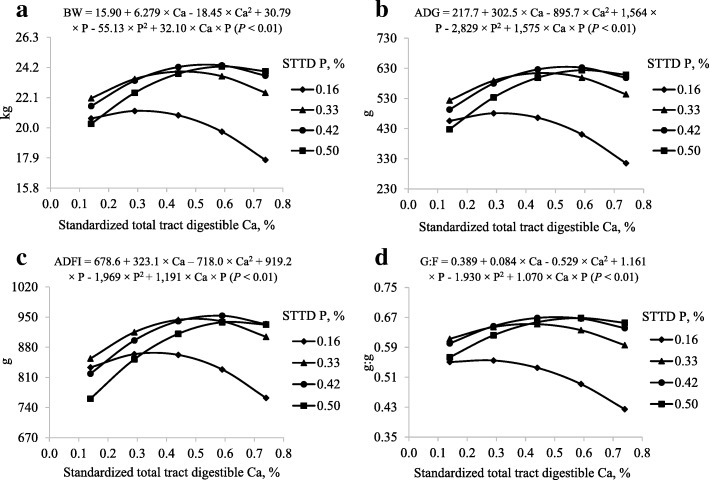
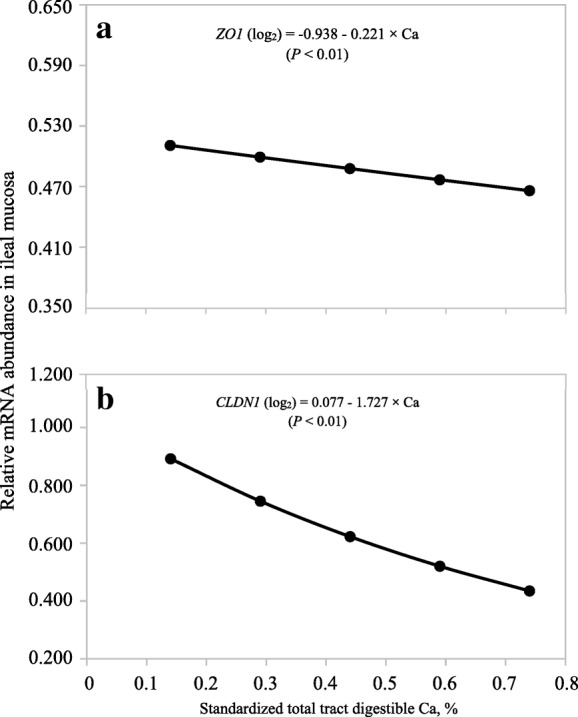
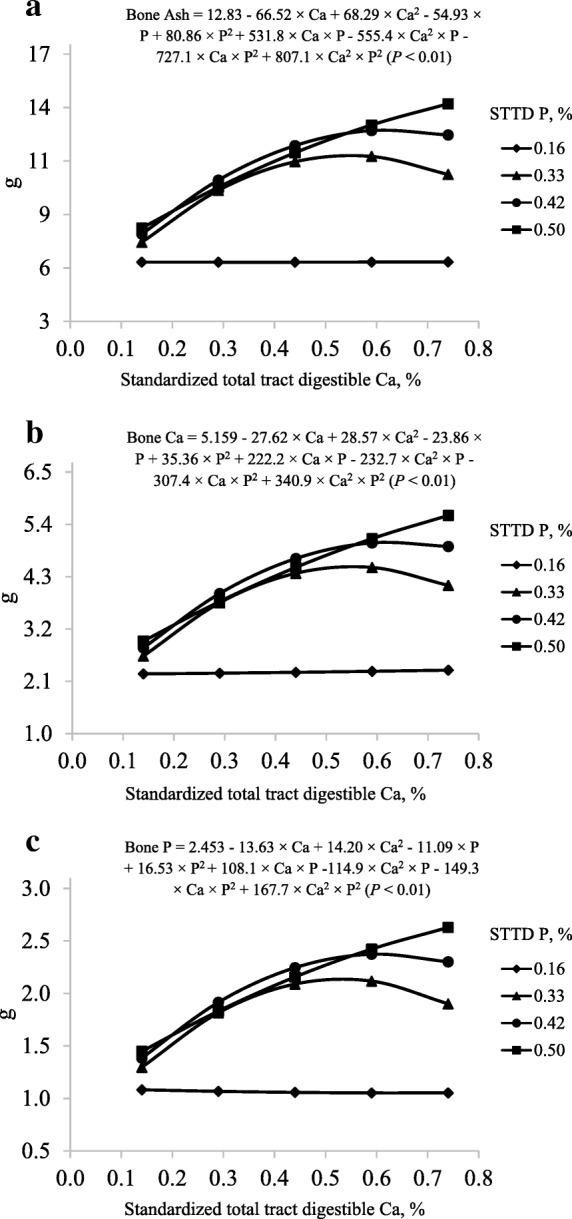
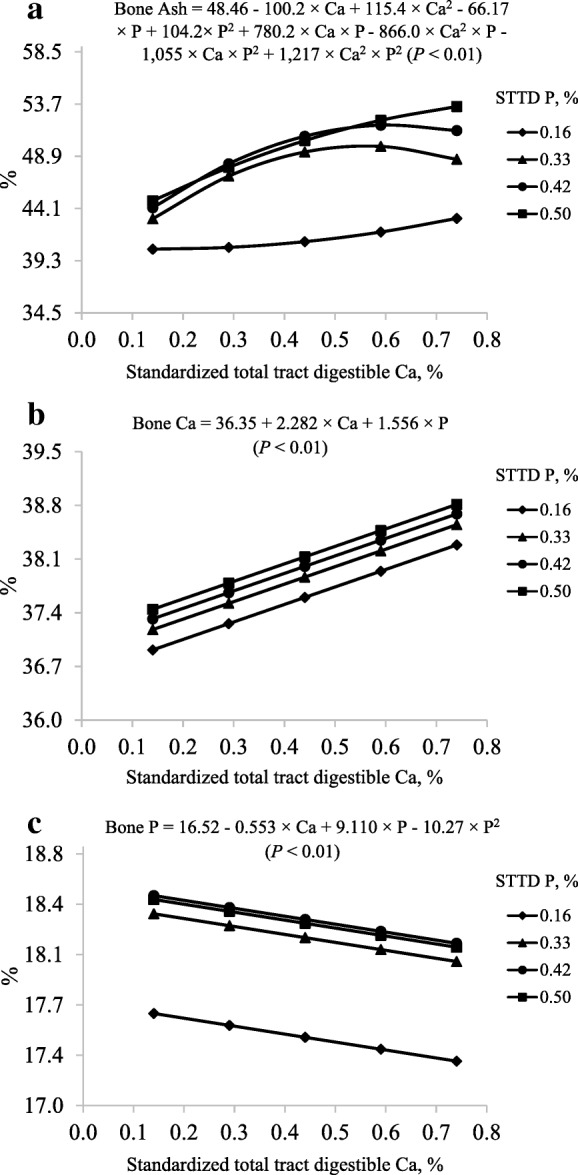
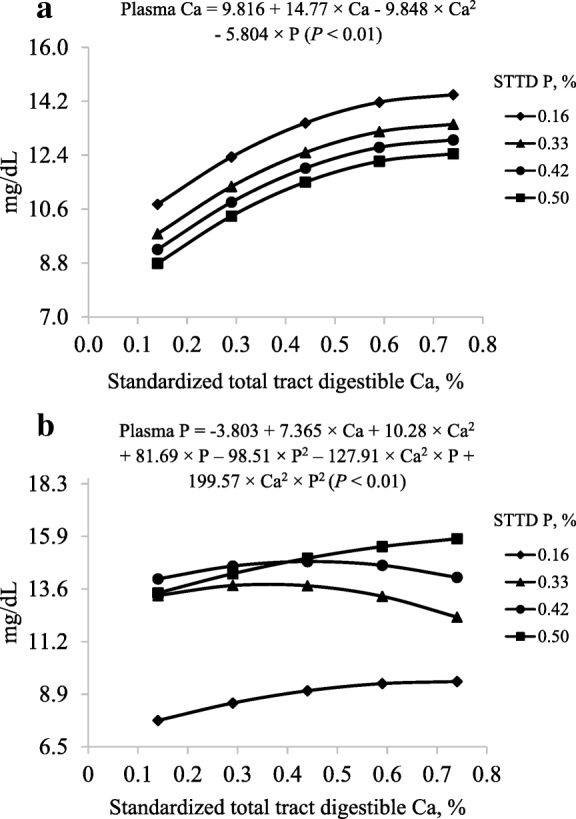
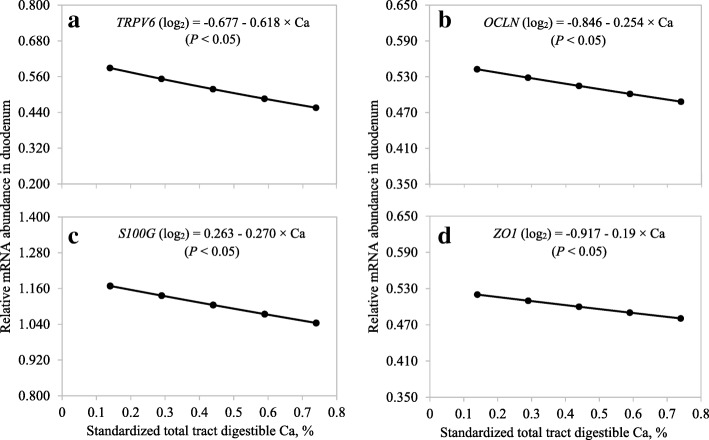
The predicted maximum ADG (614 g), G:F (0.65), and bone ash (11.68 g) was obtained at STTD Ca:STTD P ratios of 1.39:1, 1.25:1, and 1.66:1, respectively, when STTD P was provided at the requirement (0.33%). If dietary STTD P was below the requirement, increasing dietary Ca resulted in reduced ( < 0.05) ADG and G:F. However, if dietary STTD P was above the requirement, negative effects ( < 0.05) on ADG and G:F of increasing STTD Ca were observed only if dietary STTD Ca exceeded 0.6%. Plasma Ca concentration was positively affected by STTD Ca over the range studied (quadratic, < 0.01) and negatively affected by increasing STTD P (linear, < 0.01). There was a linear negative effect ( < 0.05) of STTD Ca on the abundance of , , , and in duodenum, and and in ileum.
The STTD Ca:STTD P ratio needed to maximize growth performance of 11- to 25-kg pigs is less than 1.40:1, if P is at the estimated requirement. Increasing dietary Ca reduces transcellular absorption of Ca and increases paracellular absorption of Ca.
进行了一项为期21天的试验,以验证以下假设:以标准化全肠道可消化(STTD)钙与STTD磷的比例表示,使生长性能最大化的钙需求量小于1.40:1。第二个假设是,增加日粮钙会提高血浆钙浓度,并下调十二指肠中与钙吸收相关基因(、和)以及十二指肠和回肠中紧密连接蛋白(、和)的丰度。
采用4×5析因设计配制20种玉米-豆粕型日粮,日粮中STTD磷含量分别为0.16%、0.33%、0.42%或0.50%,STTD钙含量分别为0.14%、0.29%、0.44%、0.59%或0.74%。640头猪(初始体重:11.1±1.4 kg)按照随机完全区组设计分配到20种日粮和5个区组中。在第21天,记录猪的体重和料槽中剩余的饲料量,并从每栏中选取1头猪采集血液、十二指肠组织、回肠黏膜和右侧股骨。通过定量RT-PCR测定十二指肠和回肠组织中mRNA的丰度。数据采用响应面模型进行分析。
当按照需求量(0.33%)提供STTD磷时,预测的最大日增重(614 g)、料重比(0.65)和骨灰含量(11.68 g)分别在STTD钙与STTD磷比例为1.39:1、1.25:1和1.66:1时获得。如果日粮STTD磷低于需求量,增加日粮钙会导致日增重和料重比降低(<0.05)。然而,如果日粮STTD磷高于需求量,仅当日粮STTD钙超过0.6%时,才会观察到增加STTD钙对日增重和料重比产生负面影响(<0.05)。在所研究的范围内,血浆钙浓度受到STTD钙的正向影响(二次效应,<0.01),并受到STTD磷增加的负向影响(线性效应,<0.01)。STTD钙对十二指肠中、、、以及回肠中和的丰度有线性负向影响(<0.05)。
如果磷含量为估计需求量,使11至25千克猪生长性能最大化所需的STTD钙与STTD磷比例小于1.40:1。增加日粮钙会减少钙的跨细胞吸收,并增加钙的细胞旁吸收。