Dubal Deepak P, Abdel-Azeim Safwat, Chodankar Nilesh R, Han Young-Kyu
School of Chemistry, Physics and Mechanical Engineering, Queensland University of Technology (QUT), 2 George Street, Brisbane, QLD 4001, Australia.
Center of Integrative Petroleum Research (CIPR), College of Petroleum Engineering and Geosciences, King Fahd University of Petroleum and Minerals (KFUPM), Dhahran 31261, Saudi Arabia.
iScience. 2019 Jun 28;16:50-62. doi: 10.1016/j.isci.2019.05.018. Epub 2019 May 16.
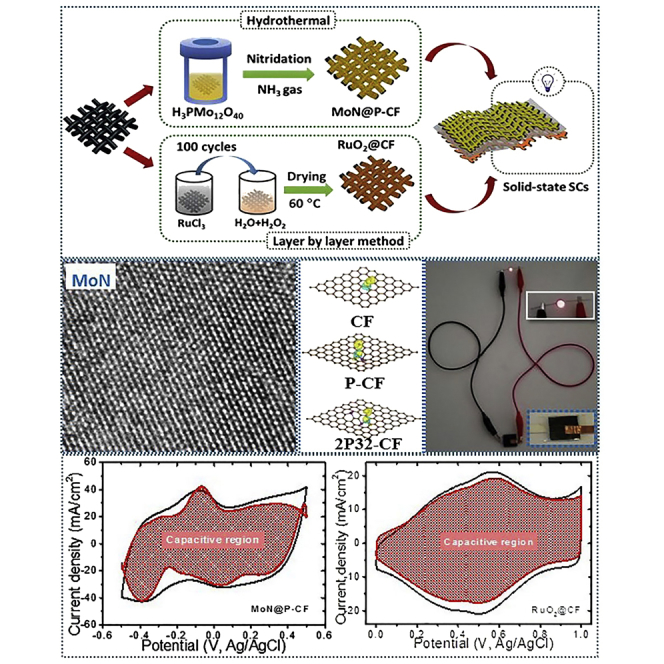
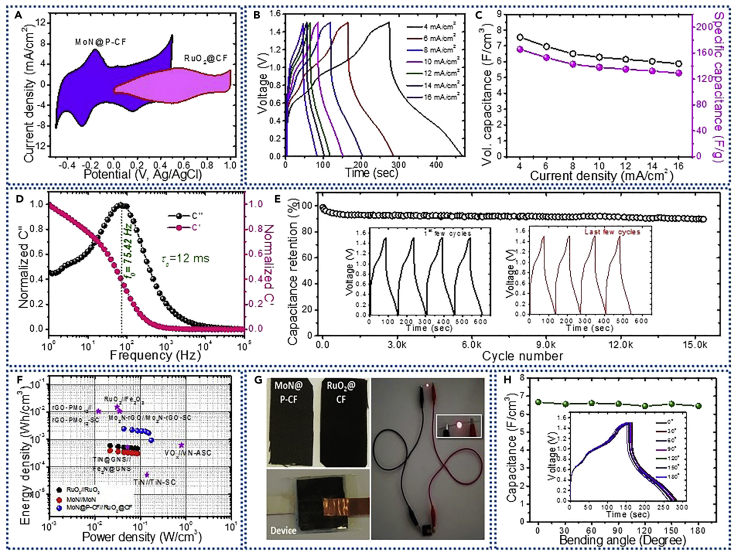
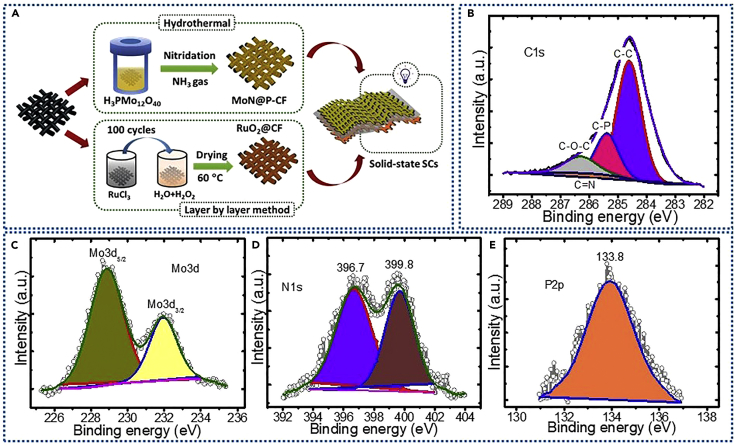
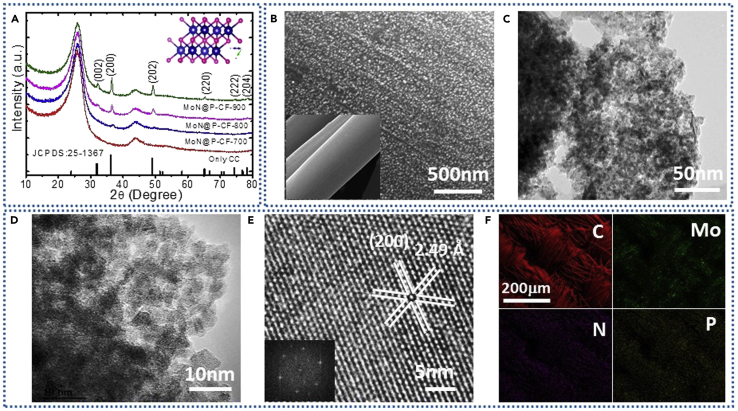
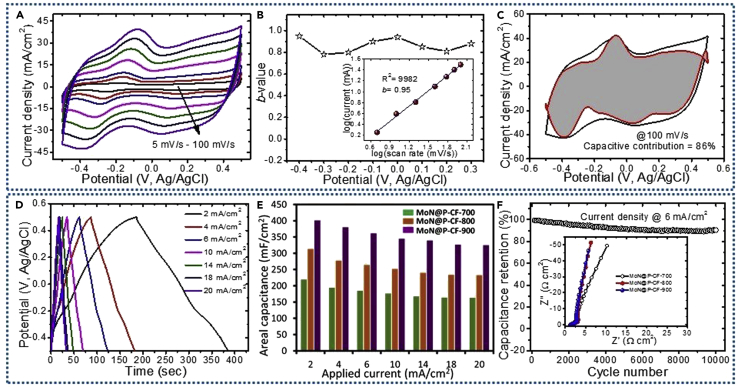
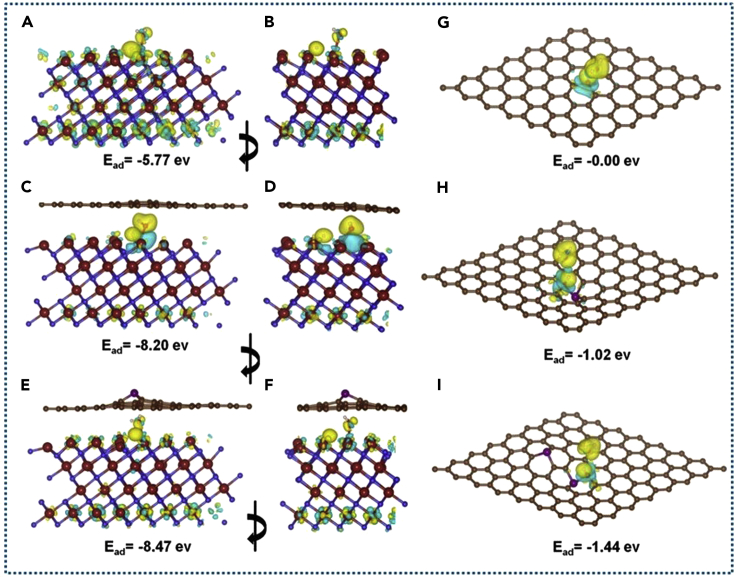
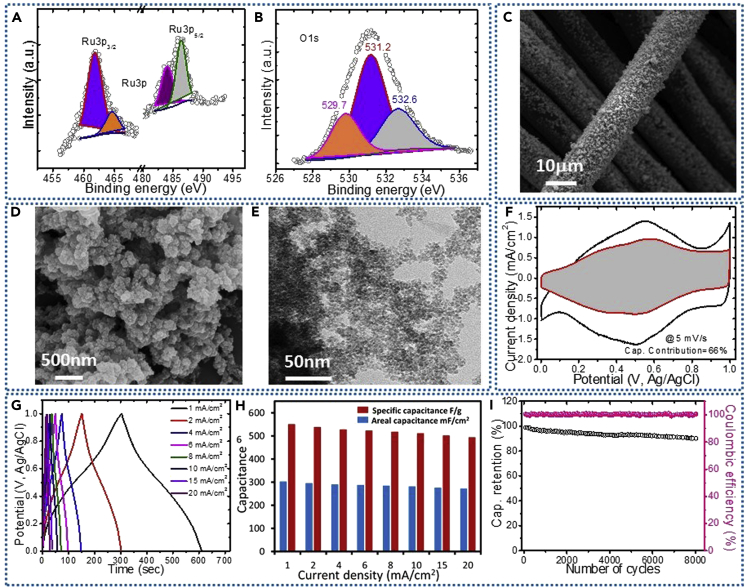
Pseudocapacitors hold great promise to provide high energy-storing capacity; however, their capacitances are still far below their theoretical values and they deliver much lower power than the traditional electric double-layer capacitors due to poor ionic accessibility. Here, we have engineered MoN nanoparticles as pseudocapacitive material on phosphorus-incorporated carbon fabric with enhanced ionic affinity and thermodynamic stability. This nanocomposite boosts surface redox kinetics, leading to pseudocapacitance of 400 mF/cm (2-fold higher than that of molybdenum nitride-based electrodes) with rapid charge-discharge rates. Density functional theory simulations are used to explain the origin of the good performance of MoN@P-CF in proton-based aqueous electrolytes. Finally, an all-pseudocapacitive solid-state asymmetric cell was assembled using MoN@P-CF and RuO (RuO@CF) as negative and positive electrodes, respectively, which delivered good energy density with low relaxation time constant (τ) of 13 ms (significantly lower than that of carbon-based supercapacitors).
赝电容器在提供高储能容量方面极具潜力;然而,由于离子可达性差,它们的电容仍远低于其理论值,且其功率输出比传统的双电层电容器低得多。在此,我们设计了在掺磷碳织物上的氮化钼纳米颗粒作为赝电容材料,具有增强的离子亲和力和热力学稳定性。这种纳米复合材料促进了表面氧化还原动力学,实现了400 mF/cm的赝电容(比基于氮化钼的电极高出2倍),且充放电速率很快。采用密度泛函理论模拟来解释氮化钼@磷-碳织物在质子基水性电解质中良好性能的起源。最后,组装了一个全赝电容固态非对称电池,分别使用氮化钼@磷-碳织物和RuO(RuO@CF)作为负极和正极,该电池具有良好的能量密度,低弛豫时间常数(τ)为13毫秒(显著低于基于碳的超级电容器)。