Primary Care Centre Versus Arthritis, Research Institute for Primary Care & Health Sciences, Keele University, Staffordshire, ST5 5BG, UK.
Lee Kong Chian School of Medicine, Nanyang Technological University, 50 Nanyang Ave, Singapore, 63979, Singapore.
BMC Musculoskelet Disord. 2019 Jun 1;20(1):271. doi: 10.1186/s12891-019-2587-z.
Musculoskeletal (MSK) pain represents a considerable worldwide healthcare burden. This study aimed to gain consensus from practitioners who work with MSK pain patients, on the most appropriate primary care treatment options for subgroups of patients based on prognostic risk of persistent disabling pain. Agreement was sought on treatment options for the five most common MSK pain presentations: back, neck, knee, shoulder and multisite pain, across three risk subgroups: low, medium and high.
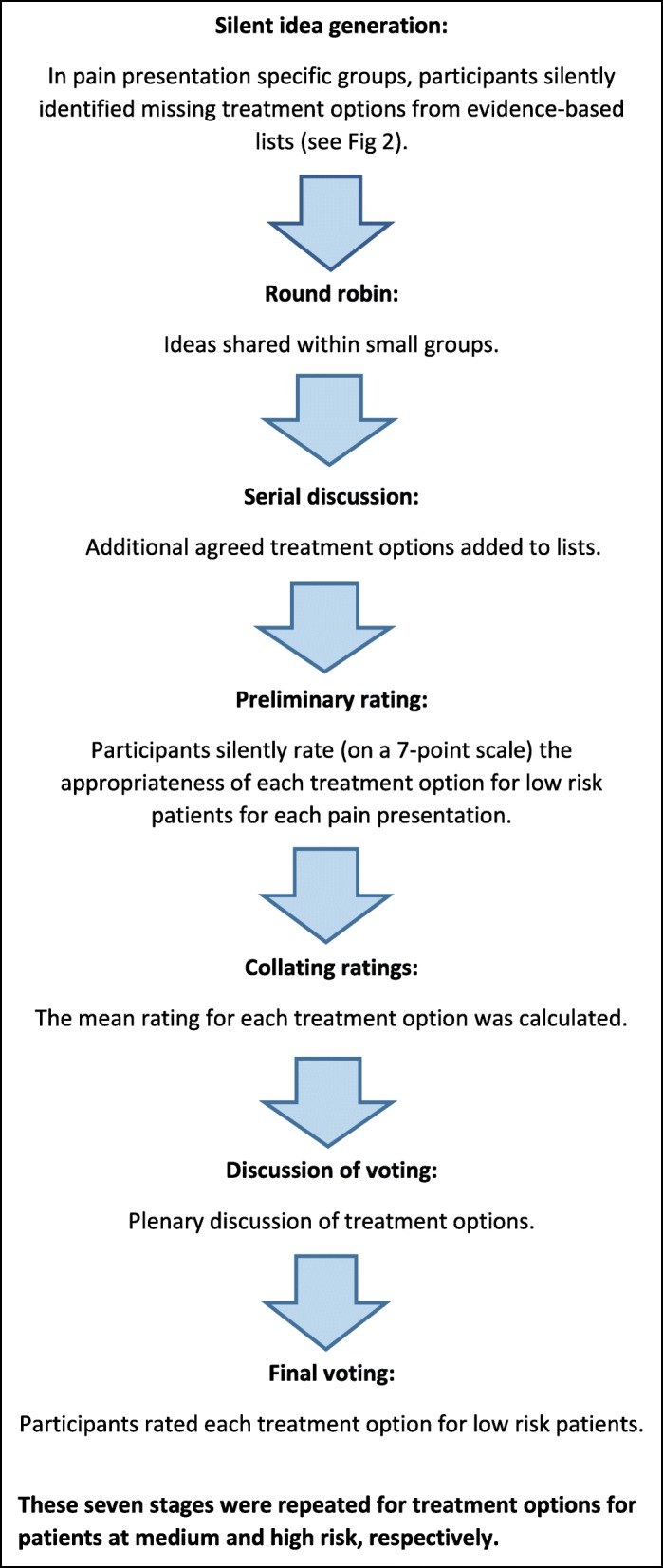
Three consensus group meetings were conducted with multi-disciplinary groups of practitioners (n = 20) using Nominal Group Technique, a systematic approach to building consensus using structured in-person meetings of stakeholders which follows a distinct set of stages.
For all five pain presentations, "education and advice" and "simple oral and topical pain medications" were agreed to be appropriate for all subgroups. For patients at low risk, across all five pain presentations "review by primary care practitioner if not improving after 6 weeks" also reached consensus. Treatment options for those at medium risk differed slightly across pain-presentations, but all included: "consider referral to physiotherapy" and "consider referral to MSK-interface-clinic". Treatment options for patients at high risk also varied by pain presentation. Some of the same options were included as for patients at medium risk, and additional options included: "opioids"; "consider referral to expert patient programme" (across all pain presentations); and "consider referral for surgical opinion" (back, knee, neck, shoulder). "Consider referral to rheumatology" was agreed for patients at medium and high risk who have multisite pain.
In addressing the current lack of robust evidence on the effectiveness of different treatment options for MSK pain, this study generated consensus from practitioners on the most appropriate primary care treatment options for MSK patients stratified according to prognostic risk. These findings can help inform future clinical decision-making and also influenced the matched treatment options in a trial of stratified primary care for MSK pain patients.
肌肉骨骼(MSK)疼痛是全球范围内相当大的医疗保健负担。本研究旨在从治疗 MSK 疼痛患者的从业者中获得共识,根据持续致残性疼痛的预后风险,确定最适合患者亚组的初级保健治疗选择。在三个风险亚组(低、中、高)中,针对最常见的五种 MSK 疼痛表现:背部、颈部、膝盖、肩部和多部位疼痛,寻求对治疗选择的共识。
使用名义群体技术(Nominal Group Technique)进行了三次共识小组会议,这是一种使用利益相关者的结构化面对面会议来建立共识的系统方法,遵循一系列明确的阶段。
对于所有五种疼痛表现,“教育和建议”和“简单的口服和局部止痛药”被认为适用于所有亚组。对于所有五种疼痛表现,低风险患者“如果在 6 周后没有改善,由初级保健医生进行复查”也达成了共识。中风险患者的治疗选择略有不同,但均包括:“考虑转介给物理治疗师”和“考虑转介给肌肉骨骼界面诊所”。高风险患者的治疗选择也因疼痛表现而异。一些与中风险患者相同的选择被包括在内,此外还包括:“阿片类药物”;“考虑转介给专家患者计划”(所有疼痛表现);和“考虑转介给手术意见”(背部、膝盖、颈部、肩部)。对于中高风险有多部位疼痛的患者,“考虑转介给风湿病科”被认为是合适的。
在解决当前缺乏关于不同 MSK 疼痛治疗选择有效性的强有力证据的问题时,本研究从从业者那里获得了共识,确定了根据预后风险分层的 MSK 患者最适合的初级保健治疗选择。这些发现可以帮助为未来的临床决策提供信息,也影响了针对 MSK 疼痛患者分层初级保健的试验中的匹配治疗选择。