Barrio-Cortes Jaime, Del Cura-González Isabel, Martínez-Martín Miguel, López-Rodríguez Carmen, Jaime-Sisó María Ángeles, Suárez-Fernández Carmen
Programa de Doctorado en Medicina y Cirugía, Universidad Autónoma de Madrid, Madrid, España; Unidad de Apoyo a la Investigación, Gerencia Asistencial de Atención Primaria, Madrid, España.
Unidad de Apoyo a la Investigación, Gerencia Asistencial de Atención Primaria, Madrid, España; Red de Investigación en servicios sanitarios en enfermedades crónicas (REDISSEC), Madrid, España; Área Medicina Preventiva y Salud Pública, Facultad de Ciencias de la Salud, Universidad Rey Juan Carlos, Madrid, España.
Aten Primaria. 2020 Feb;52(2):86-95. doi: 10.1016/j.aprim.2018.12.007. Epub 2019 May 29.
To describe the characteristics of patients with chronic conditions according to their risk levels assigned by the adjusted morbidity groups (AMG). To analyse the factors associated with a high risk level and to study their effect.
Observational cross-sectional study with an analytical focus.
Primary care (PC), Madrid Health Service.
Population of 18,107 patients stratified by their risk levels with the AMG in the computerised clinical records of Madrid PC.
The variables studied were: socio-demographic, clinical-nursing care and use of services. Univariate, bivariate, and multivariate analysis were performed.
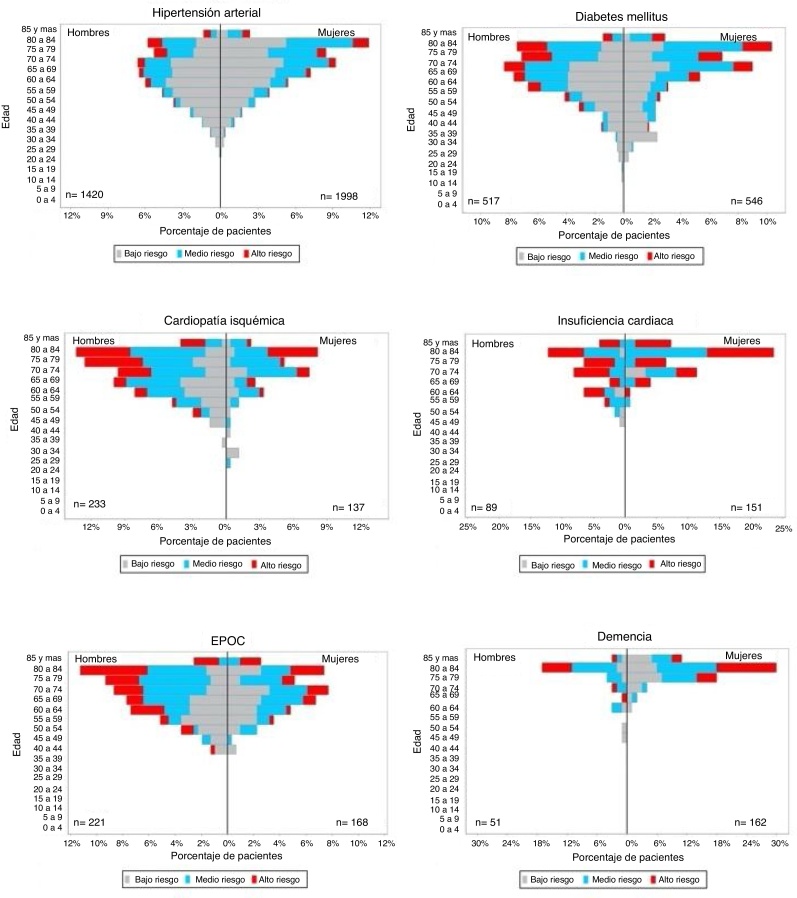
Of the 18,107 patients, 9,866(54.4%) were identified as chronic patients, with 444 (4.5%) stratified as high risk, 1784 (18,1%) as medium risk, and 7,638 (77.4%) as low risk. The high risk patients, compared with medium and low risk, had an older mean age [77.8 (SD=12.9), 72.1 (SD=12.9), 50.6 (SD=19.4)], lower percentage of women (52.3%, 65%, 61.1%), a higher number of chronic diseases [6.7 (SD=2.4), 4.3 (SD=1.5), 1.9 (SD=1.1)], polymedication (79.1%, 43.3%, 6.2%), and contact with PC [33.9 (28), 21.4 (17.3), 7.9 (9.9)] (P<.01). In the multivariate analysis, the high risk level was independently related to age>65 [1.43 (1.03-1.99), male gender (OR=3.46, 95% CI=2.64-4.52), immobility (OR=6.33, 95% CI=4.40-9.11), number of chronic conditions (OR=2.60, 95% CI=2.41-2.81), and PC contact>7 times (OR=1.95, 95% CI=1.36-2.80)] (P<.01).
More than half of the population is classified by the AMG as a chronic, and it is stratified into 3 risk levels that show differences in gender, age, functional impairment, need for care, morbidity, complexity, and use of Primary Care services. Age>65, male gender, immobility, number of chronic conditions, and contact with PC>7 times were the factors associated with high risk.
根据调整后的发病组(AMG)分配的风险水平描述慢性病患者的特征。分析与高风险水平相关的因素并研究其影响。
以分析为重点的观察性横断面研究。
马德里卫生服务中心的初级保健(PC)部门。
马德里初级保健计算机化临床记录中按AMG风险水平分层的18107名患者。
研究的变量包括:社会人口统计学、临床护理和服务使用情况。进行了单变量、双变量和多变量分析。
在18107名患者中,9866名(54.4%)被确定为慢性病患者,其中444名(4.5%)被分层为高风险,1784名(18.1%)为中等风险,7638名(77.4%)为低风险。与中等和低风险患者相比,高风险患者的平均年龄更大[77.8(标准差=12.9)、72.1(标准差=12.9)、50.6(标准差=19.4)],女性比例更低(52.3%、65%、61.1%),慢性病数量更多[6.7(标准差=2.4)、4.3(标准差=1.5)、1.9(标准差=1.1)],多重用药情况更严重(79.1%、43.3%、6.2%),与初级保健的接触更频繁[33.9(28)、21.4(17.3)、7.9(9.9)](P<0.01)。在多变量分析中,高风险水平与年龄>65岁[1.43(1.03 - 1.99)]、男性性别(比值比=3.46,95%置信区间=2.64 - 4.52)、行动不便(比值比=6.33,95%置信区间=4.40 - 9.11)、慢性病数量(比值比=2.60,95%置信区间=2.41 - 2.81)以及与初级保健接触>7次(比值比=1.95,95%置信区间=1.36 - 2.80)独立相关(P<0.01)。
超过一半的人群被AMG分类为慢性病患者,并被分层为3个风险水平,这些水平在性别、年龄、功能障碍、护理需求、发病率、复杂性以及初级保健服务使用方面存在差异。年龄>65岁、男性性别、行动不便、慢性病数量以及与初级保健接触>7次是与高风险相关的因素。