Department of Cardiology and Endocrinology, Slagelse Hospital, Slagelse, Denmark.
Institute for Regional Health Research, University of Southern Denmark, Odense, Denmark.
Diabetologia. 2019 Sep;62(9):1575-1580. doi: 10.1007/s00125-019-4920-3. Epub 2019 Jun 1.
AIMS/HYPOTHESIS: Epidemiological studies have shown that diabetes is a well-established independent but modifiable risk factor for stroke. The aim of this post hoc analysis of data from the Steno-2 Study was to examine whether multiple risk factor intervention reduced the risk for stroke in individuals with type 2 diabetes and microalbuminuria.
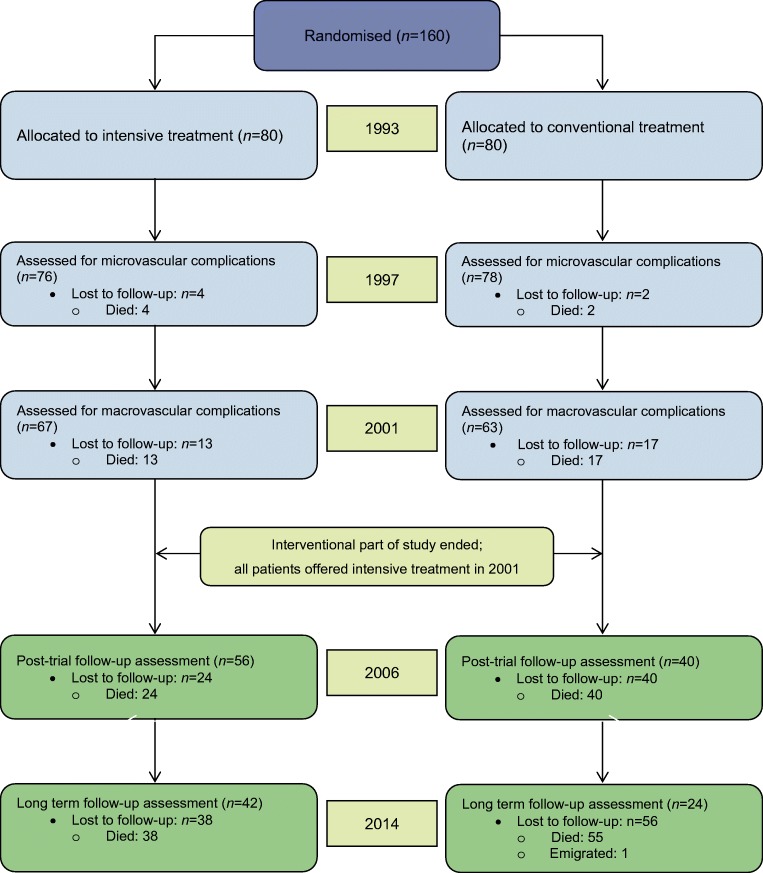
In the Steno-2 Study, 160 individuals with type 2 diabetes and microalbuminuria were randomised to intensified or conventional multiple risk factor intervention, targeting classical cardiovascular disease risk factors for a mean of 7.8 years, and then followed for a total mean of 21.2 years. The primary endpoint in this post hoc analysis was time to first stroke event.
During follow-up, 30 participants experienced a total of 39 strokes. Individuals randomised to conventional therapy were more likely to experience a stroke than those in the intensive-therapy group, with 29 total strokes occurring in 21 participants (26%) in the conventional-therapy group vs a total of ten strokes in nine participants (11%) in the intensive-therapy group (HR 0.31 [95% CI 0.14, 0.69]; p = 0.004). Also, the number of recurrent strokes was significantly reduced with intensive therapy.
CONCLUSIONS/INTERPRETATION: Intensified multiple risk factor intervention in patients with type 2 diabetes and microalbuminuria reduces the risk for strokes as well as the number of recurrent cerebrovascular events.
ClinicalTrials.gov NCT00320008.
目的/假设:流行病学研究表明,糖尿病是中风的一个既定的独立但可改变的危险因素。本研究对 Steno-2 研究的数据进行了事后分析,旨在探讨多重危险因素干预是否降低了伴有微量白蛋白尿的 2 型糖尿病患者发生中风的风险。
在 Steno-2 研究中,160 例伴有微量白蛋白尿的 2 型糖尿病患者被随机分为强化或常规多重危险因素干预组,对经典心血管疾病危险因素进行为期平均 7.8 年的靶向治疗,然后总共随访平均 21.2 年。本事后分析的主要终点是首次中风事件的时间。
在随访期间,30 名参与者共发生 39 例中风。与强化治疗组相比,常规治疗组发生中风的可能性更高,常规治疗组 21 名参与者中有 29 例(26%)共发生 29 例中风,强化治疗组 9 名参与者中有 10 例(11%)共发生 10 例中风(HR 0.31 [95% CI 0.14, 0.69];p=0.004)。此外,强化治疗组的复发性中风数量明显减少。
结论/解释:强化多重危险因素干预可降低伴有微量白蛋白尿的 2 型糖尿病患者发生中风和复发性脑血管事件的风险。
ClinicalTrials.gov NCT00320008。