Department of Internal Medicine, Chonnam National University Medical School, Gwangju, Republic of Korea.
Lung and Esophageal Cancer Clinic, Chonnam National University Hwasun Hospital, 322 Seoyang-ro, Hwasun, Jeonnam, 58128, Republic of Korea.
J Cancer Res Clin Oncol. 2019 Aug;145(8):2071-2082. doi: 10.1007/s00432-019-02944-w. Epub 2019 Jun 1.
Fluorescence in situ hybridization (FISH) using tumor tissue is the gold standard for detection of anaplastic lymphoma kinase (ALK) rearrangement in non-small cell lung cancer (NSCLC). However, this method often is not repeatable due to difficulties in the acquisition of tumor tissues. Blood-based liquid biopsy using reverse transcription polymerase chain reaction (RT-PCR) is expected to be useful to overcome this limitation. Here, we investigated the feasibility of liquid biopsy using plasma and platelets for detection of ALK rearrangement and prediction of ALK inhibitor treatment outcomes.
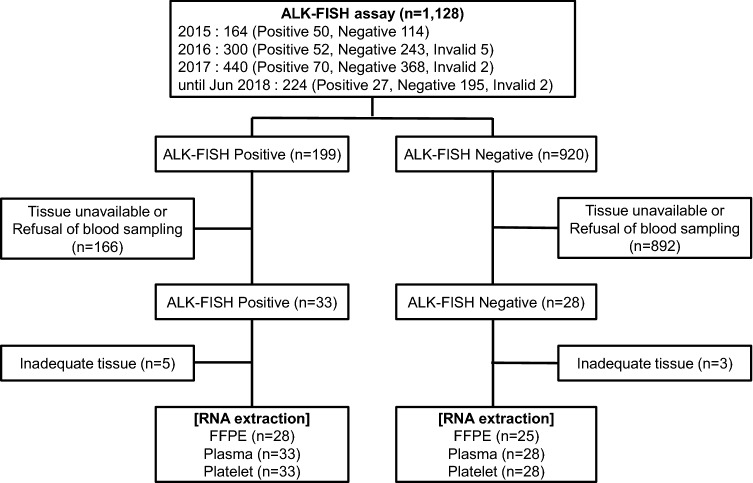
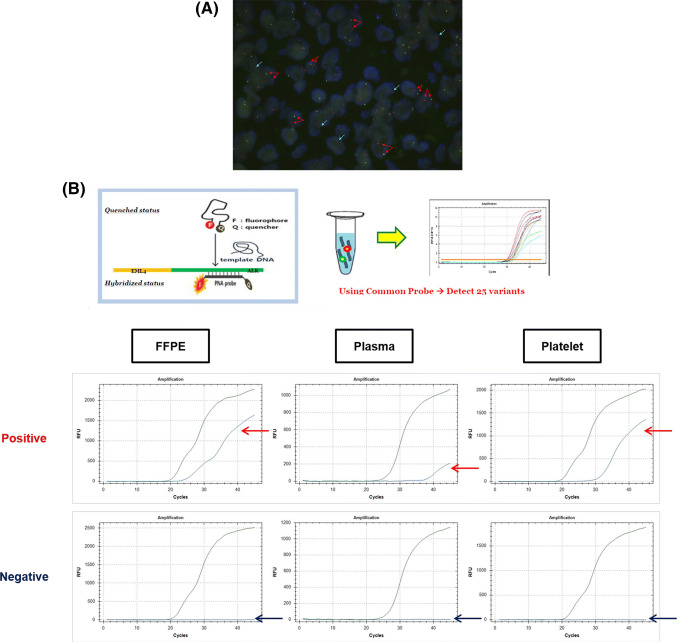
ALK-FISH assays were performed in 1128 tumor specimens of NSCLC between January 2015 and June 2018. We retrospectively analyzed formalin-fixed paraffin-embedded (FFPE) tissues from previously confirmed FISH-positive (n = 199) and -negative (n = 920) cases. We recruited patients who had available tissue specimens and agreed to venous sampling. RNA was extracted from FFPE blocks, plasma, and platelets. Fusion RNA of echinoderm microtubule-associated protein-like 4 (EML4)-ALK was detected by quantitative PCR.
Thirty-three FISH-positive and 28 FISH-negative patients were enrolled. In validation, data compared with FISH, RT-PCR using FFPE tissues showed 54.5% sensitivity, 78.6% specificity, and 75.5% accuracy. Liquid biopsy had higher sensitivity (78.8%), specificity (89.3%) and accuracy (83.6%). Higher positivity for liquid biopsy was shown in subgroups with delayed (≥ 6 months from diagnosis) blood sampling (plasma, 85.7%; platelets, 87.0%). In 26 patients treated with crizotinib, the platelet-positive subgroup showed longer median duration of treatment (7.2 versus 1.5 months), longer median progression-free survival (5.7 months versus 1.7 months), a higher overall response rate (70.6% versus 11.1%), and a higher disease control rate (88.2% versus 44.4%) than the platelet-negative subgroup.
Liquid biopsy could have applications in the diagnosis of ALK-positive NSCLC, even when using RT-PCR, and platelets can be useful for predicting treatment outcomes of ALK inhibitors.
荧光原位杂交(FISH)检测肿瘤组织是检测非小细胞肺癌(NSCLC)中间变性淋巴瘤激酶(ALK)重排的金标准。然而,由于获取肿瘤组织的困难,这种方法往往不可重复。使用逆转录聚合酶链反应(RT-PCR)的基于血液的液体活检有望克服这一限制。在这里,我们研究了使用血浆和血小板进行液体活检检测 ALK 重排和预测 ALK 抑制剂治疗结果的可行性。
2015 年 1 月至 2018 年 6 月,对 1128 例 NSCLC 肿瘤标本进行 ALK-FISH 检测。我们回顾性分析了先前通过 FISH 检测为阳性(n=199)和阴性(n=920)的福尔马林固定石蜡包埋(FFPE)组织。我们招募了有可用组织标本且同意静脉取样的患者。从 FFPE 块、血浆和血小板中提取 RNA。通过定量 PCR 检测棘皮动物微管相关蛋白样 4(EML4)-ALK 的融合 RNA。
33 例 FISH 阳性和 28 例 FISH 阴性患者入选。在验证中,与 FISH 相比,FFPE 组织的 RT-PCR 检测显示出 54.5%的灵敏度、78.6%的特异性和 75.5%的准确性。液体活检的灵敏度(78.8%)、特异性(89.3%)和准确性(83.6%)更高。液体活检的阳性率在延迟(诊断后≥6 个月)采血的亚组中更高(血浆,85.7%;血小板,87.0%)。在 26 例接受克唑替尼治疗的患者中,血小板阳性亚组的中位治疗持续时间(7.2 个月 vs 1.5 个月)、中位无进展生存期(5.7 个月 vs 1.7 个月)更长,总缓解率(70.6% vs 11.1%)更高,疾病控制率(88.2% vs 44.4%)更高。
液体活检可应用于 ALK 阳性 NSCLC 的诊断,即使使用 RT-PCR,血小板也可用于预测 ALK 抑制剂的治疗效果。