Deere Kevin, Whitehouse Michael R, Kunutsor Setor K, Sayers Adrian, Mason James, Blom Ashley W
Musculoskeletal Research Unit, Translational Health Sciences, Bristol Medical School, Southmead Hospital, Bristol, UK.
National Institute for Health Research Bristol Biomedical Research Centre, University Hospitals Bristol and Weston NHS Foundation Trust and University of Bristol, Bristol, UK.
Lancet Rheumatol. 2022 Jun 23;4(7):e468-e479. doi: 10.1016/S2665-9913(22)00097-2. eCollection 2022 Jul.
Hip replacements are common and effective operations but patients that undergo this intervention are at risk of the replacements failing, requiring costly and often complex revision surgery with poorer outcomes than primary surgery. There is paucity of reliable data examining the treatment pathway for hip replacements over the life of the patient in terms of risk of revision and re-revisions. We aim to provide detailed information on the longevity of hip revision surgery.
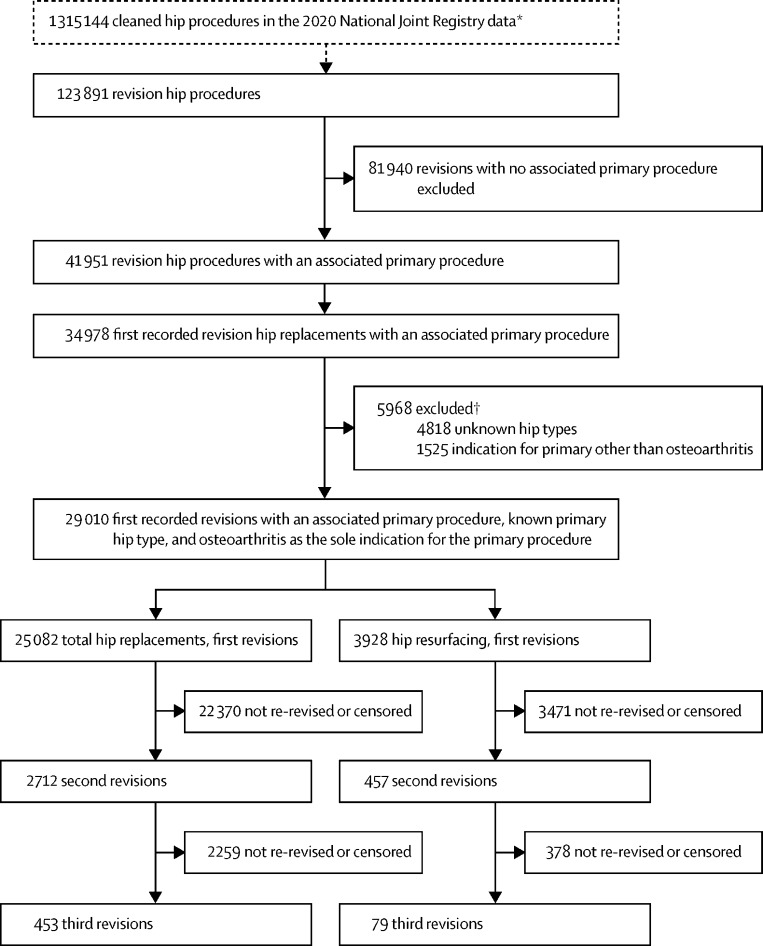
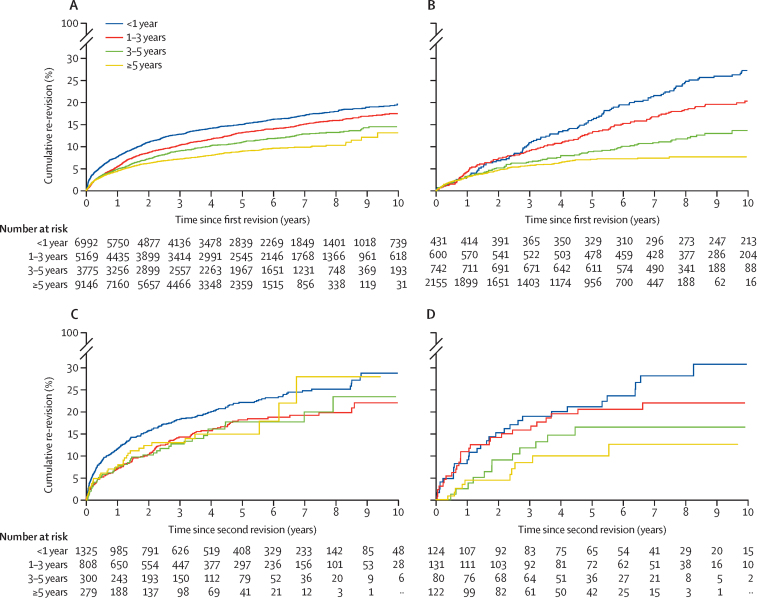
We did a retrospective observational registry-based study of the National Joint Registry, using data on hip replacements from all participating hospitals in England and Wales, UK. We included data on all first revisions, with an identifiable primary procedure, with osteoarthritis as the sole indication for the original primary procedure. Kaplan-Meier estimates were used to determine the cumulative probability of revision and subsequent re-revision after primary hip replacement. Analyses were stratified by age and gender, and the influence of time from first to second revision on the risk of further revision was explored.
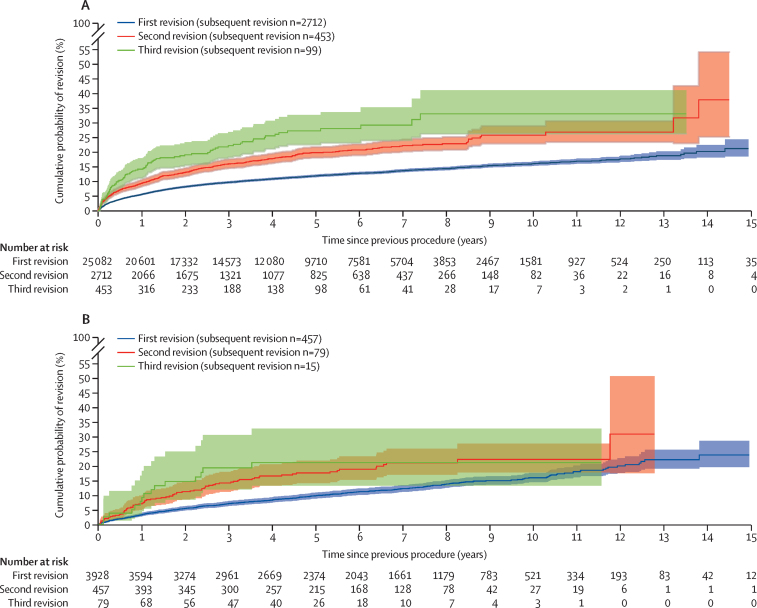
Between April 1, 2003, and Dec 31, 2019, there were 29 010 revision hip replacements with a linked primary episode. Revision rates of revision hip replacements were higher in patients younger than 55 years than in older age groups. After revision of primary total hip replacement, 21·3% (95% CI 18·6-24·4) of first revisions were revised again within 15 years, 22·3% (20·3-24·4) of second revisions were revised again within 7 years, and 22·3% (18·3-27·0) of third revisions were revised again within 3 years. After revision of hip resurfacing, 23·7% (95% CI 19·6-28·5) of these revisions were revised again within 15 years, 21·0% (17·0-25·8) of second revisions were revised again within 7 years, and 19·3% (11·9-30·4) of third revisions were revised again within 3 years. A shorter time between revision episodes was associated with earlier subsequent revision.
Younger patients are at an increased risk of multiple revisions. Patients who undergo a revision have a steadily increasing risk of further revision the more procedures they undergo, and each subsequent revision lasts for approximately half the time of the previous one. Although hip replacements are effective for improving pain and function and usually last a remarkably long time, if they are revised, successive revisions are progressively and markedly less successful.
NIHR Biomedical Research Centre at the University Hospitals Bristol and Weston NHS Foundation Trust and the University of Bristol, Healthcare Quality Improvement Partnership; and the National Joint Registry.
髋关节置换术是常见且有效的手术,但接受该手术的患者面临置换失败的风险,这需要进行代价高昂且往往复杂的翻修手术,其结果比初次手术更差。在患者的整个生命过程中,关于髋关节置换术翻修风险的治疗路径,可靠数据较少。我们旨在提供有关髋关节翻修手术长期效果的详细信息。
我们对国家关节注册中心进行了一项基于注册登记的回顾性观察研究,使用了英国英格兰和威尔士所有参与医院的髋关节置换数据。我们纳入了所有首次翻修的数据,这些翻修具有可识别的初次手术,且骨关节炎是初次手术的唯一指征。采用Kaplan-Meier估计法来确定初次髋关节置换术后翻修及后续再次翻修的累积概率。分析按年龄和性别分层,并探讨从首次翻修到第二次翻修的时间对进一步翻修风险的影响。
在2003年4月1日至2019年12月31日期间,有29010例与初次手术相关的髋关节翻修置换。年龄小于55岁的患者髋关节翻修置换的翻修率高于老年组。初次全髋关节置换翻修后,21.3%(95%置信区间18.6 - 24.4)的首次翻修在15年内再次翻修,22.3%(20.3 - 24.4)的第二次翻修在7年内再次翻修,22.3%(18.3 - 27.0)的第三次翻修在3年内再次翻修。髋关节表面置换翻修后,23.7%(95%置信区间19.6 - 28.5)的这些翻修在15年内再次翻修,21.0%(17.0 - 25.8)的第二次翻修在7年内再次翻修,19.3%(11.9 - 30.4)的第三次翻修在3年内再次翻修。翻修事件之间的时间越短,随后更早翻修的可能性越大。
年轻患者多次翻修的风险增加。接受翻修手术的患者,手术次数越多,进一步翻修的风险稳步上升,且每次后续翻修的持续时间约为前一次的一半。尽管髋关节置换术在改善疼痛和功能方面有效,且通常能维持很长时间,但如果进行翻修,后续连续翻修的成功率会逐渐且显著降低。
布里斯托尔大学医院和韦斯顿国民保健服务基金会信托基金以及布里斯托尔大学的NIHR生物医学研究中心、医疗质量改进伙伴关系;以及国家关节注册中心。