
不同形态简化方案下浦肯野细胞的编码能力
Coding Capacity of Purkinje Cells With Different Schemes of Morphological Reduction.
作者信息
An Lingling, Tang Yuanhong, Wang Quan, Pei Qingqi, Wei Ran, Duan Huiyuan, Liu Jian K
机构信息
School of Computer Science and Technology, Xidian University, Xi'an, China.
Department of Neuroscience, Psychology and Behaviour, Centre for Systems Neuroscience, University of Leicester, Leicester, United Kingdom.
出版信息
Front Comput Neurosci. 2019 May 15;13:29. doi: 10.3389/fncom.2019.00029. eCollection 2019.
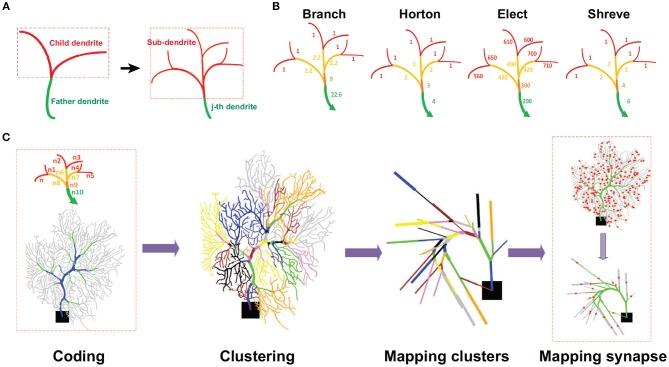
The brain as a neuronal system has very complex structures with a large diversity of neuronal types. The most basic complexity is seen from the structure of neuronal morphology, which usually has a complex tree-like structure with dendritic spines distributed in branches. To simulate a large-scale network with spiking neurons, the simple point neuron, such as the integrate-and-fire neuron, is often used. However, recent experimental evidence suggests that the computational ability of a single neuron is largely enhanced by its morphological structure, in particular, by various types of dendritic dynamics. As the morphology reduction of detailed biophysical models is a classic question in systems neuroscience, much effort has been taken to simulate a neuron with a few compartments to include the interaction between the soma and dendritic spines. Yet, novel reduction methods are still needed to deal with the complex dendritic tree. Here, using 10 individual Purkinje cells of the cerebellum from three species of guinea-pig, mouse and rat, we consider four types of reduction methods and study their effects on the coding capacity of Purkinje cells in terms of firing rate, timing coding, spiking pattern, and modulated firing under different stimulation protocols. We found that there is a variation of reduction performance depending on individual cells and species, however, all reduction methods can preserve, to some degree, firing activity of the full model of Purkinje cell. Therefore, when stimulating large-scale network of neurons, one has to choose a proper type of reduced neuronal model depending on the questions addressed. Among these reduction schemes, Branch method, that preserves the geometrical volume of neurons, can achieve the best balance among different performance measures of accuracy, simplification, and computational efficiency, and reproduce various phenomena shown in the full morphology model of Purkinje cells. Altogether, these results suggest that the Branch reduction scheme seems to provide a general guideline for reducing complex morphology into a few compartments without the loss of basic characteristics of the firing properties of neurons.
作为一个神经元系统,大脑具有非常复杂的结构,神经元类型多种多样。最基本的复杂性体现在神经元形态结构上,其通常具有复杂的树状结构,树突棘分布在分支上。为了模拟具有脉冲神经元的大规模网络,常使用简单的点神经元,如积分发放神经元。然而,最近的实验证据表明,单个神经元的计算能力在很大程度上因其形态结构而增强,特别是通过各种类型的树突动力学。由于详细生物物理模型的形态简化是系统神经科学中的一个经典问题,人们已经付出了很多努力来模拟具有几个隔室的神经元,以纳入胞体和树突棘之间的相互作用。然而,仍需要新的简化方法来处理复杂的树突树。在这里,我们使用来自豚鼠、小鼠和大鼠三种物种的小脑的10个单个浦肯野细胞,考虑四种类型的简化方法,并根据不同刺激方案下的发放率、时间编码、脉冲模式和调制发放,研究它们对浦肯野细胞编码能力的影响。我们发现,简化性能因个体细胞和物种而异,然而,所有简化方法都能在一定程度上保留浦肯野细胞完整模型的发放活动。因此,在刺激大规模神经元网络时,必须根据所解决的问题选择合适类型的简化神经元模型。在这些简化方案中,保留神经元几何体积的分支方法可以在准确性、简化和计算效率的不同性能指标之间实现最佳平衡,并重现浦肯野细胞完整形态模型中显示的各种现象。总之,这些结果表明,分支简化方案似乎为将复杂形态简化为几个隔室而不损失神经元发放特性的基本特征提供了一个通用指南。



 Zotero 插件