Smith Craig J, Heal Calvin, Vail Andy, Jeans Adam R, Westendorp Willeke F, Nederkoorn Paul J, van de Beek Diederik, Kalra Lalit, Montaner Joan, Woodhead Mark, Meisel Andreas
Greater Manchester Comprehensive Stroke Centre, Manchester Academic Health Science Centre, Salford Royal NHS Foundation Trust, Salford, United Kingdom.
Division of Cardiovascular Sciences, School of Medical Sciences, University of Manchester, Manchester, United Kingdom.
Front Neurol. 2019 May 14;10:504. doi: 10.3389/fneur.2019.00504. eCollection 2019.
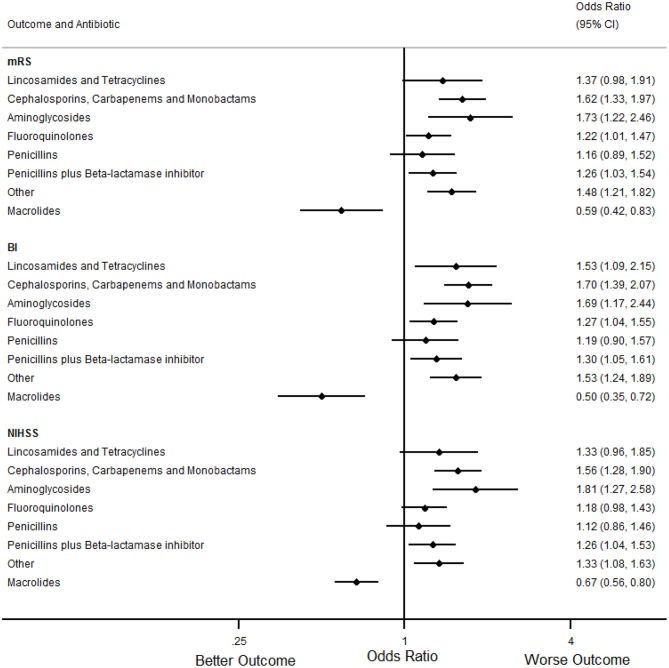
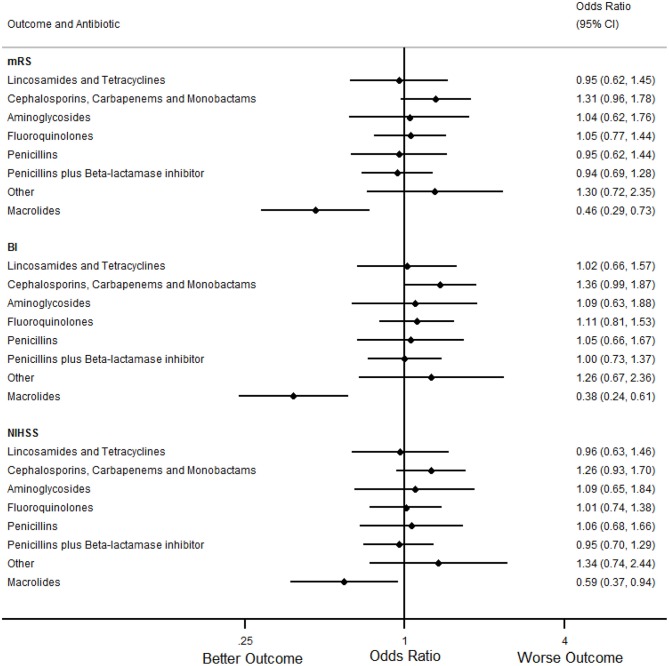
Antibiotics used to treat post-stroke infections have differing antimicrobial and anti-inflammatory effects. Our aim was to investigate whether antibiotic class was associated with outcome after post-stroke infection. We analyzed pooled individual participant data from the Virtual International Stroke Trials Archive (VISTA)-Acute. Patients with ischemic stroke and with an infection treated with systemic antibiotic therapy during the first 2 weeks after stroke onset were eligible. Antibiotics were grouped into eight classes, according to antimicrobial mechanism and prevalence. The primary analysis investigated whether antibiotic class for any infection, or for pneumonia, was independently associated with a shift in 90 day modified Rankin Scale (mRS) using ordinal logistic regression. 2,708 patients were eligible (median age [IQR] = 74 [65 to 80] y; 51% female; median [IQR] NIHSS score = 15 [11 to 19]). Pneumonia occurred in 35%. Treatment with macrolides (5% of any infections; 9% of pneumonias) was independently associated with more favorable mRS distribution for any infection [OR (95% CI) = 0.59 (0.42 to 0.83), = 0.004] and for pneumonia [OR (95% CI) = 0.46 (0.29 to 0.73), = 0.001]. Unfavorable mRS distribution was independently associated with treatment of any infection either with carbapenems, cephalosporins or monobactams [OR (95% CI) = 1.62 (1.33 to 1.97), < 0.001], penicillin plus β-lactamase inhibitors [OR (95% CI) = 1.26 (1.03 to 1.54), = 0.025] or with aminoglycosides [OR (95% CI) = 1.73 (1.22 to 2.46), = 0.002]. This retrospective study has several limitations including effect modification and confounding by indication. Macrolides may have favorable immune-modulatory effects in stroke-associated infections. Prospective evaluation of the impact of antibiotic class on treatment of post-stroke infections is warranted.
用于治疗中风后感染的抗生素具有不同的抗菌和抗炎作用。我们的目的是研究抗生素类别是否与中风后感染的预后相关。我们分析了来自虚拟国际中风试验档案库(VISTA)-急性试验汇总的个体参与者数据。中风发作后前2周内接受全身性抗生素治疗的缺血性中风且伴有感染的患者符合条件。根据抗菌机制和流行程度,抗生素被分为八类。主要分析使用有序逻辑回归研究任何感染或肺炎的抗生素类别是否与90天改良Rankin量表(mRS)的变化独立相关。2708例患者符合条件(中位年龄[四分位间距] = 74 [65至80]岁;51%为女性;中位[四分位间距]美国国立卫生研究院卒中量表(NIHSS)评分 = 15 [11至19])。35%的患者发生了肺炎。大环内酯类药物治疗(占所有感染的5%;占肺炎的9%)与任何感染[比值比(95%置信区间) = 0.59(0.42至0.83),P = 0.004]和肺炎[比值比(95%置信区间) = 0.46(0.29至0.73),P = 0.001]更有利的mRS分布独立相关。mRS分布不利与使用碳青霉烯类、头孢菌素类或单环β-内酰胺类药物治疗任何感染[比值比(95%置信区间) = 1.62(1.33至1.97),P < 0.001]、青霉素加β-内酰胺酶抑制剂[比值比(95%置信区间) = 1.26(1.03至1.54),P = 0.025]或氨基糖苷类药物[比值比(95%置信区间) = 1.73(1.22至2.46),P = 0.002]独立相关。这项回顾性研究有几个局限性,包括效应修正和指征性混杂。大环内酯类药物可能对中风相关感染具有有利的免疫调节作用。有必要对抗生素类别对中风后感染治疗的影响进行前瞻性评估。