Sapers Haley M, Razzell Hollis Joseph, Bhartia Rohit, Beegle Luther W, Orphan Victoria J, Amend Jan P
Division of Geological and Planetary Sciences, California Institute of Technology, Pasadena, CA, United States.
Jet Propulsion Laboratory, California Institute of Technology, Pasadena, CA, United States.
Front Microbiol. 2019 May 14;10:679. doi: 10.3389/fmicb.2019.00679. eCollection 2019.
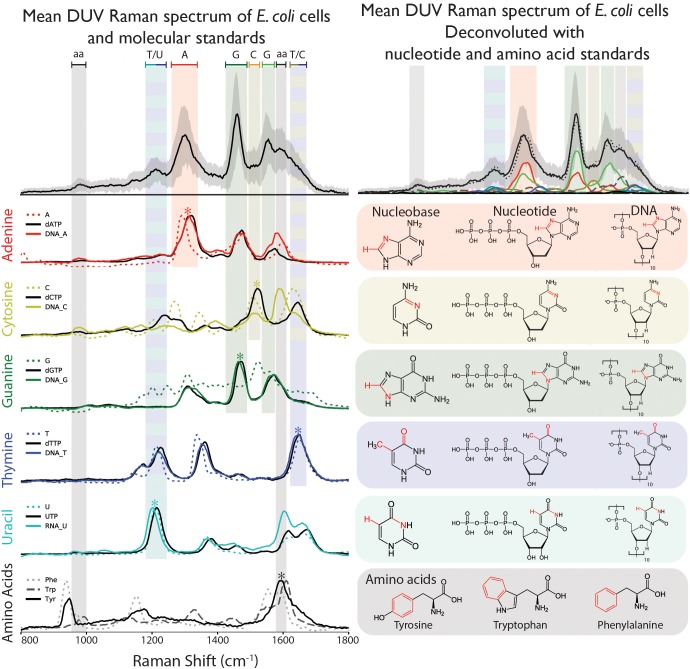
The next NASA-led Mars mission (Mars 2020) will carry a suite of instrumentation dedicated to investigating Martian history and the detection of potential biosignatures. SHERLOC, a deep UV Raman/Fluorescence spectrometer has the ability to detect and map the distribution of many organic compounds, including the aromatic molecules that are fundamental building blocks of life on Earth, at concentrations down to 1 ppm. The mere presence of organic compounds is not a biosignature: there is widespread distribution of reduced organic molecules in the Solar System. Life utilizes a select few of these molecules creating conspicuous enrichments of specific molecules that deviate from the distribution expected from purely abiotic processes. The detection of far from equilibrium concentrations of a specific subset of organic molecules, such as those uniquely enriched by biological processes, would comprise a universal biosignature independent of specific terrestrial biochemistry. The detectability and suitability of a small subset of organic molecules to adequately describe a living system is explored using the bacterium as a model organism. The DUV Raman spectra of cells are dominated by the vibrational modes of the nucleobases adenine, guanine, cytosine, and thymine, and the aromatic amino acids tyrosine, tryptophan, and phenylalanine. We demonstrate that not only does the deep ultraviolet (DUV) Raman spectrum of reflect a distinct concentration of specific organic molecules, but that a sufficient molecular complexity is required to deconvolute the cellular spectrum. Furthermore, a linear combination of the DUV resonant compounds is insufficient to fully describe the cellular spectrum. The residual in the cellular spectrum indicates that DUV Raman spectroscopy enables differentiating between the presence of biomolecules and the complex uniquely biological organization and arrangements of these molecules in living systems. This study demonstrates the ability of DUV Raman spectroscopy to interrogate a complex biological system represented in a living cell, and differentiate between organic detection and a series of Raman features that derive from the molecular complexity inherent to life constituting a biosignature.
美国国家航空航天局(NASA)主导的下一次火星任务(火星2020)将搭载一系列仪器,专门用于研究火星历史以及探测潜在的生物特征。SHERLOC是一台深紫外拉曼/荧光光谱仪,能够检测并绘制多种有机化合物的分布图谱,包括地球上生命的基本构成要素——芳香族分子,其检测浓度低至百万分之一。仅仅有机化合物的存在并非生物特征:在太阳系中,还原态有机分子广泛分布。生命利用其中少数几种分子,使得特定分子显著富集,偏离了纯粹非生物过程所预期的分布。检测特定有机分子子集的远非平衡态浓度,例如那些由生物过程独特富集的分子,将构成一个独立于特定地球生物化学的通用生物特征。以细菌作为模式生物,探索了一小部分有机分子用于充分描述生命系统的可检测性和适用性。细胞的深紫外拉曼光谱主要由腺嘌呤、鸟嘌呤、胞嘧啶和胸腺嘧啶等核碱基以及芳香族氨基酸酪氨酸、色氨酸和苯丙氨酸的振动模式主导。我们证明,不仅 的深紫外(DUV)拉曼光谱反映了特定有机分子的独特浓度,而且还需要足够的分子复杂性来解卷积细胞光谱。此外,DUV共振化合物的线性组合不足以完全描述细胞光谱。细胞光谱中的残余部分表明,DUV拉曼光谱能够区分生物分子的存在以及这些分子在生命系统中独特的生物组织和排列方式。这项研究展示了DUV拉曼光谱对活细胞中所代表的复杂生物系统进行询问的能力,并区分有机检测与源自生命固有分子复杂性的一系列拉曼特征,这些特征构成了生物特征。