Goudarzi Mehdi, Eslami Gita, Rezaee Razieh, Heidary Mohsen, Khoshnood Saeed, Sajadi Nia Raheleh
Department of Microbiology, School of Medicine, Shahid Beheshti University of Medical Sciences, Tehran, Iran.
Microbiology Department, Faculty of Biological Sciences, Shahid Beheshti University, Tehran, Iran.
Iran J Basic Med Sci. 2019 Mar;22(3):238-245. doi: 10.22038/ijbms.2018.30067.7245.
In the current research, the prevalence of clones and genes encoding antimicrobial resistance and toxins were examined among 120 strains from nosocomial infections in tehran, Iran.
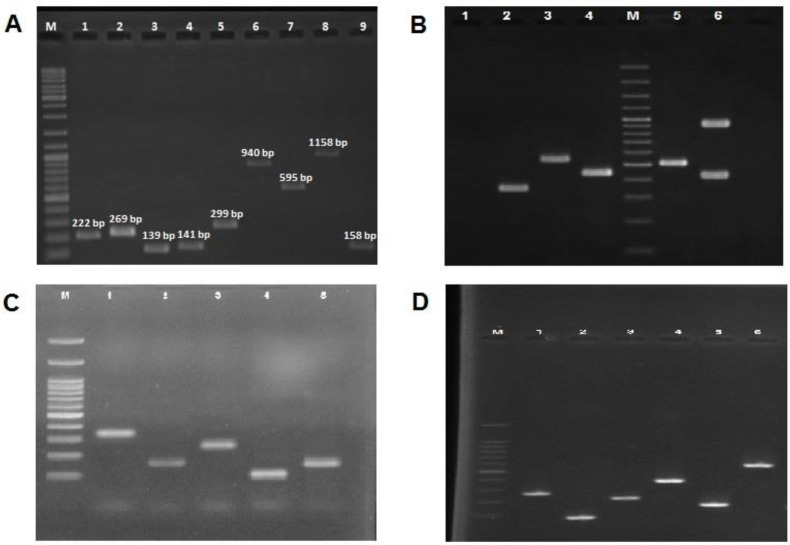
Antimicrobial susceptibility was examined, based on disk diffusion and PCR method to identify resistance and toxin-encoding genes. Based on the polymorphisms in SCC, , and MLST, the isolates were typed.
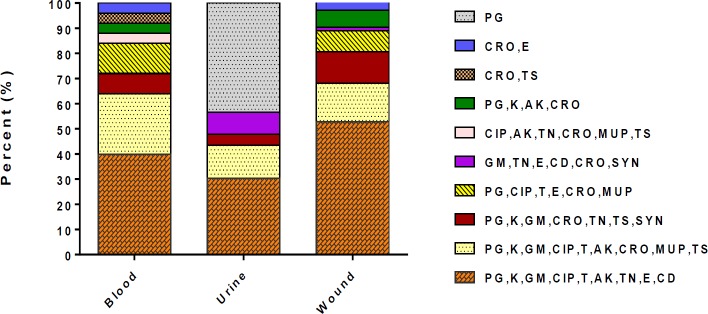
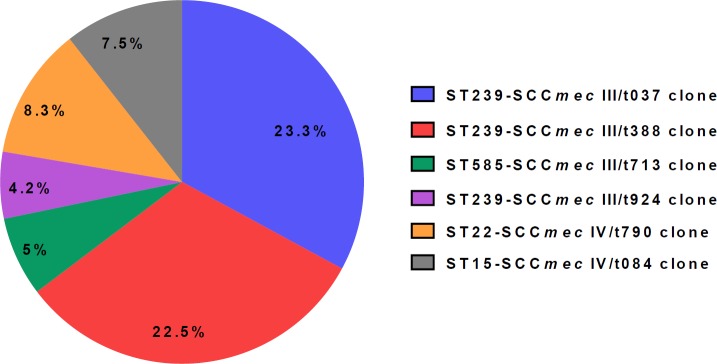
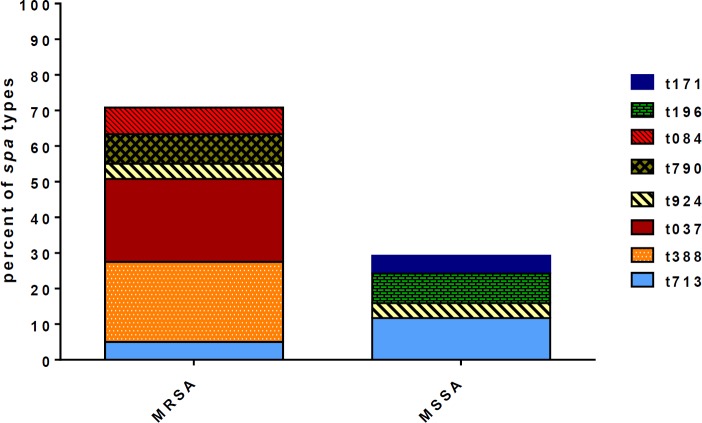
Among 120 isolates, 85 (70.8%) were methicilin resistant MRSA), and 35 (29.2%) were methicilin sensetive MSSA). The tested isolates contained resistance genes, including (90%), (80%), (30%), (26.7%), (10.8%), (11.7%), (40.8%), (14.2%), (45.8%), and (8.3%). The MRSA strains were clustered into six different clones. The most common genotypes included ST239-SCC III/t037 (23.3%), ST239-SCC III/t388 (22.5%), ST22-SCC IV/t790 (8.3%), ST15-SCC IV/t084 (7.5%), ST585-SCC III/t713 (5%), and ST239-SCC III/t924 (4.2%), respectively. ST182/t196 (8.3%) and ST123/t171 (5%) belonged exclusively to MSSA strains. Overall, 10 (66.7%) and 5 (33.3%) out of 15 isolates with genes were attributed to clones ST22-SCC IV/t790 and ST15-SCC IV/t084, respectively. ST22-SCC IV/t790, ST239-SCC III/t037, and ST15-SCC IV/t084, were related to high-level mupirocin-resistant phenotypes.
The genetic diversity of was confirmed in our hospitals, and ST239-SCCmec III/t037 showed a relatively high prevalence in our study. It seems that assessment of resistance and virulence genes in different molecular types is necessary for proper antibiotic consumption.
在当前研究中,对来自伊朗德黑兰医院感染的120株菌株中编码抗菌药物耐药性和毒素的克隆及基因的流行情况进行了检测。
采用纸片扩散法检测抗菌药物敏感性,并通过PCR方法鉴定耐药性和毒素编码基因。根据葡萄球菌染色体盒式 mec (SCCmec)、葡萄球菌蛋白A(spa)和多位点序列分型(MLST)的多态性对分离株进行分型。
在120株分离株中,85株(70.8%)为耐甲氧西林金黄色葡萄球菌(MRSA),35株(29.2%)为甲氧西林敏感金黄色葡萄球菌(MSSA)。检测的分离株含有耐药基因,包括 mecA(90%)、tst(80%)、seu(30%)、eta(26.7%)、etb(10.8%)、lukS-PV(11.7%)、hlgA(40.8%)、hlgB(14.2%)、lukF-PV(45.8%)和 sak(8.3%)。MRSA菌株被分为六个不同的克隆。最常见的基因型分别为ST239-SCCmec III/t037(23.3%)、ST239-SCCmec III/t388(22.5%)、ST22-SCCmec IV/t790(8.3%)、ST15-SCCmec IV/t084(7.5%)、ST585-SCCmec III/t713(5%)和ST239-SCCmec III/t924(4.2%)。ST182/t196(8.3%)和ST123/t171(5%)仅属于MSSA菌株。总体而言,15株携带eta基因的分离株中,10株(66.7%)和5株(33.3%)分别属于克隆ST22-SCCmec IV/t790和ST15-SCCmec IV/t084。ST22-SCCmec IV/t790、ST239-SCCmec III/t037和ST15-SCCmec IV/t084与高水平莫匹罗星耐药表型相关。
我们医院中金黄色葡萄球菌的遗传多样性得到证实,并且ST239-SCCmec III/t037在我们的研究中显示出相对较高的流行率。似乎对不同分子类型的耐药性和毒力基因进行评估对于合理使用抗生素是必要的。