Chai Fang, Zeng Lu, Li Chunhua, Zhao Xiquan
Shaanxi Ophthalmic Medical Center, Xi'an No. 4 Hospital, Affiliated Guangren Hospital, School of Medicine, Xi'an Jiaotong University, Xi'an 710004, China.
Shaanxi Ophthalmic Medical Center, Xi'an No. 4 Hospital, Affiliated Guangren Hospital, School of Medicine, Xi'an Jiaotong University, Xi'an 710004, China
Biosci Rep. 2019 Jun 25;39(6). doi: 10.1042/BSR20181454. Print 2019 Jun 28.
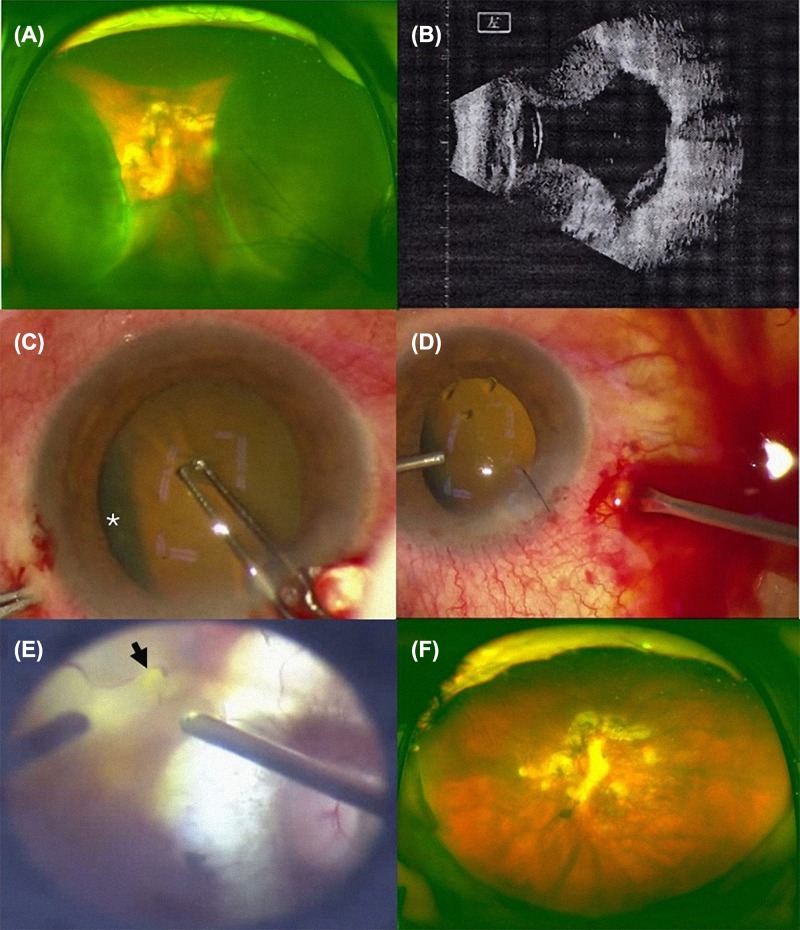
To report a rare case of spontaneous suprachoroidal hemorrhage (SSCH) in a high myopia patient with rhegmatogenous retinal detachment (RRD) and successful treatment. We present a case of SSCH that occurred in a 73 woman with high myopia with RRD and discuss the results of a systemic review of the literature published from 1999 to 2017. Phacoemulsification without intraocular lens implantation and vitrectomy combined with silicone oil injection was performed and retinal detachment and choroidal detachment were reattached after oil removed. In the literature review, we found that among a total of 36 patients (37 eyes), acute secondary glaucoma was a complication in 70.3% (26 eyes) of the cases, and over half of the cases (24 eyes, 64.9%) were treated with surgery. Eighteen cases (50%) were characterized by systemic hypertension and 21 cases (58.3%) had abnormal hemostasis. Age-related macular degeneration (ARMD) was the most common (12 eyes, 32.4%) ocular disease and was followed by glaucoma (7 cases, 18.9%). Visual acuity was classified as hand motion (HM) or worse in 25 eyes (out of 34 eyes, 73.5%) at initial presentation and in 25 eyes (out of 36 eyes, 69.4%) upon final examination. Nine cases experienced significant visual improvement, including six that underwent vitrectomy. Advanced age, systemic anticoagulation, and hypertension are strong risk factors. RRD associated with massive SSCH is an extremely rare event. Vitrectomy and choroidal blood drainage can effectively remove suprachoroidal hemorrhage (SCH) and promote retinal reattachment in these eyes. However, the final visual prognosis usually remains poor.
报告一例高度近视合并孔源性视网膜脱离(RRD)患者发生的自发性脉络膜上腔出血(SSCH)及成功治疗的罕见病例。我们呈现了一例发生在一名73岁高度近视合并RRD女性患者身上的SSCH病例,并讨论了1999年至2017年发表的文献系统综述结果。进行了无晶状体植入的超声乳化术以及玻璃体切除术联合硅油注入,在硅油取出后视网膜脱离和脉络膜脱离复位。在文献综述中,我们发现总共36例患者(37只眼)中,70.3%(26只眼)的病例出现急性继发性青光眼这一并发症,超过半数病例(24只眼,64.9%)接受了手术治疗。18例(50%)有系统性高血压特征,21例(58.3%)存在止血异常。年龄相关性黄斑变性(ARMD)是最常见的眼部疾病(12只眼,32.4%),其次是青光眼(7例,18.9%)。初诊时34只眼中25只眼(73.5%)视力为手动(HM)或更差,最终检查时36只眼中25只眼(69.4%)如此。9例视力有显著改善,其中6例接受了玻璃体切除术。高龄、全身抗凝和高血压是强烈的危险因素。RRD合并大量SSCH是极其罕见的事件。玻璃体切除术和脉络膜血液引流可有效清除脉络膜上腔出血(SCH)并促进这些眼的视网膜复位。然而,最终视力预后通常仍然很差。