Federal University of Mato Grosso, Faculty of Medicine, Laboratory of Mycology/Research, Cuiabá, Mato Grosso, Brazil.
Federal University of Mato Grosso, Júlio Muller University Hospital, Mato Grosso, Brazil.
PLoS Negl Trop Dis. 2019 Jun 4;13(6):e0007437. doi: 10.1371/journal.pntd.0007437. eCollection 2019 Jun.
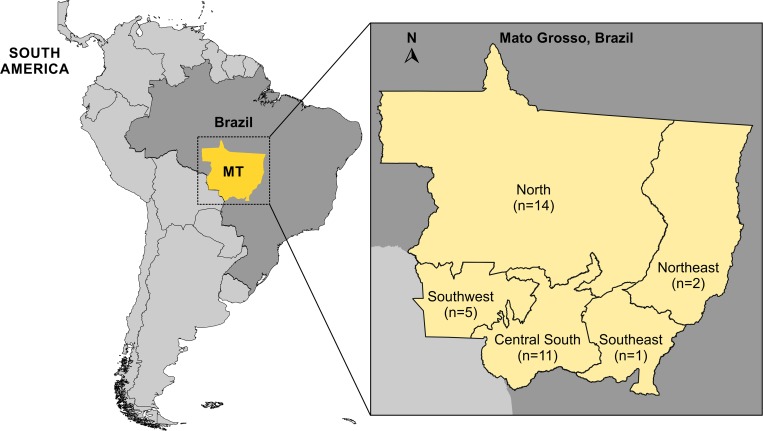
The fungus Paracoccidioides lutzii was recently included as a new causative species of paracoccidioidomycosis (PCM) and most cases have been reported from Brazil. According to available epidemiological information, P. lutzii is concentrated in the Middle-West region in Brazil, mainly in the state of Mato Grosso. However, clinical and laboratorial data available on patients infected with P. lutzii remain extremely limited.
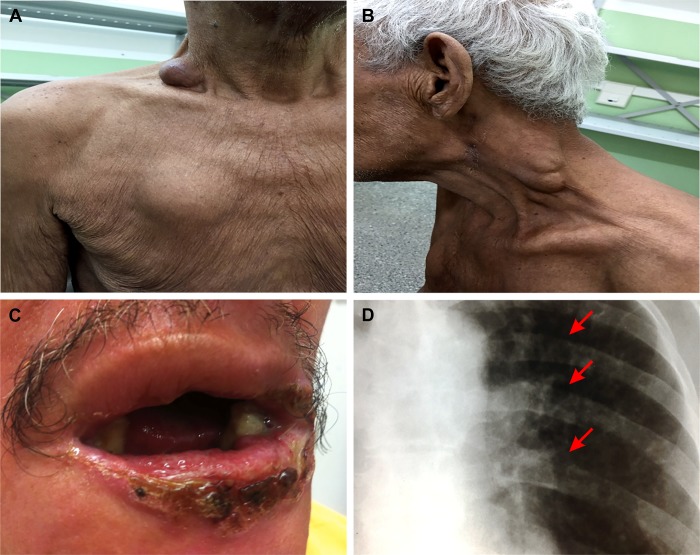
METHODOLOGY/MAIN FINDINGS: This work describes the clinical manifestations of 34 patients suffering from PCM caused by P. lutzii, treated along 5 years (2011-2017) at a reference service center for systemic mycoses in Mato Grosso, Brazil. Adult rural workers (men), aged between 28 and 67 predominated. All patients had the chronic form of the disease, and the oral mucosa (n = 19; 55.9%), lymph nodes (n = 23; 67.7%), skin (n = 16; 47.1%) and lung (n = 28; 82.4%) were the most affected sites. Alcohol intake (n = 19; 55.9%) and smoking (n = 29; 85.3%) were frequent habits among the patients. No patient suffered from any other life-threatening disease, such as tuberculosis, cancer or other inflammatory or infectious parasitic diseases. The positivity in culture examination (97.1%) was higher than that found for the direct mycological examination (88.2%). Particularly, one patient presented fungemia at diagnosis, which lead to his death. The time elapsed between the initial symptoms and the initiation of treatment of PCM caused by P. lutzii was 19.7 (31.5) months, with most patients diagnosed 7 months after the symptoms' onset.
CONCLUSIONS/SIGNIFICANCE: Compared with the classical clinical-epidemiological profile of PCM caused by P. brasiliensis, the results of this descriptive study did not show significant clinical or epidemiological differences that could be attributed to the species P. lutzii. Future studies may confirm or refute the existence of clinical differences between the two fungal species.
最近,真菌 Paracoccidioides lutzii 被归入新型的副球孢子菌病(PCM)病因菌种,且大多数病例均来自巴西。根据现有的流行病学信息,P. lutzii 主要集中在巴西中西部地区,特别是马托格罗索州。然而,关于感染 P. lutzii 的患者的临床和实验室数据仍然极为有限。
方法/主要发现:本研究描述了在巴西马托格罗索州的一个系统性真菌病参考服务中心,对 34 名患有由 P. lutzii 引起的 PCM 的患者进行了 5 年(2011-2017 年)的治疗的临床表现。成年农村工人(男性),年龄在 28 至 67 岁之间占主导地位。所有患者均患有慢性疾病,口腔黏膜(n=19;55.9%)、淋巴结(n=23;67.7%)、皮肤(n=16;47.1%)和肺部(n=28;82.4%)是最常受影响的部位。酒精摄入(n=19;55.9%)和吸烟(n=29;85.3%)是患者中常见的习惯。没有患者患有任何其他危及生命的疾病,如结核病、癌症或其他炎症或传染性寄生虫病。培养检查的阳性率(97.1%)高于直接真菌学检查(88.2%)。特别是,有一位患者在诊断时出现菌血症,导致他死亡。从 P. lutzii 引起的 PCM 的初始症状到开始治疗的时间为 19.7(31.5)个月,大多数患者在症状出现后 7 个月被诊断。
结论/意义:与 P. brasiliensis 引起的 PCM 的经典临床流行病学特征相比,这项描述性研究的结果并未显示出可能归因于 P. lutzii 物种的显著临床或流行病学差异。未来的研究可能会证实或反驳这两种真菌物种之间存在临床差异。