Discipline of Physiology, The University of Sydney, Sydney, NSW, Australia.
Bosch Institute, The University of Sydney, Sydney, NSW, Australia.
Front Neural Circuits. 2019 May 21;13:37. doi: 10.3389/fncir.2019.00037. eCollection 2019.
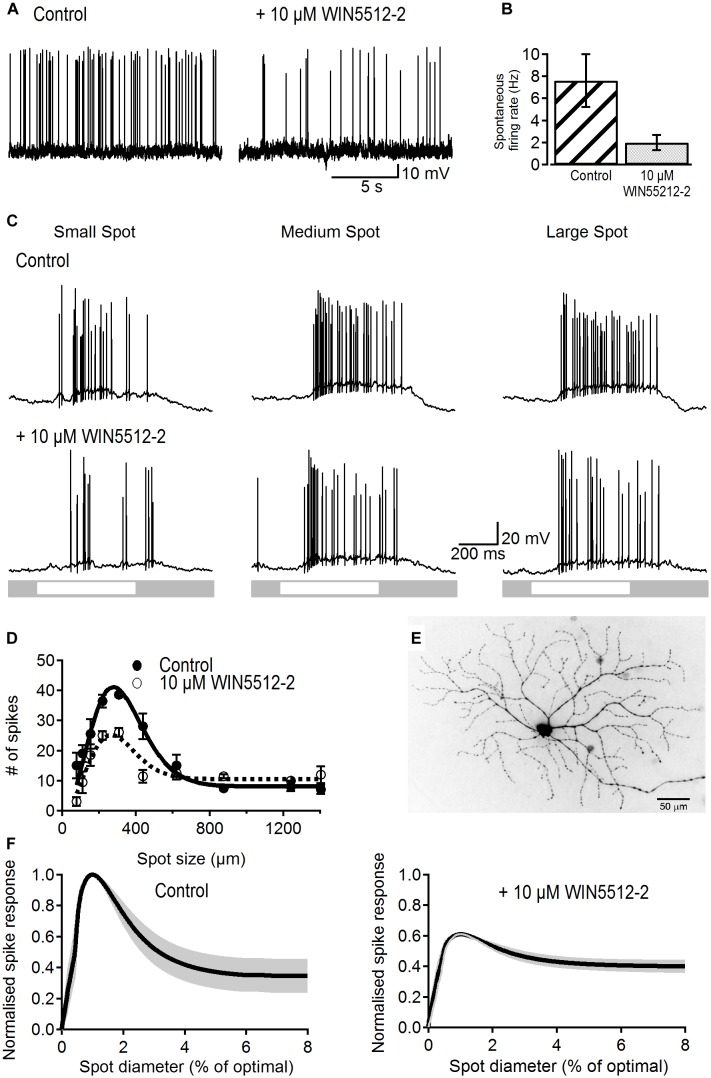
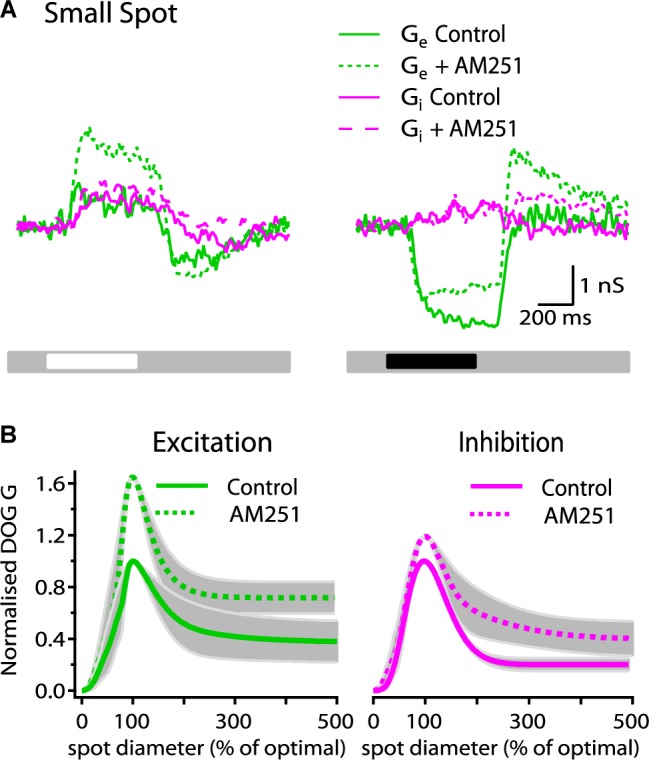
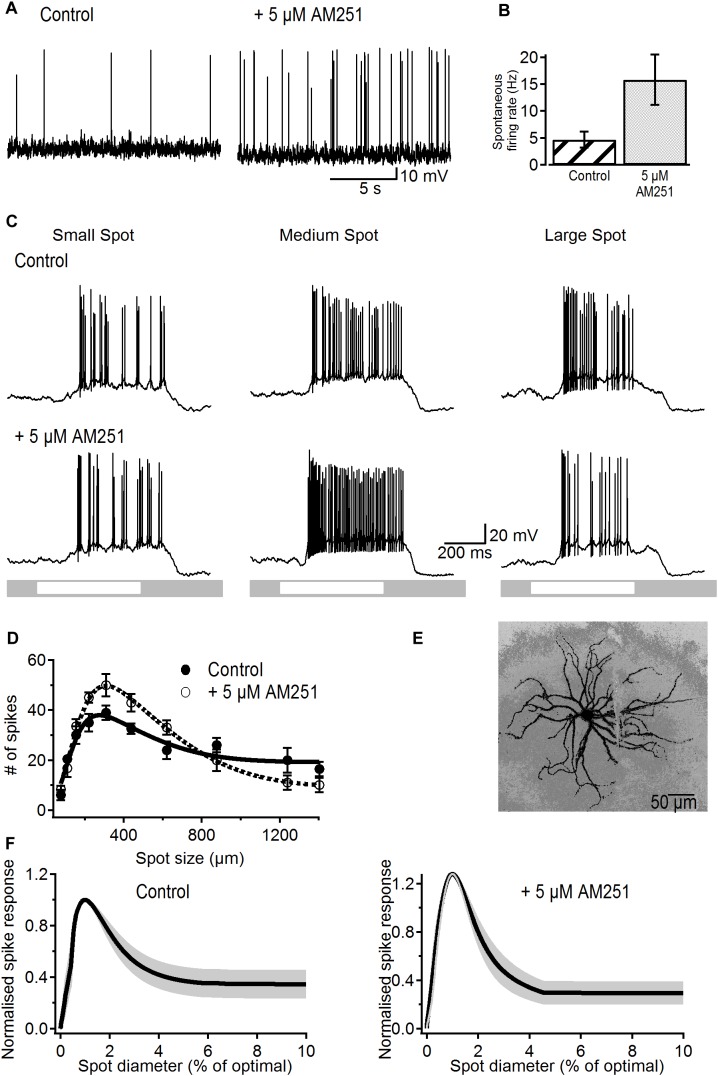
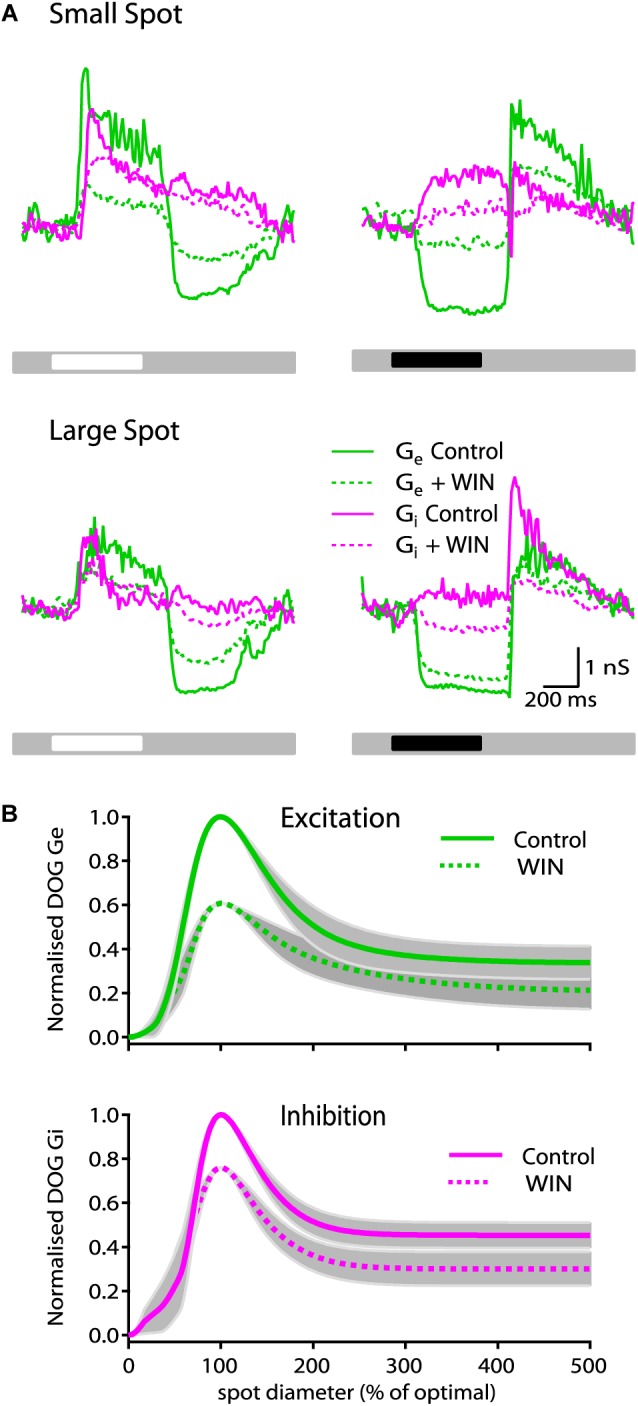
The sole output of the retina to the brain is a signal that results from the integration of excitatory and inhibitory synaptic inputs at the level of retinal ganglion cells (RGCs). Endogenous cannabinoids (eCBs) are found throughout the central nervous system where they modulate synaptic excitability. Cannabinoid receptors and their ligands have been localized to most retinal neurons in mammals, yet their impact on retinal processing is not well known. Here, we set out to investigate the role of the cannabinoid system in retinal signaling using electrophysiological recordings from ON-sustained (ON-S) RGCs that displayed morphological and physiological signatures of ON alpha RGCs in dark adapted mouse retina. We studied the effect of the cannabinoid agonist WIN55212-2 and the inverse agonist AM251 on the spatial tuning of ON-S RGCs. WIN55212-2 significantly reduced their spontaneous spiking activity and responses to optimal spot size as well as altered their spatial tuning by reducing light driven excitatory and inhibitory inputs to RGCs. AM251 produced the opposite effect, increasing spontaneous spiking activity and peak response as well as increasing inhibitory and excitatory inputs. In addition, AM251 sharpened the spatial tuning of ON-S RGCs by increasing the inhibitory effect of the surround. These results demonstrate the presence of a functional cannabinergic system in the retina as well as sensitivity of ON-RGCs to cannabinoids. These results reveal a neuromodulatory system that can regulate the sensitivity and excitability of retinal synapses in a dynamic, activity dependent manner and that endocannabinoids may play a significant role in retinal processing.
视网膜向大脑的唯一输出是一种信号,这种信号源自视网膜神经节细胞(RGCs)水平上兴奋性和抑制性突触输入的整合。内源性大麻素(eCBs)存在于中枢神经系统中,在那里它们调节突触兴奋性。大麻素受体及其配体已在哺乳动物的大多数视网膜神经元中定位,但它们对视网膜处理的影响尚不清楚。在这里,我们使用暗适应小鼠视网膜中具有 ON-α RGC 形态和生理特征的 ON 持续(ON-S)RGC 的电生理记录,着手研究大麻素系统在视网膜信号中的作用。我们研究了大麻素激动剂 WIN55212-2 和反向激动剂 AM251 对 ON-S RGC 空间调谐的影响。WIN55212-2 显著降低了它们的自发放电活动和对最佳光斑大小的反应,并且通过减少对 RGC 的光驱动兴奋性和抑制性输入来改变它们的空间调谐。AM251 产生了相反的效果,增加了自发放电活动和峰值反应,以及增加了兴奋性和抑制性输入。此外,AM251 通过增加周围抑制作用,锐化了 ON-S RGC 的空间调谐。这些结果表明,视网膜中存在功能性大麻素系统,以及 ON-RGC 对大麻素的敏感性。这些结果揭示了一种神经调制系统,它可以以动态的、依赖于活动的方式调节视网膜突触的敏感性和兴奋性,内源性大麻素可能在视网膜处理中发挥重要作用。