1 University of Tennessee, Knoxville, TN, USA.
2 Huntsman Cancer Institute, University of Utah, Salt Lake City, UT, USA.
Integr Cancer Ther. 2019 Jan-Dec;18:1534735419855138. doi: 10.1177/1534735419855138.
The primary aims of this Stage I pilot randomized controlled trial were to establish the feasibility of integrating exercise and nutrition counseling with Mindfulness-Oriented Recovery Enhancement (MORE), a novel intervention that unites training in mindfulness, reappraisal, and savoring skills to target mechanisms underpinning appetitive dysregulation a pathogenic process that contributes to obesity among cancer survivors; to identify potential therapeutic mechanisms of the MORE intervention; and to obtain effect sizes to power a subsequent Stage II trial.
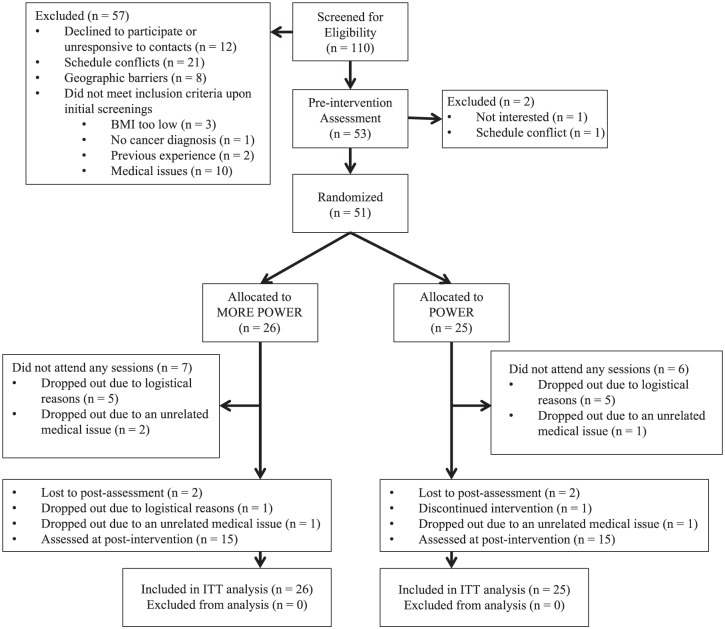
Female overweight and obese cancer survivors (N = 51; mean age = 57.92 ± 10.04; 88% breast cancer history; 96% white) were randomized to one of two 10-week study treatment conditions: ( a) exercise and nutrition counseling or ( b) exercise and nutrition counseling plus the MORE intervention. Trial feasibility was assessed via recruitment and retention metrics. Measures of therapeutic mechanisms included self-reported interoceptive awareness, maladaptive eating behaviors, and savoring, as well as natural reward responsiveness and food attentional bias, which were evaluated as psychophysiological mechanisms.
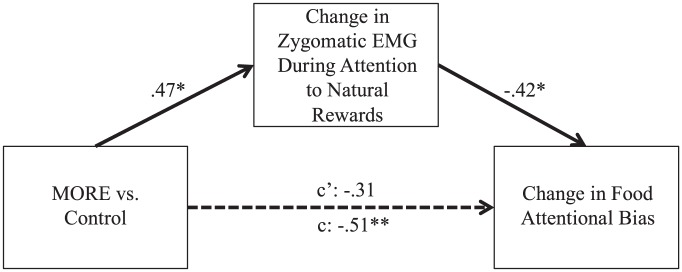
Feasibility was demonstrated by 82% of participants who initiated MORE receiving a full dose of the intervention. Linear mixed models revealed that the addition of MORE led to significantly greater increases in indices of interoceptive awareness, savoring, and natural reward responsiveness, and, significantly greater decreases in external eating behaviors and food attentional bias-the latter of which was significantly associated with decreases in waist-to-hip ratio. Path analysis demonstrated that the effect of MORE on reducing food attentional bias was mediated by increased zygomatic electromyographic activation during attention to natural rewards.
MORE may target appetitive dysregulatory mechanisms implicated in obesity by promoting interoceptive awareness and restructuring reward responsiveness.
本阶段 I 试点随机对照试验的主要目的是确定将运动和营养咨询与正念康复增强(MORE)相结合的可行性,这是一种新的干预措施,将正念、重新评估和享受技能的培训结合起来,针对促进食欲失调的机制,这是导致癌症幸存者肥胖的一个致病过程;确定 MORE 干预措施的潜在治疗机制;并获得后续阶段 II 试验的效应量。
招募了 51 名超重和肥胖的女性癌症幸存者(平均年龄为 57.92±10.04 岁;88%有乳腺癌病史;96%为白人),将她们随机分为两种 10 周的研究治疗条件之一:(a)运动和营养咨询或(b)运动和营养咨询加 MORE 干预。通过招募和保留指标评估试验的可行性。治疗机制的测量包括自我报告的内脏感知、适应不良的进食行为和享受,以及自然奖励反应和食物注意力偏向,这些都被评估为心理生理机制。
82%的参与者开始接受完整剂量的 MORE 干预,表明可行性较高。线性混合模型显示,加入 MORE 可显著增加内脏感知、享受和自然奖励反应的指标,显著减少外部进食行为和食物注意力偏向,后者与腰围与臀围比的降低显著相关。路径分析表明,MORE 对减少食物注意力偏向的影响是通过增加对自然奖励的注意力期间的颧肌肌电图激活来介导的。
MORE 可能通过促进内脏感知和重构奖励反应来针对与肥胖相关的食欲失调调节机制。