Jeyathevan Gaya, Cameron Jill I, Craven B Catharine, Munce Sarah E P, Jaglal Susan B
Institute of Health Policy, Management and Evaluation, University of Toronto, Toronto, Ontario, Canada.
Neural Engineering and Therapeutics Team, KITE, Toronto Rehab - University Health Network, Toronto, Ontario, Canada.
BMC Neurol. 2019 Jun 8;19(1):117. doi: 10.1186/s12883-019-1347-x.
Following spinal cord injury (SCI), family members are often called upon to undertake the caregiving role. This change in the nature of the relationship between the individuals with SCI and their families can lead to emotional, psychological, and relationship challenges. There is limited research on how individuals with SCI and their family caregivers adapt to their new lives post-injury, or on which dyadic coping strategies are used to maintain relationships. Thus, the objectives of this study were to obtain an in-depth understanding of 1) the experiences and challenges within a caregiving relationship post-SCI among spouses, as well as parents and adult children; and 2) the coping strategies used by caregivers and care recipients to maintain/rebuild their relationships.
A qualitative descriptive approach with an exploratory design was used. Semi-structured face-to-face and telephone interviews were conducted. Thematic analysis was used to identify key themes arising from individuals with SCI's (n = 19) and their family caregivers' (n = 15) experiences.
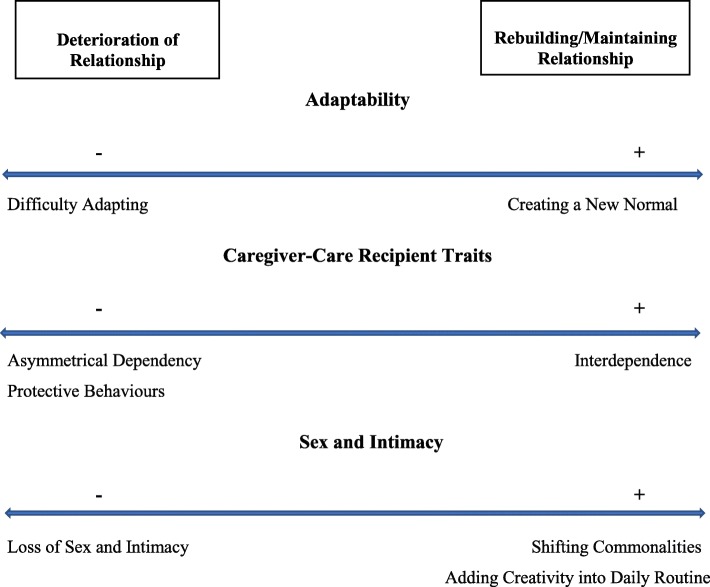
Individuals with SCI and family caregivers spoke in-depth and openly about their experiences and challenges post-injury, with two emerging themes (including subsequent sub-themes). The first theme of deterioration of relationship, which reflects the challenges experienced/factors that contributed to disintegration in a relationship post-injury, included: protective behaviours, asymmetrical dependency, loss of sex and intimacy, and difficulty adapting. The second theme of re-building/maintaining the relationship, which reflects the strategies used by dyads to adjust to the changes within the relationship brought upon by the injury, included: interdependence, shifting commonalities, adding creativity into routine, and creating a new normal.
These findings should alert healthcare professionals and peer support groups as to the need for possible education and training (e.g., coping strategies, communication skills training) as well as counseling prior to discharge to assist individuals with SCI and family caregivers with adaptation to a new life post-injury.
脊髓损伤(SCI)后,家庭成员常常被要求承担起照顾的角色。脊髓损伤患者与其家人之间关系性质的这种变化可能会导致情感、心理和人际关系方面的挑战。关于脊髓损伤患者及其家庭照顾者如何适应受伤后的新生活,或者使用哪些二元应对策略来维持关系的研究有限。因此,本研究的目的是深入了解:1)脊髓损伤后配偶、父母与成年子女之间照顾关系中的经历和挑战;2)照顾者和受照顾者用于维持/重建其关系的应对策略。
采用探索性设计的定性描述方法。进行了半结构化的面对面和电话访谈。主题分析用于识别脊髓损伤患者(n = 19)及其家庭照顾者(n = 15)经历中出现的关键主题。
脊髓损伤患者和家庭照顾者深入且坦诚地讲述了他们受伤后的经历和挑战,出现了两个主题(包括后续子主题)。第一个主题是关系恶化,反映了受伤后关系中经历的挑战/导致关系瓦解的因素,包括:保护行为、不对称依赖、性与亲密关系的丧失以及适应困难。第二个主题是重建/维持关系,反映了二元组用于适应损伤给关系带来变化的策略,包括:相互依赖、转移共性、在日常生活中增添创造力以及创造新的常态。
这些发现应提醒医疗保健专业人员和同伴支持团体,需要在出院前提供可能的教育和培训(如应对策略、沟通技能培训)以及咨询,以帮助脊髓损伤患者和家庭照顾者适应受伤后的新生活。