Department of Physiology, University of Maryland School of Medicine, Baltimore, MD, 21201, USA.
J Physiol. 2020 May;598(9):1775-1790. doi: 10.1113/JP278327. Epub 2019 Jul 3.
Circadian oscillations in spontaneous action potential firing in the suprachiasmatic nucleus (SCN) translate time-of-day throughout the mammalian brain. The ion channels that regulate the circadian pattern of SCN firing have not been comprehensively identified. Ca channels regulate action potential activity across many types of excitable cells, and the activity of L-, N-, P/Q- and R-type channels are required for normal daytime firing frequency in SCN neurons and circuit rhythms. Only the L-type Ca current exhibits a day versus night difference in current magnitude, providing insight into the mechanism that produces rhythmic action potential firing in SCN.
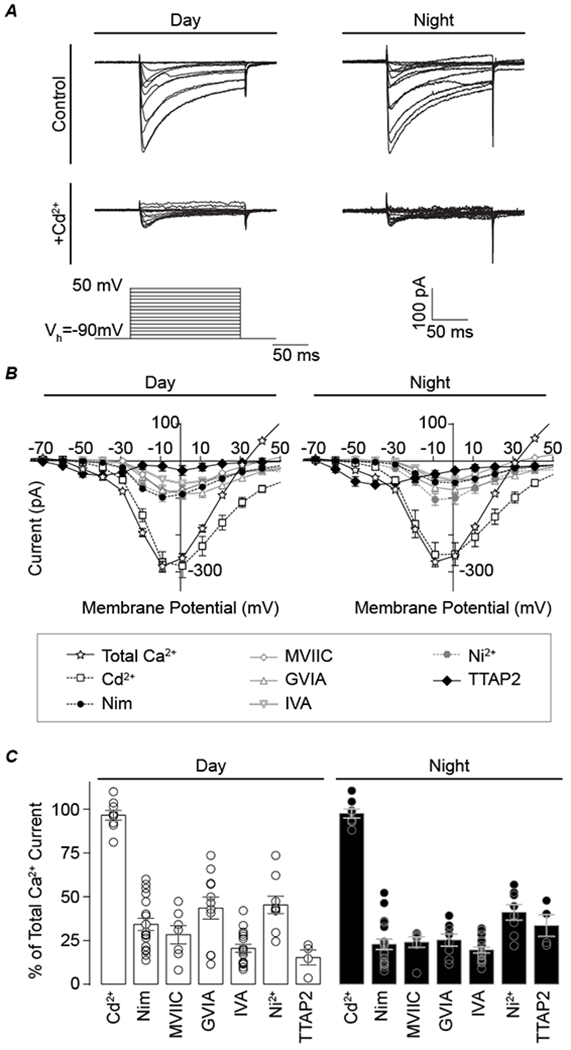
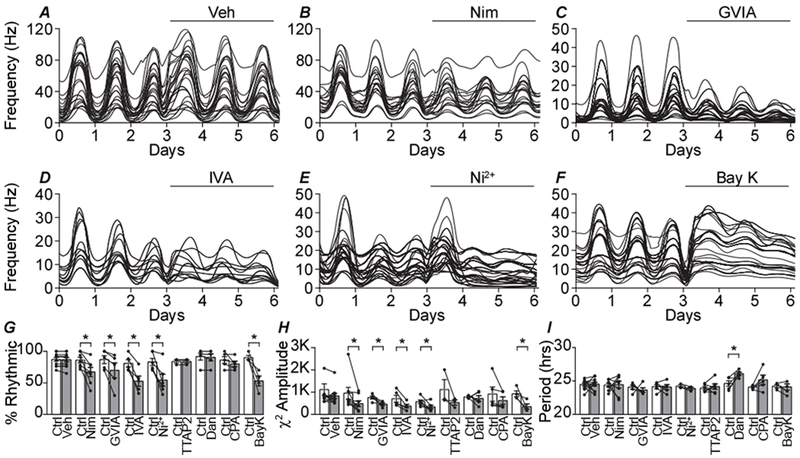
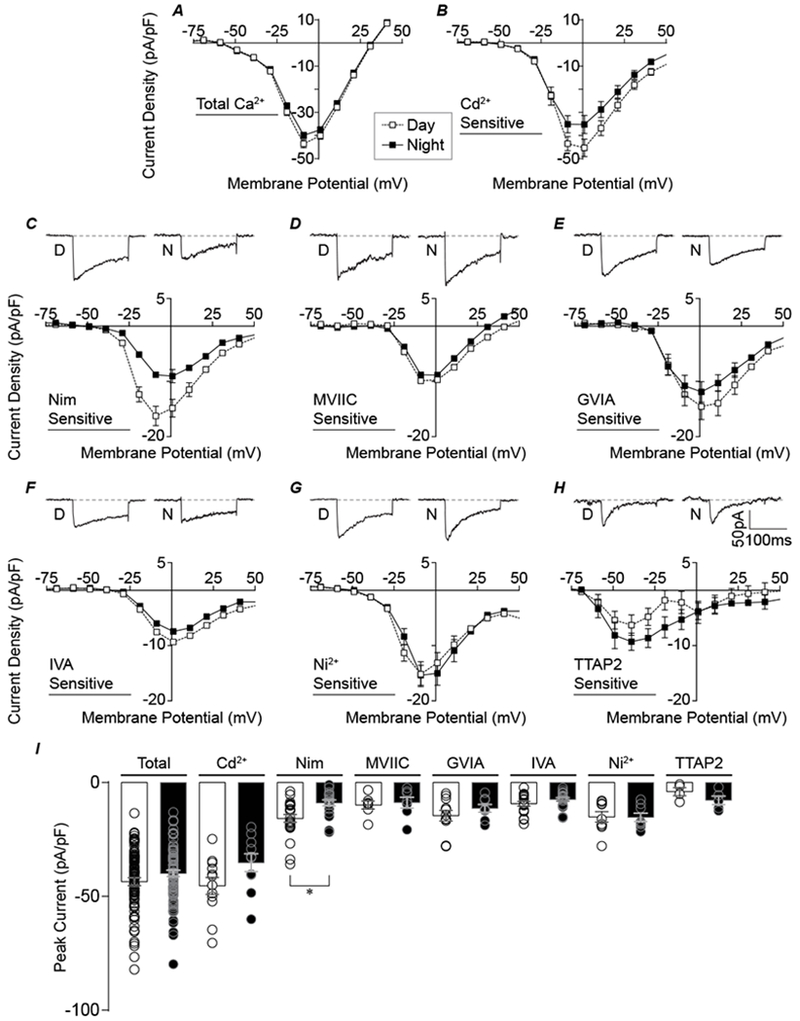
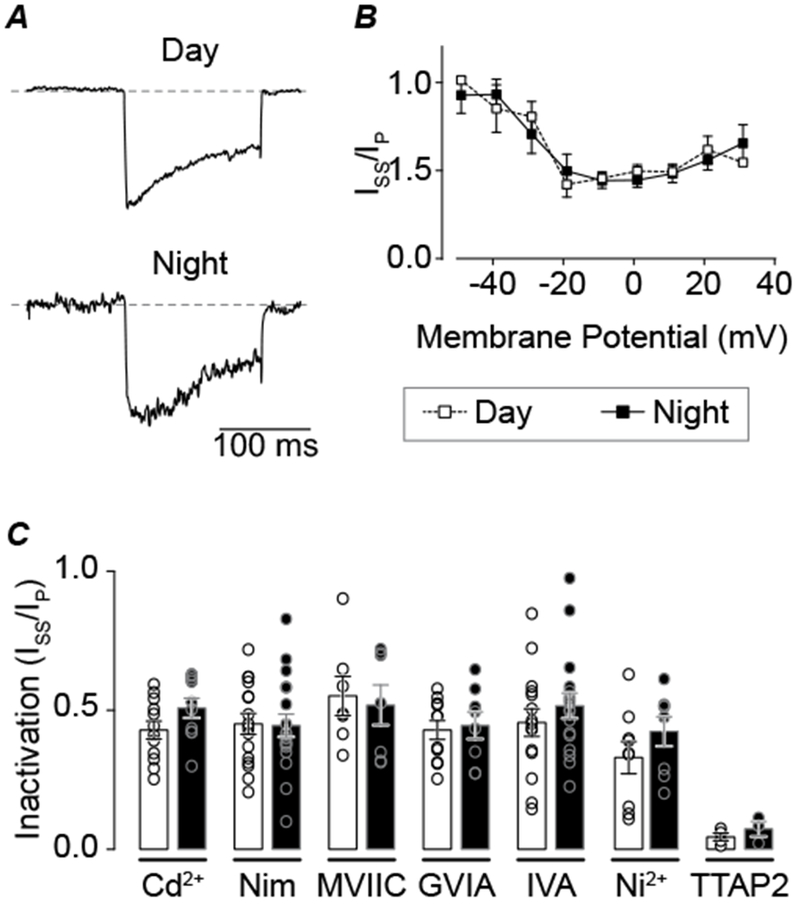
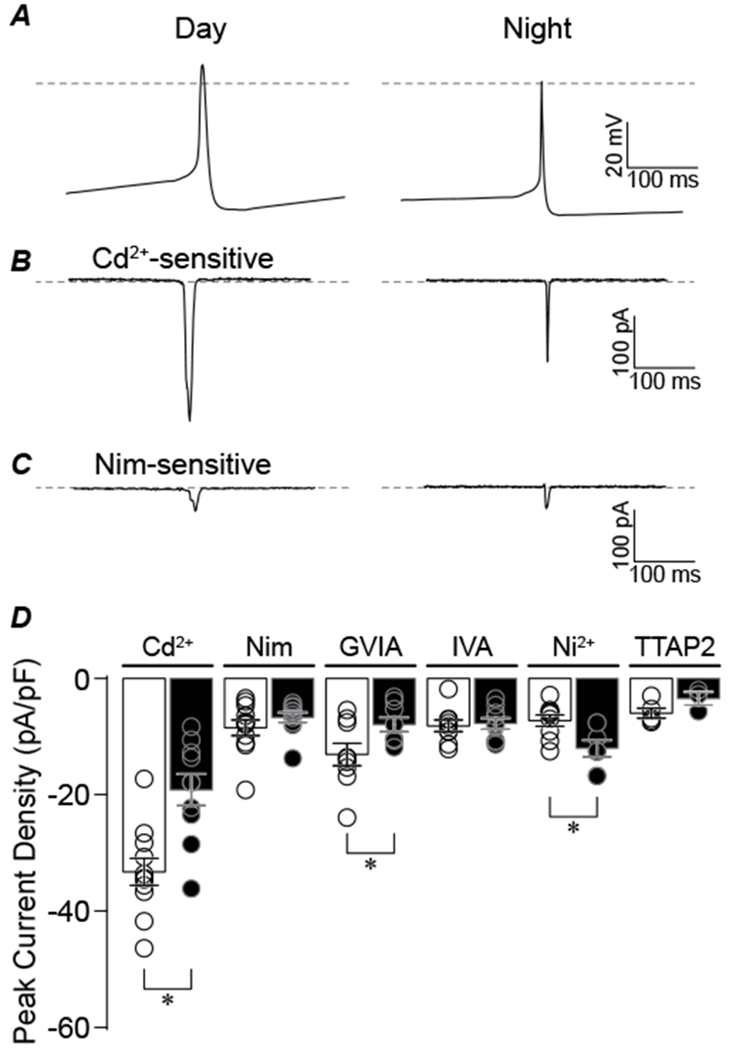
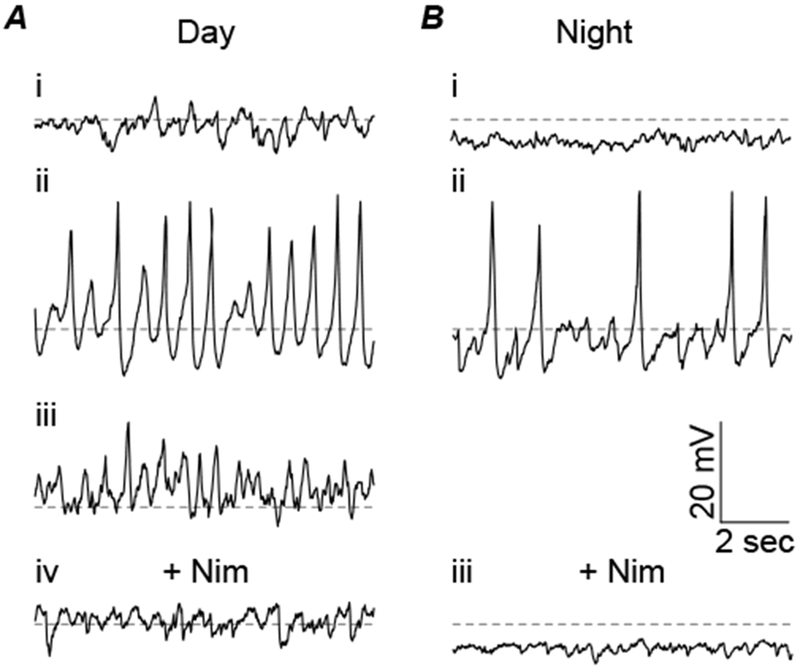
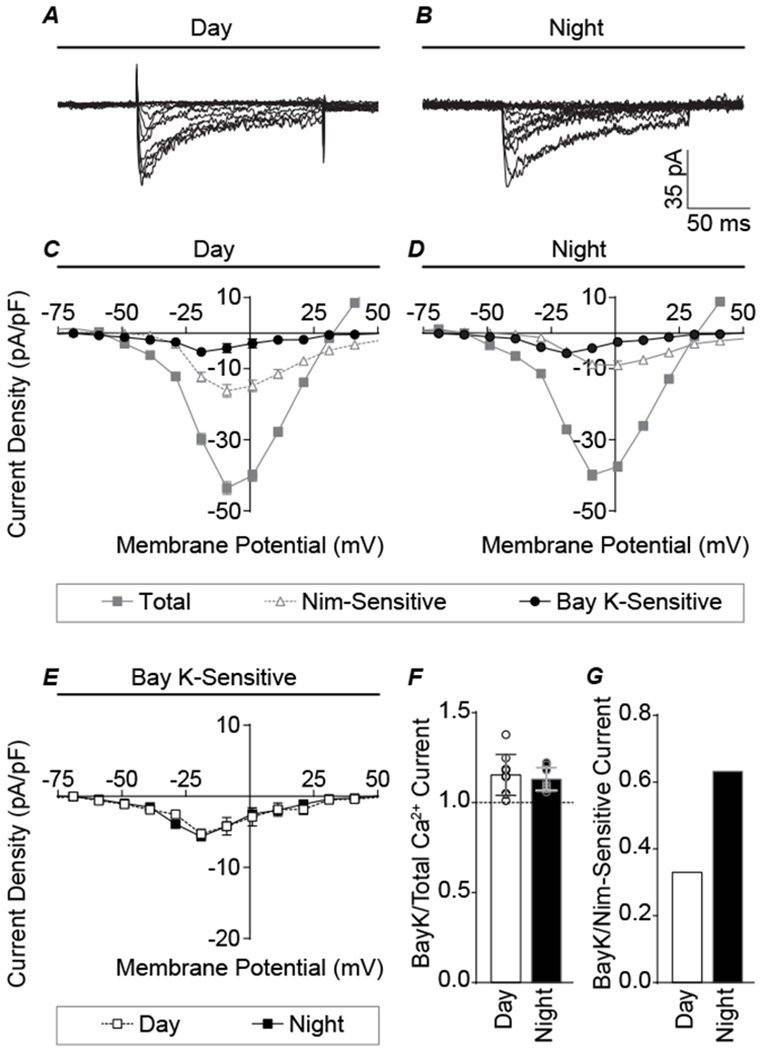
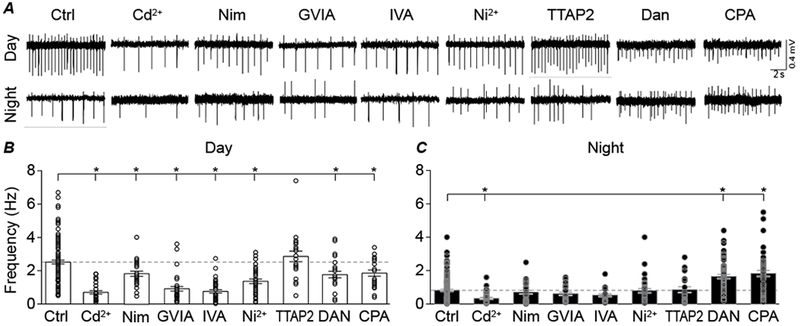
The mammalian circadian clock encodes time via rhythmic action potential activity in the suprachiasmatic nucleus (SCN) of the hypothalamus, which governs daily rhythms in physiology and behaviour. SCN neurons exhibit 24 h oscillations in spontaneous firing, with higher firing during day compared to night. Several ionic currents have been identified that regulate SCN firing, including voltage-gated Ca currents, but the circadian regulation of distinct voltage-gated Ca channel (VGCC) components has not been comprehensively addressed. In this study, whole-cell L- (nimodipine-sensitive), N- and P/Q- (ω-agatoxin IVA, ω-conotoxin GVIA, ω-conotoxin MVIIC-sensitive), R- (Ni -sensitive) and T-type (TTA-P2-sensitive) currents were recorded from day and night SCN slices. Using standard voltage protocols, Ni -sensitive currents comprised the largest proportion of total VGCC current, followed by nimodipine-, ω-agatoxin IVA-, ω-conotoxin GVIA- and TTA-P2-sensitive currents. Only the nimodipine-sensitive current exhibited a diurnal difference in magnitude, with daytime current larger than night. No diurnal variation was observed for the other Ca current subtypes. The difference in nimodipine-sensitive current was due to larger peak current activated during the day, not differences in inactivation, and was eliminated by Bay K8644. Blocking L-type channels decreased firing selectively during the day, consistent with higher current magnitudes, and reduced SCN circuit rhythmicity recorded by multi-electrode arrays. Yet blocking N-, P/Q- and R-type channels also decreased daytime firing, with little effect at night, and decreased circuit rhythmicity. These data identify a unique diurnal regulation of L-type current among the major VGCC subtypes in SCN neurons, but also reveal that diurnal modulation is not required for time-of-day-specific effects on firing and circuit rhythmicity.
在视交叉上核(SCN)中自发动作电位发射的昼夜节律振荡将一天中的时间转化为哺乳动物大脑中的时间。调节 SCN 发射昼夜节律模式的离子通道尚未得到全面鉴定。钙通道调节多种类型的可兴奋细胞中的动作电位活动,而 L 型、N 型、P/Q 型和 R 型通道的活性是 SCN 神经元正常日间发射频率和电路节律所必需的。只有 L 型钙电流在电流幅度上表现出昼夜差异,为 SCN 中产生节律性动作电位发射的机制提供了深入了解。
哺乳动物生物钟通过下丘脑视交叉上核(SCN)中节律性动作电位活动来编码时间,该活动控制着生理和行为的每日节律。SCN 神经元表现出 24 小时自发发射的振荡,白天比夜间发射更高。已经确定了几种调节 SCN 发射的离子电流,包括电压门控钙电流,但电压门控钙通道(VGCC)成分的昼夜调节尚未得到全面解决。在这项研究中,从白天和夜间 SCN 切片中记录了全细胞 L-(尼莫地平敏感)、N-和 P/Q-(ω-芋螺毒素 IVA、ω-芋螺毒素 GVIA、ω-芋螺毒素 MVIIC 敏感)、R-(Ni 敏感)和 T 型(TTA-P2 敏感)电流。使用标准电压方案,Ni 敏感电流构成总 VGCC 电流的最大比例,其次是尼莫地平、ω-芋螺毒素 IVA、ω-芋螺毒素 GVIA 和 TTA-P2 敏感电流。只有尼莫地平敏感电流在幅度上表现出昼夜差异,白天电流大于夜间。其他钙电流亚型没有观察到昼夜变化。尼莫地平敏感电流的差异是由于白天激活的峰值电流更大,而不是失活的差异引起的,并且被 Bay K8644 消除。阻断 L 型通道选择性地减少白天的放电,这与更高的电流幅度一致,并减少通过多电极阵列记录的 SCN 电路节律性。然而,阻断 N、P/Q 和 R 型通道也减少了白天的放电,夜间影响较小,并减少了电路节律性。这些数据表明,在 SCN 神经元的主要 VGCC 亚型中,L 型电流存在独特的昼夜调节,但也表明昼夜调制不是时间特异性影响放电和电路节律性所必需的。