Clark Rashel L, Famodu Oluremi A, Barr Makenzie L, Hagedorn Rebecca L, Ruseski Jane, White Jade A, Warner Caitlin M, Morrell Alexandra M, Murray Pamela J, Olfert I Mark, McFadden Joseph W, Downes Marianne T, Colby Sarah E, Olfert Melissa D
West Virginia University, Davis College of Agriculture, Natural Resources, and Design, Division of Animal and Nutritional Sciences, Morgantown, WV, USA.
West Virginia University, College of Business and Economics, Morgantown, WV, USA.
J Nutr Metab. 2019 May 2;2019:2790963. doi: 10.1155/2019/2790963. eCollection 2019.
Cost is a commonly reported barrier to healthy eating. This is a secondary research analysis designed to examine the food expenditures of young adults on a university campus following the United States Department of Agriculture (USDA) MyPlate guidelines for fruits and vegetables.
Meal receipts and dietary intake were recorded weekly. Anthropometrics and clinical assessments were recorded before intervention. Researchers rated compliance based on the participant's dietary food log, receipt matching, food pictures, and reports during weekly 1-hour consultations.
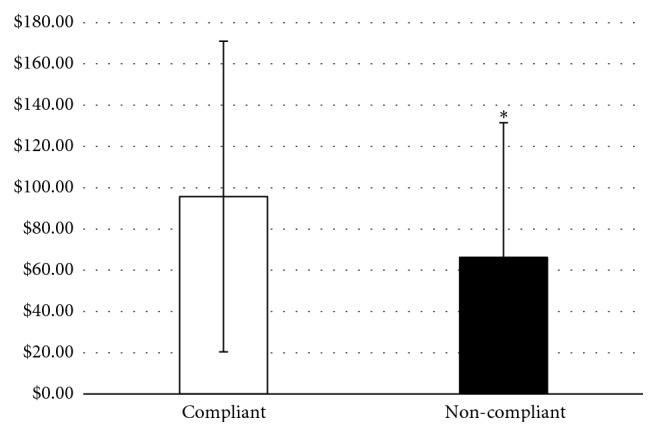
Fifty-three young adults (18-30 years old) at-risk of, or diagnosed with, metabolic syndrome (MetS) were enrolled in the study, with 10 excluded ( = 43) from analyses due to enrollment in a fixed cost university campus dining meal plan. A two sample -test assessed differences in food costs and regression analysis determined associations between food cost and diet compliance while controlling for confounding factors of age, sex, and body mass index (BMI). Diet compliant subjects ( = 38) had higher weekly food cost at $95.73 compared to noncompliant subjects ( = 5) who spent $66.24 (=0.01). A regression analysis controlling for age, sex, BMI, and geographical region also indicated cost differences based on diet compliance ( < 0.0001).
Results indicate an ∼$29.00 per week increase in food cost when eating the recommended amount of fruit and vegetables. These findings can contribute to research incentive design, program planning cost, and determining effective interventions to improve diet in this population.
成本是健康饮食中普遍存在的障碍。这是一项二次研究分析,旨在根据美国农业部(USDA)的蔬果摄入指南,研究大学校园里年轻人的食物支出情况。
每周记录膳食收据和饮食摄入量。在干预前记录人体测量数据和临床评估结果。研究人员根据参与者的饮食日志、收据匹配情况、食物照片以及每周1小时咨询期间的报告对依从性进行评分。
53名有代谢综合征(MetS)风险或已被诊断患有代谢综合征的年轻人(18 - 30岁)参与了该研究,其中10人因参加了固定成本的大学校园餐饮计划而被排除在分析之外(n = 43)。采用双样本t检验评估食物成本差异,并通过回归分析确定食物成本与饮食依从性之间的关联,同时控制年龄、性别和体重指数(BMI)等混杂因素。饮食依从的受试者(n = 38)每周食物成本较高,为95.73美元,而非依从受试者(n = 5)花费66.24美元(P = 0.01)。一项控制年龄、性别、BMI和地理区域的回归分析也表明,饮食依从性不同,成本存在差异(P < 0.0001)。
结果表明,当摄入推荐量的水果和蔬菜时,每周食物成本增加约29.00美元。这些发现有助于研究激励设计、项目规划成本以及确定改善该人群饮食的有效干预措施。