Hadyeh Etaf, Azmi Kifaya, Seir Rania Abu, Abdellatief Inas, Abdeen Ziad
Al-Quds Public Health Society, Jerusalem, Palestine.
Department of Medical Lab Sciences, Faculty of Health Professions, Jerusalem, Palestine.
Front Public Health. 2019 May 28;7:130. doi: 10.3389/fpubh.2019.00130. eCollection 2019.
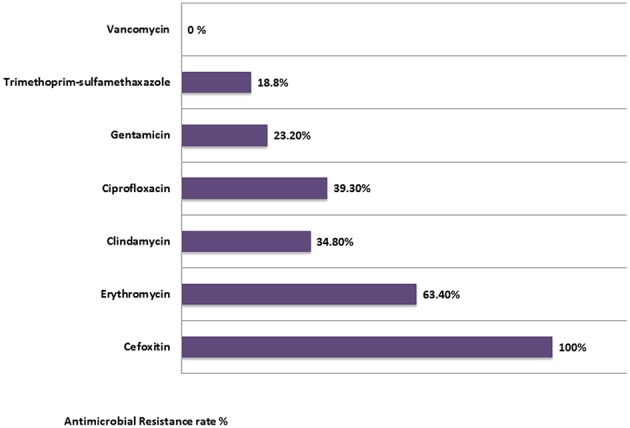
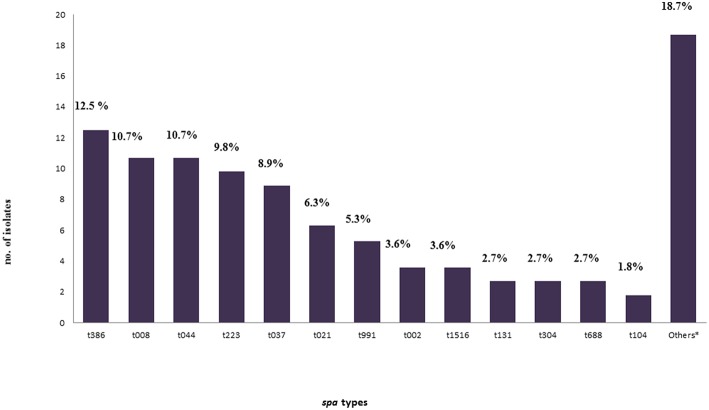
Methicillin-resistant (MRSA) is a public health threat and a major cause of hospital-acquired and community-acquired infections. This study aimed to investigate the genetic diversity of MRSA isolates from 2015 to 2017 and to characterize the major MRSA clones and anti-biogram trends in Palestine. Isolates were obtained from 112 patients admitted to different hospitals of West Bank and East Jerusalem, originating from different clinical sources. Antibiotic susceptibility patterns, staphylococcal chromosomal cassette (SCC) typing, and protein A () typing were determined. Also, a panel of toxin genes and virulence factors was studied, including: Panton-Valentine Leukocidin (PVL), ACME-A, Toxic Shock Syndrome Toxin-1 (TSST-1), and Exfoliative Toxin A (ETA). Of the 112 confirmed MRSA isolates, 100% were resistant to all β-lactam antibiotics. Resistance rates to other non- β-lactam classes were as the following: 18.8% were resistant to trimethoprim-sulfamethoxazole, 23.2% were resistant to gentamicin, 34.8% to clindamycin, 39.3% to ciprofloxacin, and 63.4% to erythromycin. All MRSA isolates were susceptible to vancomycin (100%). Of all isolates, 32 isolates (28.6%) were multidrug- resistant (MDR). The majority of the isolates were identified as SCC type IV (86.6%). The molecular typing identified 29 types representing 12 MLST-clonal complexes (CC). The most prevalent types were: type t386 (CC1)/(12.5%), type t044 (CC80)/(10.7%), type t008 (CC8)/(10.7%), and type t223 (CC22)/(9.8%). PVL toxin gene was detected in (29.5%) of all isolates, while ACME- gene was present in 18.8% of all isolates and 23.2% had the TSST-1 gene. The two most common types among the TSST-1positive isolates were the type t223 (CC22)/(Gaza clone) and the type t021 (CC30)/(South West Pacific clone). All isolates with the type t991 were ETA positive (5.4%). USA-300 clone ( type t008, positive for PVL toxin gene and ACME- genes) was found in nine isolates (8.0%). Our results provide insights into the epidemiology of MRSA strains in Palestine. We report a high diversity of MRSA strains among hospitals in Palestine, with frequent SCC type IV carriage. The four prominent clones detected were: t386-IV/ CC1, the European clone (t044/CC80), Gaza clone (t223/CC22), and the USA-300 clone (t008/CC8).
耐甲氧西林金黄色葡萄球菌(MRSA)是一种公共卫生威胁,也是医院获得性感染和社区获得性感染的主要原因。本研究旨在调查2015年至2017年期间巴勒斯坦MRSA分离株的遗传多样性,并鉴定主要的MRSA克隆以及耐药谱趋势。分离株取自约旦河西岸和东耶路撒冷不同医院收治的112例患者,这些患者来自不同的临床来源。确定了抗生素敏感性模式、葡萄球菌染色体盒式(SCC)分型以及蛋白A()分型。此外,还研究了一组毒素基因和毒力因子,包括:杀白细胞素(PVL)、ACME-A、中毒性休克综合征毒素-1(TSST-1)和剥脱性毒素A(ETA)。在112株确诊的MRSA分离株中,100%对所有β-内酰胺类抗生素耐药。对其他非β-内酰胺类抗生素的耐药率如下:对甲氧苄啶-磺胺甲恶唑耐药率为18.8%,对庆大霉素耐药率为23.2%,对克林霉素耐药率为34.8%,对环丙沙星耐药率为39.3%,对红霉素耐药率为63.4%。所有MRSA分离株对万古霉素均敏感(100%)。在所有分离株中,32株(28.6%)为多重耐药(MDR)。大多数分离株被鉴定为SCC IV型(86.6%)。分子分型鉴定出29种类型,代表12个多位点序列分型-克隆复合体(CC)。最常见的类型为:t386型(CC1)/(12.5%)、t044型(CC80)/(10.7%)、t008型(CC8)/(10.7%)和t223型(CC22)/(9.8%)。在所有分离株中,29.5%检测到PVL毒素基因,18.8%存在ACME-基因,23.2%具有TSST-1基因。TSST-1阳性分离株中最常见的两种类型是t223型(CC22)/(加沙克隆)和t021型(CC30)/(西南太平洋克隆)。所有t991型分离株均为ETA阳性(5.4%)。在9株分离株(8.0%)中发现了USA-300克隆(t008型,PVL毒素基因和ACME-基因阳性)。我们的研究结果为巴勒斯坦MRSA菌株的流行病学提供了见解。我们报告了巴勒斯坦各医院中MRSA菌株的高度多样性,且SCC IV型携带率较高。检测到的四个主要克隆为:t386-IV/CC1,欧洲克隆(t044/CC80),加沙克隆(t223/CC22)和USA-300克隆(t008/CC8)。