McElroy Eoin, Napoleone Elisa, Wolpert Miranda, Patalay Praveetha
Institute of Psychology, Health and Society, University of Liverpool, Liverpool, UK.
Evidence Based Practice Unit, University College London, London, UK.
EClinicalMedicine. 2019 Mar 14;8:29-36. doi: 10.1016/j.eclinm.2019.02.009. eCollection 2019 Feb.
There are suggestions that denser network connectivity (i.e., the strength of associations between individual symptoms) may be a prognostic indicator of poor treatment response in depression. We sought to examine this aspect of depressive symptom networks in the context of early responses to treatment in adolescents.
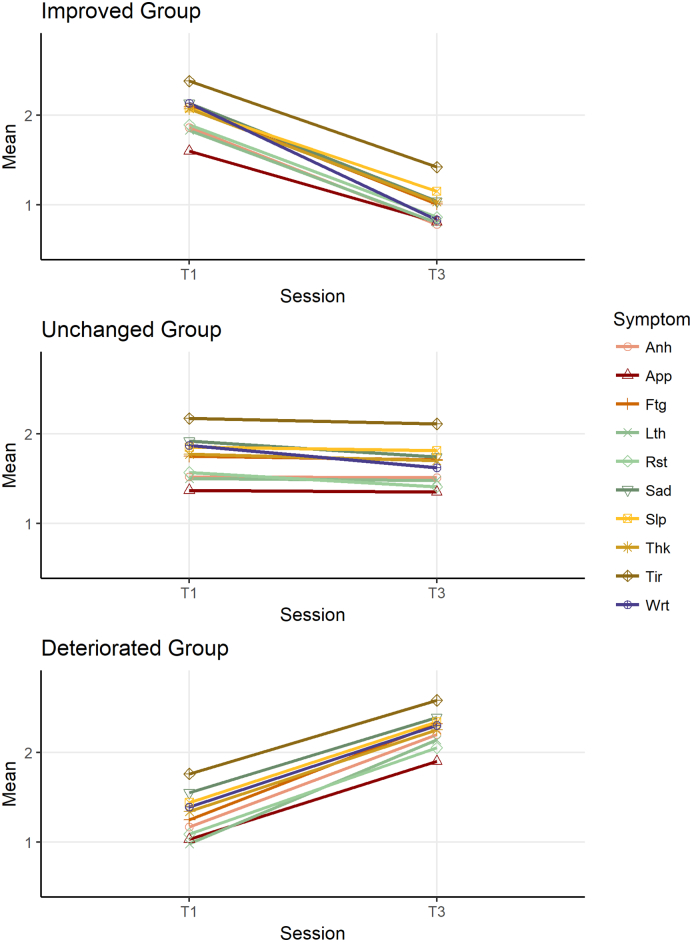
Routine psychiatric data were obtained for child/adolescent service users who underwent at least three treatment sessions in publicly funded services in England between 2011 and 2015 (N = 3017, 78% female; mean age [SD] = 14.43 years [1.75]). Depressive symptoms were assessed using the Revised Children's Anxiety and Depression Scale at presentation, and again after three treatment sessions. Treatment response was determined using the Reliable Change Index. Network analysis was used to compare the depressive symptom structure and connectivity of sub-samples who, after three treatment sessions had: 1) positively responded (n = 566), 2) not reliably changed (n = 2277), and 3) reliably deteriorated (n = 174), using matched samples to control for baseline severity.
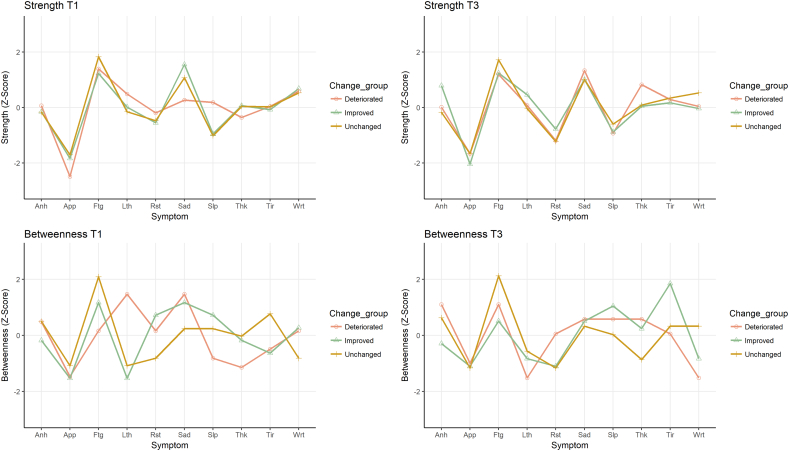
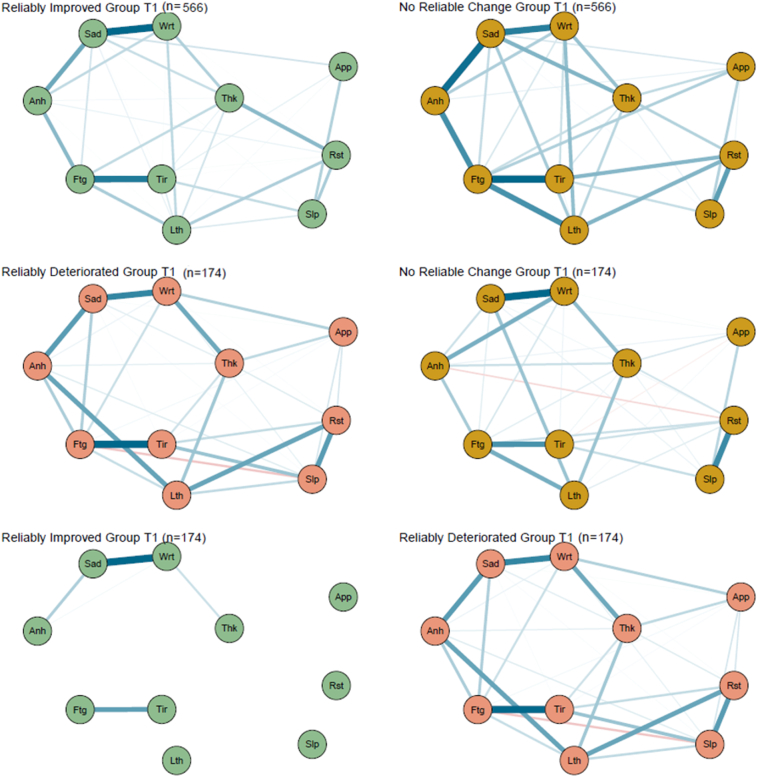
Overall connectivity (i.e., the summed total of weighted connections) was significantly weaker for the positive treatment response group at baseline (compared with unchanged and deteriorated groups), however, this group saw the largest increase in connectivity over the course of treatment. With regard to the overall importance of specific symptoms within the networks, fatigue was highest in strength for the unchanged and deteriorated groups, whereas low mood was highest in strength for the improved group.
This study demonstrates that adolescents who respond early to treatment for depression are characterised by symptom networks that are less densely connected initially, yet increase in connectivity over the course of treatment. This may be indicative of 'positive spirals' whereby improvement in one symptom triggers improvements in other symptoms, thereby increasing symptom-symptom associations even as severity decreases.
The study was supported by the Wellcome Trust grant 204366/Z/16/Z. The funders had no role in the study design, data collection, data analysis, interpretation, or writing of the report.
有研究表明,更密集的网络连通性(即个体症状之间关联的强度)可能是抑郁症治疗反应不佳的一个预后指标。我们试图在青少年对治疗的早期反应背景下,研究抑郁症状网络的这一方面。
获取了2011年至2015年间在英格兰公共资助服务机构接受至少三次治疗的儿童/青少年服务使用者的常规精神病学数据(N = 3017,78%为女性;平均年龄[标准差]=14.43岁[1.75])。在就诊时以及三次治疗后,使用修订版儿童焦虑和抑郁量表评估抑郁症状。使用可靠变化指数确定治疗反应。网络分析用于比较经过三次治疗后出现以下情况的子样本的抑郁症状结构和连通性:1)有积极反应(n = 566),2)无可靠变化(n = 2277),以及3)可靠恶化(n = 174),使用匹配样本控制基线严重程度。
在基线时,积极治疗反应组的总体连通性(即加权连接的总和)明显弱于无变化组和恶化组,然而,该组在治疗过程中连通性增加幅度最大。关于网络中特定症状的总体重要性,在无变化组和恶化组中,疲劳的强度最高,而在改善组中,情绪低落的强度最高。
本研究表明,对抑郁症治疗早期有反应的青少年的特征是症状网络最初连接不太密集,但在治疗过程中连通性增加。这可能表明存在“积极螺旋”,即一种症状的改善会引发其他症状的改善,从而即使严重程度降低,症状 - 症状关联也会增加。
该研究由惠康信托基金204366/Z/16/Z资助。资助者在研究设计、数据收集、数据分析、解读或报告撰写方面没有参与。