Rajakumaran Arasappan, Ganesh Arathi
Department of Conservative Dentistry and Endodontics, Faculty of Dental Sciences, Sri Ramachandra Institute of Higher Education and Research, Chennai, Tamil Nadu, India.
J Pharm Bioallied Sci. 2019 May;11(Suppl 2):S216-S220. doi: 10.4103/JPBS.JPBS_300_18.
The aim of this study was to compare and evaluate the penetration depth of irrigant after using manual, passive ultrasonic, and diode laser-assisted irrigant activation technique.
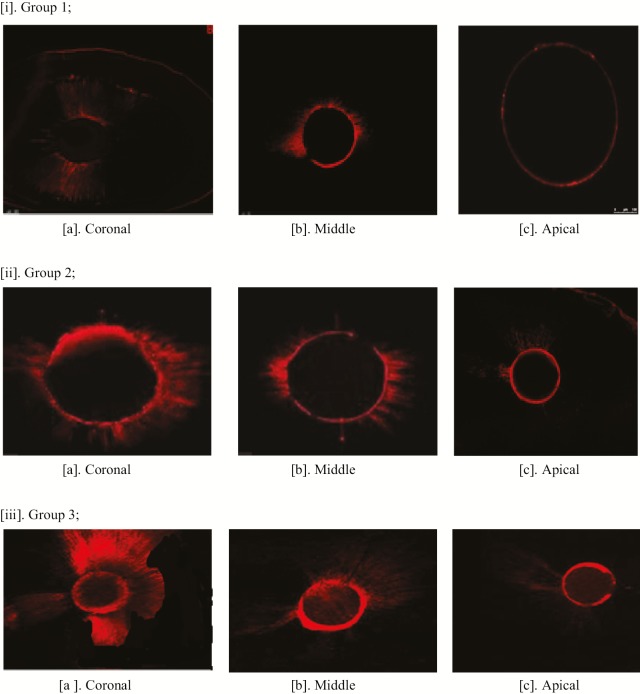
Ninety extracted single-rooted human mandibular premolars were selected ( = 90). Teeth were decoronated and working length was standardized for 12 mm. Root canals were shaped using ProTaper Universal F3. Saline was used as an irrigant in between every successful instrumentation. After completion of chemomechanical preparation, root canals were filled with Rhodamine-B-labeled sodium hypochlorite (3%). Teeth samples were divided into three experimental groups. In Group 1 ( = 30), manual irrigant activation was performed for 30 seconds with master cone gutta-percha (F3) in gentle up and down motion. In Group 2 ( = 30), ultrasonic irrigant activation was performed using passive ultrasonic endo tips for 30 seconds. In Group 3 ( = 30), laser activation was performed using diode laser for 30 seconds with 200-µm tips. Transverse sections were made at 2, 5, and 8 mm from the root apex and were observed under confocal laser scanning microscopy. Maximum penetration depth of irrigant was recorded and statistically analyzed.
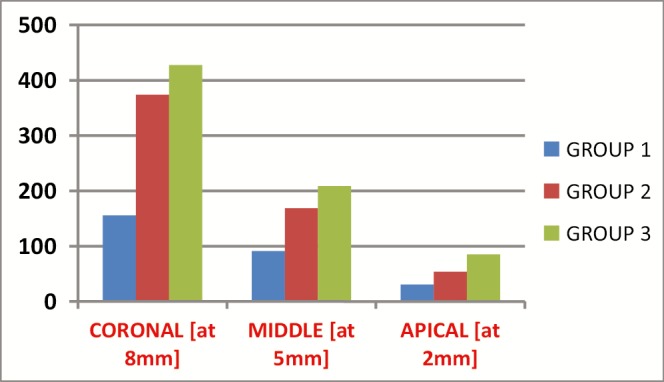
In the all three groups, coronal third (sections at 8 mm from root apex) showed the highest penetration depth of irrigant. Laser activation (Group 3) showed the highest penetration depth in all the three sections when compared with manual and passive ultrasonic irrigant activation. One-way analysis of variance and test showed there were significantly high differences among all the three groups and also at all three levels ( < 0.05).
Diode laser-assisted irrigant activation technique had better penetration depth in all the three aspects of root dentin.
本研究旨在比较和评估使用手动、被动超声和二极管激光辅助冲洗液激活技术后冲洗液的渗透深度。
选取90颗拔除的单根人下颌前磨牙(n = 90)。去除牙冠,将工作长度标准化为12 mm。使用ProTaper Universal F3对根管进行预备。在每次成功的器械操作之间使用生理盐水作为冲洗液。化学机械预备完成后,根管内充满罗丹明B标记的次氯酸钠(3%)。牙齿样本分为三个实验组。第1组(n = 30),使用主尖牙胶尖(F3)以轻柔的上下运动进行手动冲洗液激活30秒。第2组(n = 30),使用被动超声根管锉进行超声冲洗液激活30秒。第3组(n = 30),使用200-μm尖端的二极管激光进行激光激活30秒。在距根尖2、5和8 mm处制作横切面,并在共聚焦激光扫描显微镜下观察。记录冲洗液的最大渗透深度并进行统计学分析。
在所有三组中,冠方三分之一(距根尖8 mm处的切片)显示冲洗液的渗透深度最高。与手动和被动超声冲洗液激活相比,激光激活(第3组)在所有三个切片中显示出最高的渗透深度。单因素方差分析和检验显示,所有三组之间以及所有三个水平之间均存在显著差异(P < 0.05)。
二极管激光辅助冲洗液激活技术在根管牙本质的所有三个方面都具有更好的渗透深度。