Center of Social and Cognitive Neuroscience, Universidad Adolfo Ibáñez, Santiago, Chile.
PLoS One. 2019 Jun 14;14(6):e0218236. doi: 10.1371/journal.pone.0218236. eCollection 2019.
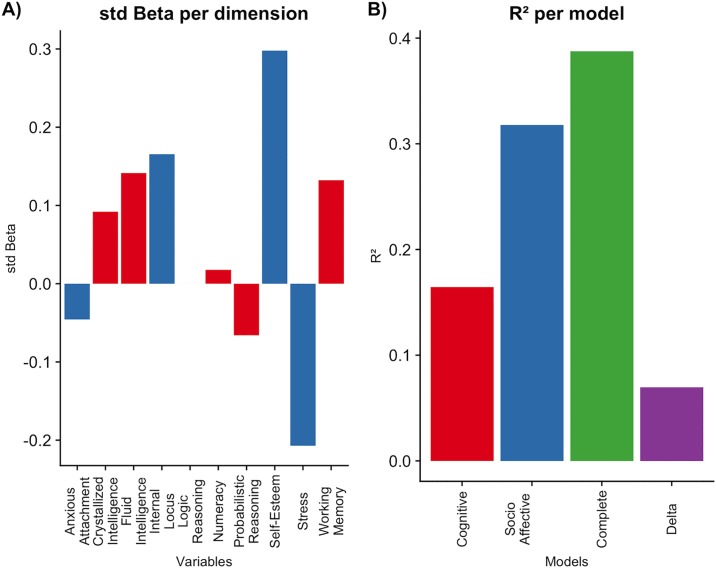
People living in vulnerable environments face a harder set of challenges adapting to their context. Nevertheless, an important number of them adapt successfully. However, which cognitive and socio-affective variables are specifically related to these variations in social adaptation in vulnerable contexts has not been fully understood nor directly addressed. Here we evaluated socio-affective variables (anxious attachment style, internal locus of control, self-esteem and stress) and cognitive variables (fluid intelligence, crystallized intelligence, working memory, numeracy, probabilistic reasoning and logical reasoning) to explain variations in social adaptation in a sample of 232 adults living in vulnerable contexts (M = 42.3, SD = 14.9, equal amount of men and women). Our results show that an important amount of variance in social adaptation can be explained by socio-affective variables, principally by self-esteem, while cognitive variables also contributed significantly. As far as we know, this is one of the first steps towards understanding the role of cognitive and socio-affective features on social adaptation. In the long run, this area of research could play an important role on the assignation of resources to ease people's integration into society. Our data and R analysis scripts can be found at: https://osf.io/egxy5/.
生活在脆弱环境中的人在适应环境方面面临着更严峻的挑战。然而,他们中有相当一部分人成功地适应了。然而,哪些认知和社会情感变量与脆弱环境中的这些社会适应变化有具体的关系,尚未得到充分理解,也没有直接涉及。在这里,我们评估了社会情感变量(焦虑依恋风格、内部控制点、自尊和压力)和认知变量(流体智力、晶体智力、工作记忆、计算能力、概率推理和逻辑推理),以解释 232 名生活在脆弱环境中的成年人(M=42.3,SD=14.9,男女数量相等)的社会适应变化。我们的结果表明,社会情感变量可以解释社会适应变化的很大一部分,主要是通过自尊,而认知变量也有显著贡献。据我们所知,这是理解认知和社会情感特征对社会适应影响的第一步。从长远来看,这一研究领域可能在分配资源以促进人们融入社会方面发挥重要作用。我们的数据和 R 分析脚本可以在以下网址找到:https://osf.io/egxy5/。