Cognitive Neuroscience Center (CNC), Universidad de San Andrés, Buenos Aires, Argentina.
Mental Health Group, National Department of Public Health, University of Antioquia, UDEA, calle 62#52-59, 050010, Medellín, Colombia.
Sci Rep. 2022 Nov 4;12(1):18693. doi: 10.1038/s41598-022-21985-9.
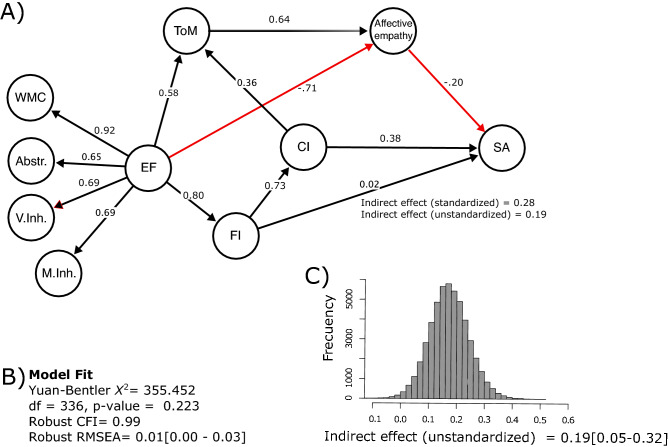
This study sought to evaluate the roles of and interactions between cognitive processes that have been shown to exhibit impact from socioeconomic status (SES) and living conditions in predicting social adaptation (SA) in a population of adults living in socially vulnerable conditions. Participants included 226 people between the ages of 18 and 60 who have been living in vulnerable contexts throughout life in Santiago, Chile. Data was collected through a battery of psychological assessments. A structural equation model (SEM) was implemented to examine the interrelationships among cognitive and social variables. Results indicate a significant relationship between executive function (EF) and SA through both social cognition (SC) and intelligence. Theory of Mind (ToM), a component of SC, was shown to exhibit a significant relationship with affective empathy; interestingly, this was negatively related to SA. Moreover, fluid intelligence (FI) was found to exhibit a positive, indirect relationship with SA through crystallized intelligence (CI). Evaluation of these results in the context of research on the impacts of SES and vulnerable living conditions on psychological function may allow for the development of more effective clinical, political, and social interventions to support psychosocial health among socially vulnerable populations.
本研究旨在评估认知过程的作用和相互作用,这些认知过程已被证明受到社会经济地位(SES)和生活条件的影响,并预测生活在社会弱势环境中的成年人的社会适应(SA)。参与者包括 226 名年龄在 18 至 60 岁之间的智利圣地亚哥生活在弱势环境中的成年人。通过一系列心理评估收集数据。实施结构方程模型(SEM)来检验认知和社会变量之间的相互关系。结果表明,执行功能(EF)通过社会认知(SC)和智力与 SA 之间存在显著关系。社会认知的一个组成部分,即心理理论(ToM),与情感同理心之间存在显著关系;有趣的是,这与 SA 呈负相关。此外,发现流体智力(FI)通过晶体智力(CI)与 SA 呈正间接关系。在 SES 和弱势生活条件对心理功能影响的研究背景下评估这些结果,可以为支持社会弱势群体的心理社会健康制定更有效的临床、政治和社会干预措施。