Ph.D. Program in Biochemistry, The Graduate Center, The City University of New York, New York, New York, United States of America.
Ph.D. Program in Computer Science, The Graduate Center, The City University of New York, New York, New York, United States of America.
PLoS Comput Biol. 2019 Jun 17;15(6):e1006619. doi: 10.1371/journal.pcbi.1006619. eCollection 2019 Jun.
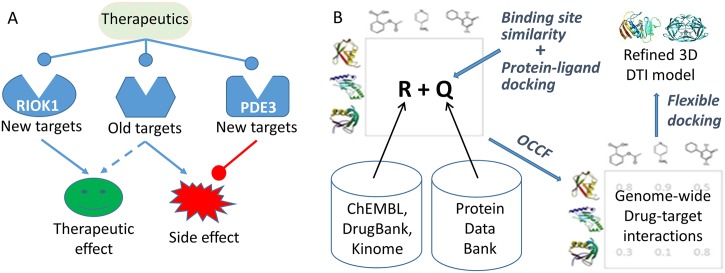
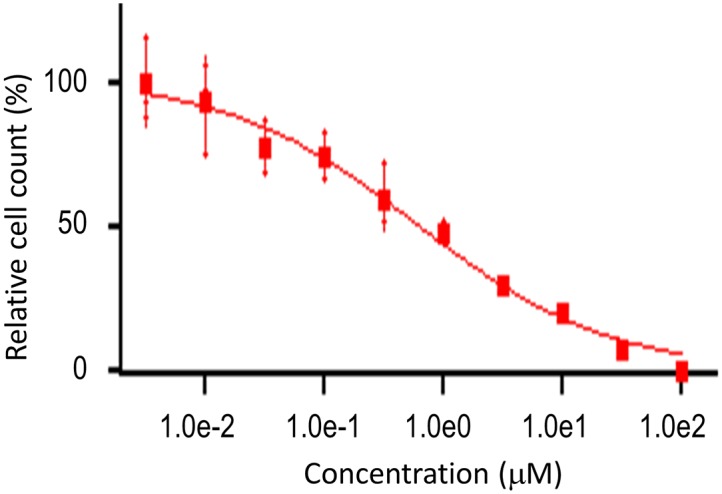
Many complex diseases such as cancer are associated with multiple pathological manifestations. Moreover, the therapeutics for their treatments often lead to serious side effects. Thus, it is needed to develop multi-indication therapeutics that can simultaneously target multiple clinical indications of interest and mitigate the side effects. However, conventional one-drug-one-gene drug discovery paradigm and emerging polypharmacology approach rarely tackle the challenge of multi-indication drug design. For the first time, we propose a one-drug-multi-target-multi-indication strategy. We develop a novel structural systems pharmacology platform 3D-REMAP that uses ligand binding site comparison and protein-ligand docking to augment sparse chemical genomics data for the machine learning model of genome-scale chemical-protein interaction prediction. Experimentally validated predictions systematically show that 3D-REMAP outperforms state-of-the-art ligand-based, receptor-based, and machine learning methods alone. As a proof-of-concept, we utilize the concept of drug repurposing that is enabled by 3D-REMAP to design dual-indication anti-cancer therapy. The repurposed drug can demonstrate anti-cancer activity for cancers that do not have effective treatment as well as reduce the risk of heart failure that is associated with all types of existing anti-cancer therapies. We predict that levosimendan, a PDE inhibitor for heart failure, inhibits serine/threonine-protein kinase RIOK1 and other kinases. Subsequent experiments and systems biology analyses confirm this prediction, and suggest that levosimendan is active against multiple cancers, notably lymphoma, through the direct inhibition of RIOK1 and RNA processing pathway. We further develop machine learning models to predict cancer cell-line's and a patient's response to levosimendan. Our findings suggest that levosimendan can be a promising novel lead compound for the development of safe, effective, and precision multi-indication anti-cancer therapy. This study demonstrates the potential of structural systems pharmacology in designing polypharmacology for precision medicine. It may facilitate transforming the conventional one-drug-one-gene-one-disease drug discovery process and single-indication polypharmacology approach into a new one-drug-multi-target-multi-indication paradigm for complex diseases.
许多复杂疾病,如癌症,与多种病理表现有关。此外,其治疗方法往往会导致严重的副作用。因此,需要开发能够同时针对多个感兴趣的临床适应症并减轻副作用的多适应症治疗方法。然而,传统的单药单基因药物发现范式和新兴的多药理学方法很少能够解决多适应症药物设计的挑战。我们首次提出了一种单药多靶多适应症的策略。我们开发了一种新型的结构系统药理学平台 3D-REMAP,该平台使用配体结合位点比较和蛋白-配体对接来增强稀疏的化学生物组学数据,用于基因组规模的化学-蛋白相互作用预测的机器学习模型。经过实验验证的预测系统地表明,3D-REMAP 优于最先进的基于配体、基于受体和基于机器学习的方法。作为概念验证,我们利用 3D-REMAP 实现的药物再利用概念来设计双适应症抗癌治疗。这种再利用的药物可以针对没有有效治疗方法的癌症表现出抗癌活性,并降低与所有类型现有抗癌疗法相关的心力衰竭风险。我们预测,心力衰竭的 PDE 抑制剂左西孟旦抑制丝氨酸/苏氨酸蛋白激酶 RIOK1 和其他激酶。随后的实验和系统生物学分析证实了这一预测,并表明左西孟旦通过直接抑制 RIOK1 和 RNA 处理途径对多种癌症,特别是淋巴瘤具有活性。我们进一步开发了机器学习模型来预测癌细胞系和患者对左西孟旦的反应。我们的研究结果表明,左西孟旦可以成为开发安全、有效和精准多适应症抗癌治疗的有前途的新型先导化合物。这项研究表明了结构系统药理学在设计精准医学多药理学方面的潜力。它可能有助于将传统的单药单基因单疾病药物发现过程和单适应症多药理学方法转化为针对复杂疾病的新的单药多靶多适应症范式。