Laboratorio di Tecnologia Medica, IRCCS-Istituto Ortopedico Rizzoli , Bologna , Italy.
Ortopedia-Traumatologia e Chirurgia protesica e dei reimpianti d'anca e di ginocchio, IRCCS-Istituto Ortopedico Rizzoli , Bologna , Italy.
Acta Orthop. 2019 Oct;90(5):417-420. doi: 10.1080/17453674.2019.1618649. Epub 2019 Jun 18.
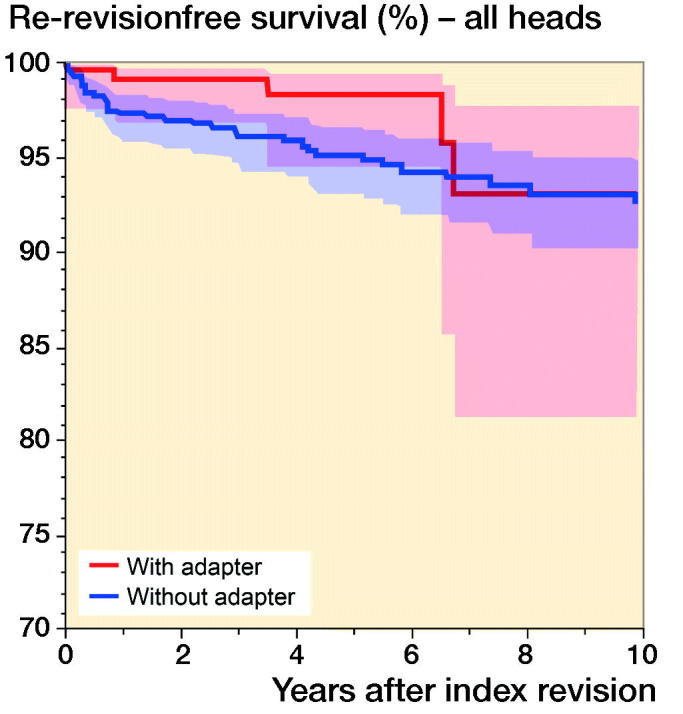
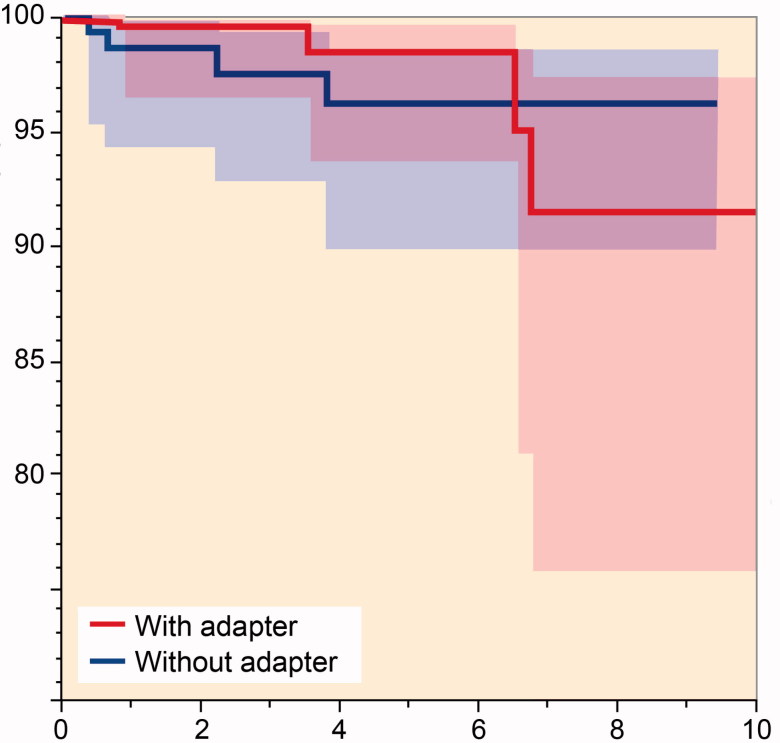
Background and purpose - Little is known about the role of retained trunnions in revision hip arthroplasties, i.e., when only the femoral head is substituted. Wear (fretting corrosion) and ceramic head fractures are 2 poorly understood concerns related to use, and the role of adapter sleeves has not been defined. In this registry study we assessed the influence of sleeve interposition on re-revision rates in revision hip arthroplasties with retained stems. Confounding factors (demographics, implant-related features) and failures were also analyzed. Patients and methods - We conducted a registry study on 1,127 revised implants (retained trunnion and head exchange). In 26% of implants an adapter sleeve was interposed; in 74% no adapter sleeve was implanted. Demographic and implant-related features were investigated including a descriptive analysis of failures. Results - The mean follow-up of revised implants with and without the use of an adapter sleeve was 3.3 and 5.1 years, respectively. The implant survival without an adapter sleeve was significantly higher, 98.4% (95% CI 96.9-99.8) vs. 95.2% (CI 93.2-96.6) with an adapter sleeve at 5 years. No re-revisions due to adverse local tissue reactions or ceramic head fractures were reported. In order to overcome the different distribution of head materials and head sizes in the two cohorts, only Delta balls were investigated. Interpretation - Adapter sleeve interposition had a minor influence on the revision rates. No adverse local tissue reactions or head fractures occurred.
背景与目的-对于翻修髋关节置换术中保留的转筒(即仅更换股骨头)的作用知之甚少。与使用相关的两个尚未被充分理解的问题是磨损(微动腐蚀)和陶瓷头破裂,而适配器套筒的作用尚未确定。在本注册研究中,我们评估了在保留股骨柄的翻修髋关节置换术中,套筒介入对再次翻修率的影响。还分析了混杂因素(人口统计学,与植入物相关的特征)和失败。
患者和方法-我们对 1127 例翻修植入物(保留转筒和头置换)进行了注册研究。在 26%的植入物中插入了适配器套筒;在 74%的植入物中未植入适配器套筒。研究了人口统计学和与植入物相关的特征,包括对失败的描述性分析。
结果-有和没有使用适配器套筒的翻修植入物的平均随访时间分别为 3.3 年和 5.1 年。没有使用适配器套筒的植入物存活率明显更高,5 年时为 98.4%(95%CI 96.9-99.8),而使用适配器套筒时为 95.2%(CI 93.2-96.6)。没有因不良局部组织反应或陶瓷头破裂而导致的再次翻修。为了克服两个队列中头材料和头尺寸分布的不同,仅对头球进行了研究。
解释-适配器套筒的介入对翻修率的影响较小。未发生不良局部组织反应或头破裂。