Turner Piers, Hodnett Mark, Dorey Robert, Carey J David
Ultrasound and Underwater Acoustics, National Physical Laboratory, Teddington, Middlesex, TW11 0LW, United Kingdom.
Centre for Engineering Materials, Department of Mechanical Engineering Sciences, University of Surrey, Guildford, Surrey, GU2 7XH, United Kingdom.
Sci Rep. 2019 Jun 18;9(1):8710. doi: 10.1038/s41598-019-45059-5.
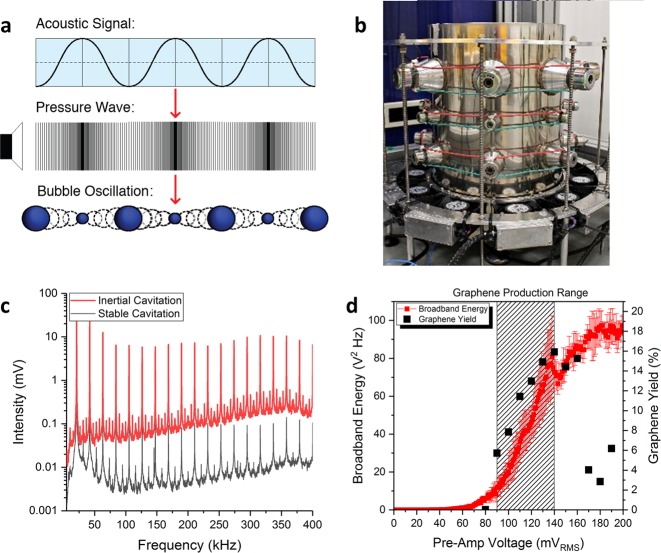
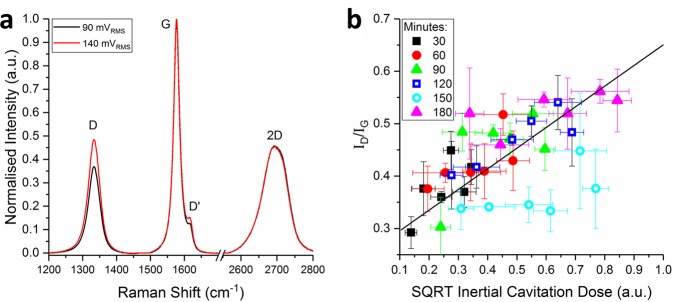
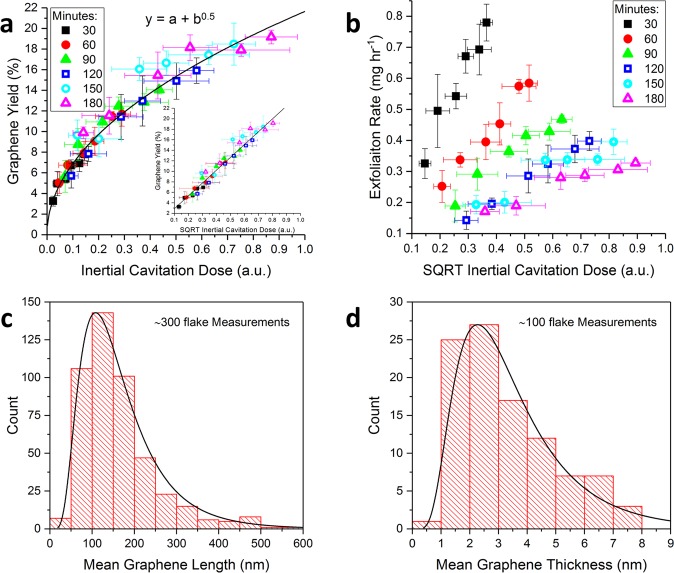
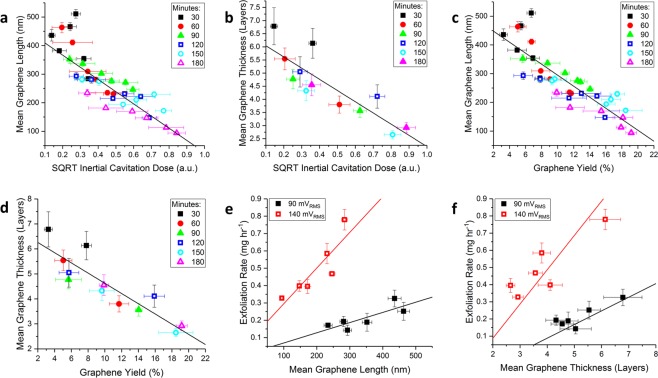
Ultrasonication is widely used to exfoliate two dimensional (2D) van der Waals layered materials such as graphene. Its fundamental mechanism, inertial cavitation, is poorly understood and often ignored in ultrasonication strategies resulting in low exfoliation rates, low material yields and wide flake size distributions, making the graphene dispersions produced by ultrasonication less economically viable. Here we report that few-layer graphene yields of up to 18% in three hours can be achieved by optimising inertial cavitation dose during ultrasonication. We demonstrate that inertial cavitation preferentially exfoliates larger flakes and that the graphene exfoliation rate and flake dimensions are strongly correlated with, and therefore can be controlled by, inertial cavitation dose. Furthermore, inertial cavitation is shown to preferentially exfoliate larger graphene flakes which causes the exfoliation rate to decrease as a function of sonication time. This study demonstrates that measurement and control of inertial cavitation is critical in optimising the high yield sonication-assisted aqueous liquid phase exfoliation of size-selected nanomaterials. Future development of this method should lead to the development of high volume flow cell production of 2D van der Waals layered nanomaterials.
超声处理被广泛用于剥离二维(2D)范德华层状材料,如石墨烯。其基本机制——惯性空化,目前仍知之甚少,并且在超声处理策略中常常被忽视,这导致剥离速率低、材料产率低以及薄片尺寸分布广泛,使得通过超声处理制备的石墨烯分散体在经济上缺乏可行性。在此,我们报告通过在超声处理过程中优化惯性空化剂量,可在三小时内实现高达18%的少层石墨烯产率。我们证明惯性空化优先剥离较大的薄片,并且石墨烯的剥离速率和薄片尺寸与惯性空化剂量密切相关,因此可以通过惯性空化剂量来控制。此外,研究表明惯性空化优先剥离较大的石墨烯薄片,这导致剥离速率随超声处理时间的增加而降低。这项研究表明,在优化尺寸选择的纳米材料的高产率超声辅助水相液相剥离过程中,测量和控制惯性空化至关重要。该方法的未来发展应会推动二维范德华层状纳米材料的高体积流通池生产的发展。