Graven H, Hocking T, Zazzeri G
Department of Physics Imperial College London London UK.
Earths Future. 2019 Mar;7(3):283-299. doi: 10.1029/2018EF001064. Epub 2019 Mar 18.
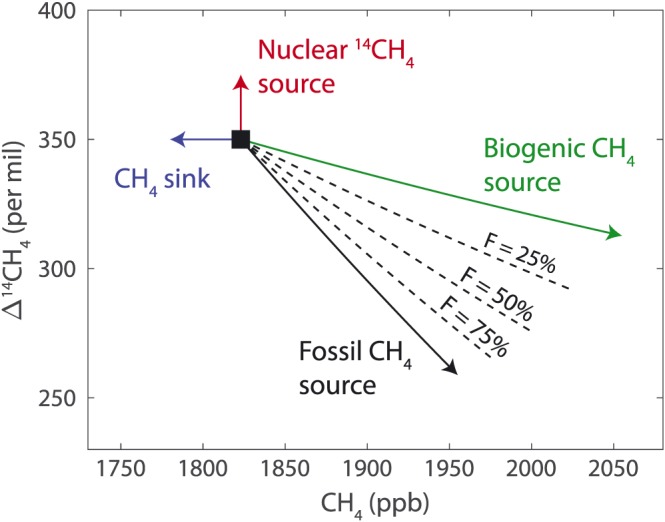
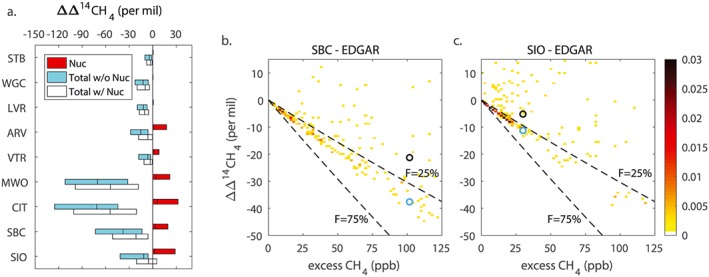
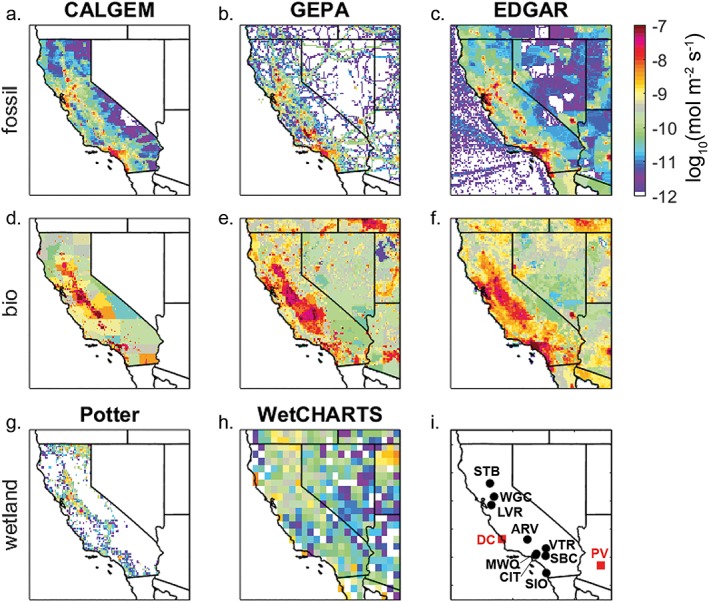
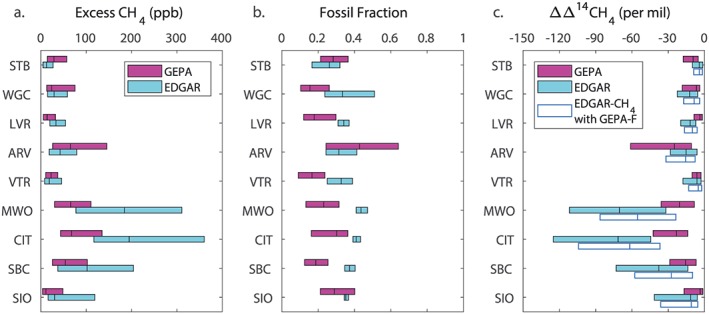
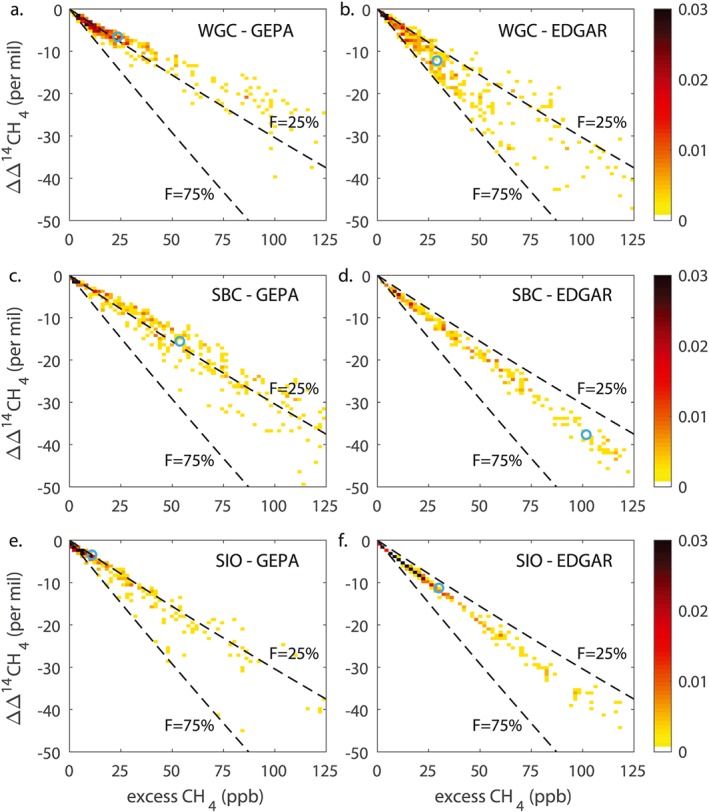
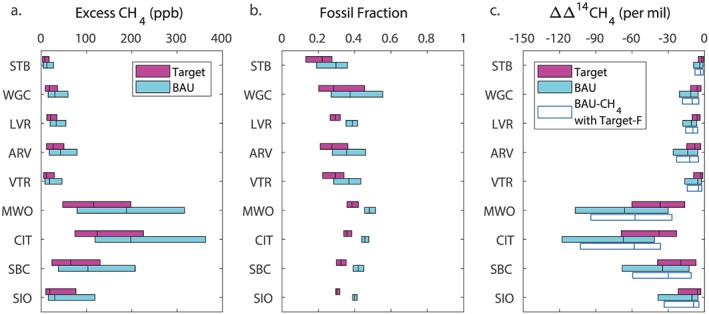
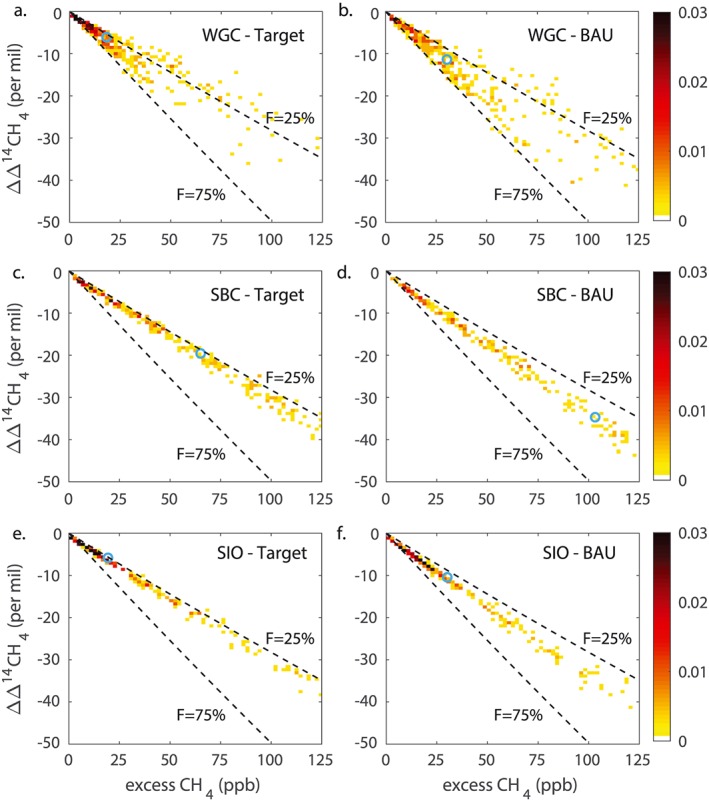
Regional emissions of methane and their attribution to a variety of sources presently have large uncertainties. Measurements of radiocarbon (C) in methane (CH) may provide a method for identifying regional CH emissions from fossil versus biogenic sources because adding C-free fossil carbon reduces the C/C ratio (ΔCH) in atmospheric CH much more than biogenic carbon does. We describe an approach for estimating fossil and biogenic CH at regional scales using atmospheric ΔCH observations. As a case study to demonstrate expected ΔCH and ΔCH-CH relationships, we simulate and compare ΔCH at a network of sites in California using two gridded CH emissions estimates (Emissions Database for Global Atmospheric Research, EDGAR, and Gridded Environmental Protection Agency, GEPA) and the CarbonTracker-Lagrange model for 2014, and for 2030 under business-as-usual and mitigation scenarios. The fossil fraction of CH (F) is closely linked with the simulated ΔCH-CH slope and differences of 2-21% in median F are found for EDGAR versus GEPA in 2014, and 7-10% for business-as-usual and mitigation scenarios in 2030. Differences of 10% in F for >200 ppb of added CH produce differences of >10‰ in ΔCH, which are likely detectable from regular observations. Nuclear power plant CH emissions generally have small simulated median influences on ΔCH (0-7‰), but under certain atmospheric conditions they can be much stronger (>30‰) suggesting they must be considered in applications of ΔCH in California. This study suggests that atmospheric ΔCH measurements could provide powerful constraints on regional CH emissions, complementary to other monitoring techniques.
目前,甲烷的区域排放量及其各种来源的归因存在很大的不确定性。甲烷(CH₄)中放射性碳(¹⁴C)的测量可能提供一种方法,用于识别来自化石源与生物源的区域CH₄排放,因为添加不含¹⁴C的化石碳对大气中CH₄的¹⁴C/¹²C比值(Δ¹⁴CH₄)的降低幅度远大于生物碳。我们描述了一种利用大气Δ¹⁴CH₄观测值在区域尺度上估算化石源和生物源CH₄的方法。作为一个案例研究,以展示预期的Δ¹⁴CH₄和Δ¹⁴CH₄- CH₄关系,我们使用两个网格化CH₄排放估算值(全球大气研究排放数据库,EDGAR,和美国环境保护局网格化排放数据,GEPA)以及CarbonTracker-Lagrange模型,对2014年以及2030年在照常营业和减排情景下加利福尼亚州一个站点网络的Δ¹⁴CH₄进行了模拟和比较。CH₄的化石源比例(F)与模拟的Δ¹⁴CH₄- CH₄斜率密切相关,2014年EDGAR与GEPA相比,F的中位数差异为2 - 21%,2030年照常营业和减排情景下为7 - 10%。对于添加的CH₄>200 ppb,F的差异为10%会导致Δ¹⁴CH₄的差异>10‰,这很可能可以从常规观测中检测到。核电站CH₄排放通常对Δ¹⁴CH₄的模拟中位数影响较小(0 - 7‰),但在某些大气条件下,其影响可能会大得多(>30‰),这表明在加利福尼亚州应用Δ¹⁴CH₄时必须考虑这些排放。这项研究表明,大气Δ¹⁴CH₄测量可以为区域CH₄排放提供有力的约束,是对其他监测技术的补充。