
接种途径影响瑞士小白鼠感染克氏锥虫和布氏锥虫的毒力。
Route of inoculation influences Trypanosoma congolense and Trypanosoma brucei brucei virulence in Swiss white mice.
机构信息
Biotechnology Research Institute, Kenya Agricultural and Livestock Research Organization, Kikuyu, Kenya.
Centre for Geographic Medicine Research-Coast, Kenya Medical Research Institute, Kilifi, Kenya.
出版信息
PLoS One. 2019 Jun 20;14(6):e0218441. doi: 10.1371/journal.pone.0218441. eCollection 2019.
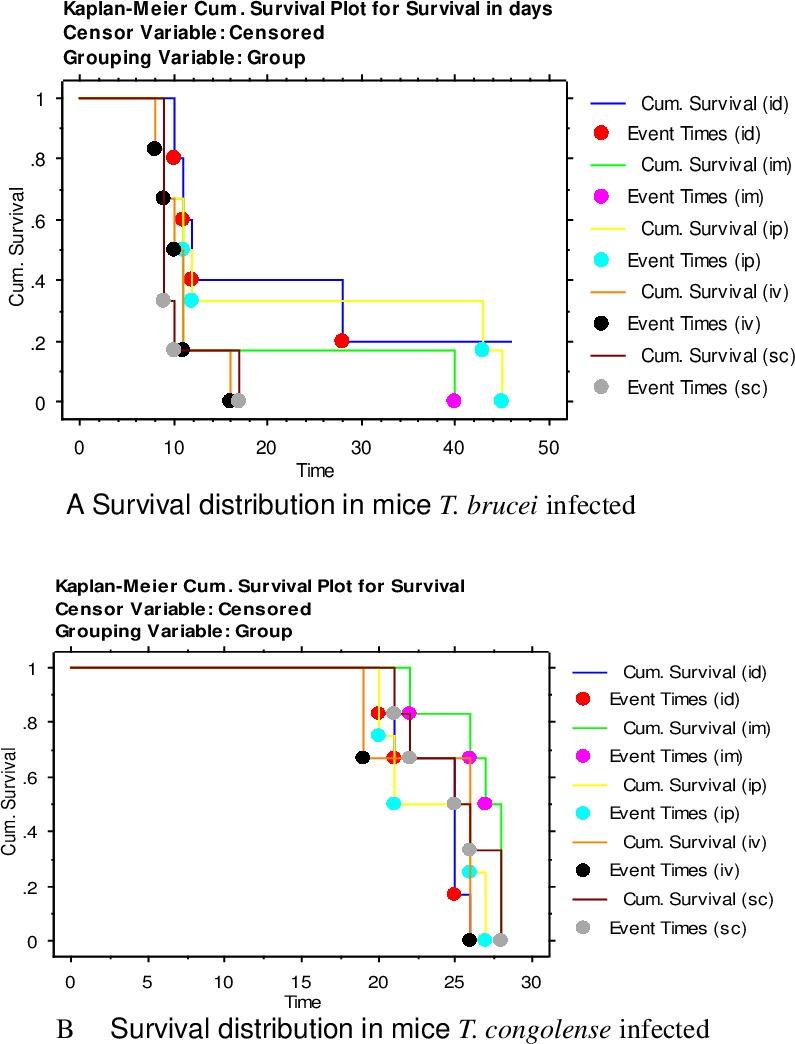
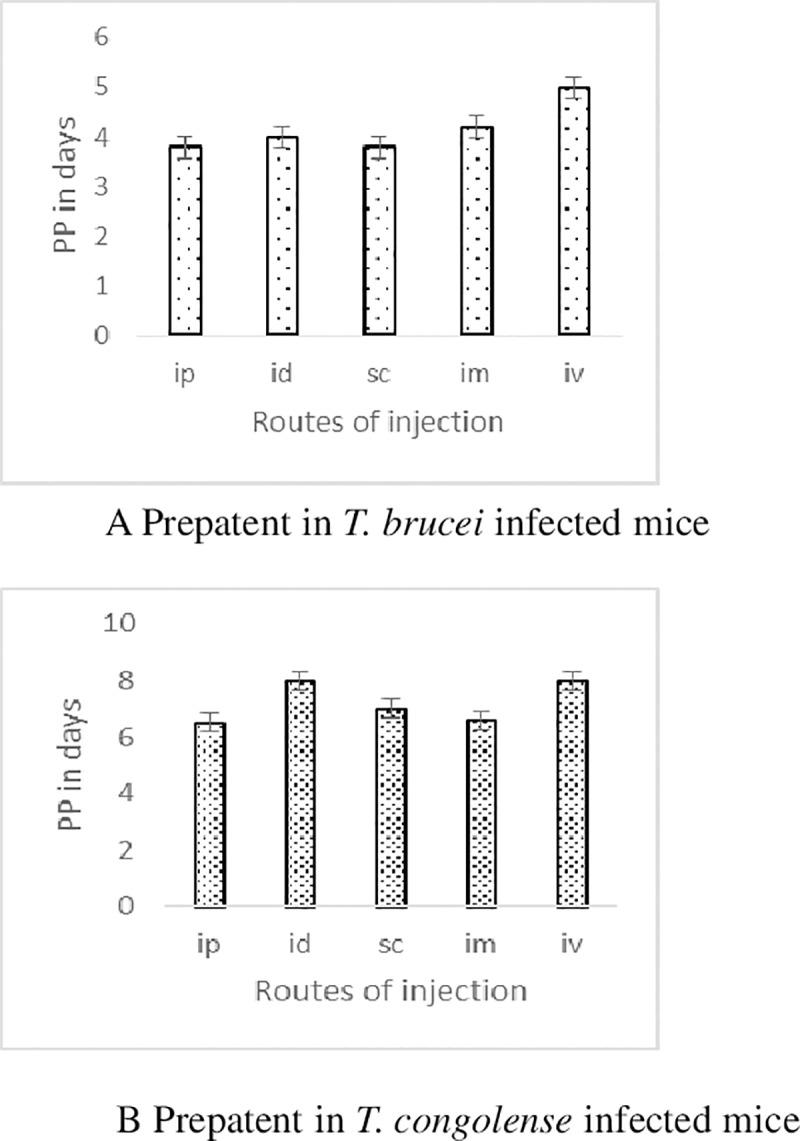
Experiments on infections caused by trypanosomes are widely performed in Swiss white mice through various inoculation routes. To better understand the effect of route of trypanosome inoculation on disease outcomes in this model, we characterised the virulence of two isolates, Trypanosoma brucei KETRI 2710 and T. congolense KETRI 2765 in Swiss white mice. For each of the isolates, five routes of parasite inoculation, namely intraperitoneal (IP), subcutaneous (SC), intramuscular (IM) intradermal (ID) and intravenous (IV) were compared using groups (n = 6) of mice, with each mouse receiving 1x10⁴ trypanosomes. We subsequently assessed impact of the routes on disease indices that included pre-patent period (PP), parasitaemia levels, Packed Cell Volume (PCV), bodyweight changes and survival time. Pre-patent period for IP inoculated mice was a mean ± SE of 3.8 ± 0.2 and 6.5 ± 0.0 for the T brucei and T. congolense isolates respectively; the PP for mice groups inoculated using other routes were not significantly different(p> 0.05) irrespective of route of inoculation and species of trypanosomes. With ID and IP routes, parasitaemia was significantly higher in T. brucei and significantly lower in T. congolense infected mice and the progression to peak parasitaemia routes showed no significant different between the routes of either species of trypanosome. The IM and ID routes in T. congolense inoculations, and IP and IV in T. b. brucei induced the fastest and slowest parasitaemia progressions respectively. There were significant differences in rates of reduction of PCV with time post infection in mice infected by the two species and which was more pronounced in sc and ip injected mice. No significant differences in mice body weight changes and survivorship was observed between the routes of inoculation. Inoculation route therefore appears to be a critical determinant of pathogenicity of Trypanosoma congolense and Trypanosoma brucei brucei in murine mouse model of African trypanosomiasis.
实验性感染通过各种接种途径广泛应用于瑞士白色小鼠中的锥虫。为了更好地理解接种途径对该模型疾病结果的影响,我们对两种分离株,即布氏锥虫 KETRI 2710 和冈比亚锥虫 KETRI 2765 的毒力进行了特征描述。对于每一种分离株,通过腹腔内(IP)、皮下(SC)、肌肉内(IM)、皮内(ID)和静脉内(IV)五种途径接种寄生虫,用每组(n = 6)的小鼠进行比较,每只小鼠接受 1x10⁴ 个锥虫。随后,我们评估了接种途径对疾病指标的影响,包括潜伏前期(PP)、寄生虫血症水平、红细胞压积(PCV)、体重变化和存活时间。腹腔内接种小鼠的潜伏前期平均为 3.8 ± 0.2,布氏锥虫和冈比亚锥虫的潜伏前期分别为 6.5 ± 0.0;通过其他途径接种的小鼠组的潜伏前期无明显差异(p>0.05),无论接种途径和锥虫种类如何。通过 ID 和 IP 途径,布氏锥虫感染的小鼠的寄生虫血症明显升高,冈比亚锥虫感染的小鼠的寄生虫血症明显降低,并且两种锥虫的任何一种途径的寄生虫血症进展到峰值都没有显著差异。在 T. congolense 接种的 IM 和 ID 途径,以及 T. b. brucei 的 IP 和 IV 途径中,分别诱导了最快和最慢的寄生虫血症进展。两种锥虫感染的小鼠红细胞压积随感染后时间的变化率有显著差异,在 sc 和 ip 注射的小鼠中更为明显。接种途径之间的小鼠体重变化和存活率没有显著差异。因此,接种途径似乎是冈比亚锥虫和布氏锥虫在非洲锥虫病小鼠模型中致病性的关键决定因素。

 Zotero 插件